

Corporate employment contracts are now taking different forms. Apart from traditional corporate offices, employees perform their daily duties from alternative locations, such as home, coworking spaces, or other states or even countries.
Managing employment contracts across multiple states is one of the most operationally complex challenges for HR and legal teams. For instance, the United States has varying labor regulations for HR operations, from wage-and-hour laws to leave requirements, non-compete restrictions, and contract-specific mandates.
One template cannot hold up across jurisdictions. Manual employment contract drafting and management often lead to errors, compliance risks, and inefficiencies. Therefore, most HR professionals rely on employment contract automation platforms that have essential features for daily operations.
What is multi-state labor law compliance software?
A multi-state labor law compliance system is an HR documentation platform that automates and manages complex, overlapping federal, state, and local employment regulations.
These software solutions track minimum wage changes, pay transparency, tax obligations and leave requirements across multiple jurisdictions. They ensure that remote and distributed teams remain completely legally compliant.
Unlike generic document management platforms, these platforms track legal changes and integrate regulatory requirements directly into HR workflows and employment documentation.
To choose the right solution for your business, you need to assess your workforce footprint and pain points. Request for demos and check integration capabilities with your existing tech stack.
Why multi-state employment contract compliance is challenging for HR professionals
Employment contracts must align with the laws within the jurisdiction. Countries across the globe don’t have a single, unified employment contract law. For multinational companies or businesses with employees in more than one state, this creates dozens of jurisdictional permutations that must be managed as employment law evolves.
Laws and policies about employment practices keep evolving, and without automated tracking, HR professionals will likely use outdated clauses. Non-compete law has shifted dramatically in the past three years alone, with several states tightening restrictions. Furthermore, paid leave mandates, salary transparency requirements, and predictive scheduling laws are expanding annually.
Core features of a software platform for labor law compliance
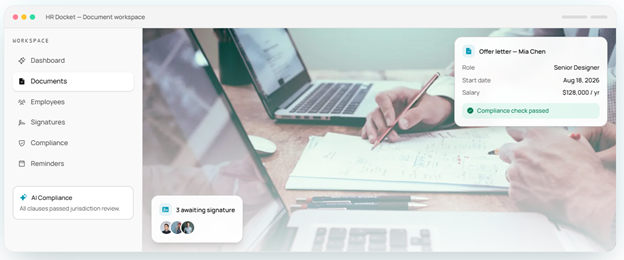
Some contract automation platforms are built for multi-state environments, while others still rely on traditional templates. Here are some top features you should consider when choosing a labor law compliance system.
1. Jurisdiction-aware clause libraries
The platform must maintain a dynamically updated library of employment contract clauses mapped to specific states and localities. It should automatically apply state-specific language, including mandatory wage disclosures and valid non-solicitation language, without requiring HR to manually select the right clauses.
2. Real-time compliance alerts
The platform should have built-in legal updates and risk assessments. When employment law changes in a covered jurisdiction, the platform should flag existing active contracts that may be affected and provide updated clause language.
3. Version control and audit trail
Changes made to the contract, approvals, and signed agreement should be logged with timestamps and user IDs under the employee profile.
4. E-signature and HRIS integration
The platform should integrate natively with your existing HR stack and support legally compliant e-signature workflows. This helps to reduce version-control risks and increase completion rates.
5. Role-based access and approval workflows
HR professionals should be able to generate jurisdiction-compliant contracts without requiring legal review of every agreement. The platform should also support configurable access tiers across HR, legal, and leadership.
6. Template standardization with controlled flexibility
The platform should allow pre-approved alternate clauses that can be inserted within controlled parameters, not free-form editing that creates compliance exposure.
Best Multi-State Labor Law Compliance Software
1. HR Docket
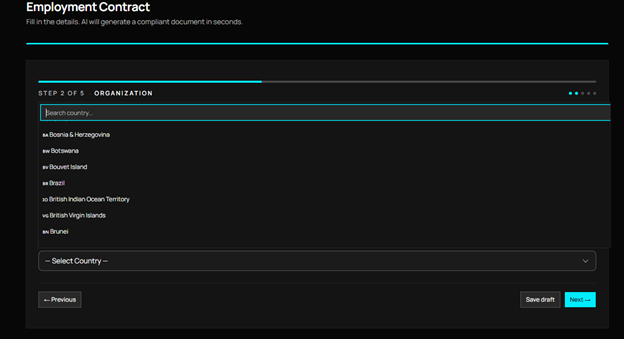
HR Docket is a modern AI-powered HR documentation software with particularly strong capabilities for employment contract automation. The platform assists HR and legal teams in building sophisticated employment contracts with jurisdiction-aware clause selection.
HR Docket’s employment contract generator helps you create structured employment agreements covering role scope, pay, benefits, confidentiality, probation, and termination terms. The software has many special features such as guided AI drafting, risk-aware review, reusable templates, employee-linked records and export-ready formatting.
Its repository intelligence continuously analyzes your contract library for outdated language, missing provisions, and jurisdiction-specific gaps.
2. SixFifty
SixFifty is one of the specialized employment contract automation platforms built for HR and legal teams. It combines conversational AI with document automation to streamline employment contract generation for small-to mid-size businesses.
Its features include AI-powered answers to employment law questions and automatic policy updates. The platform allows teams to configure jurisdiction-specific contract templates that are populated automatically based on employee data from your HRIS.
3. Deel
Deel is a dedicated HR software built for global workforce compliance and excels in environments where employment contracts must comply with both local and international employment frameworks.
Its state-by-state employment feature automatically configures employment agreements based on the employee’s work location, including jurisdiction-specific at-will disclaimers, leave policy notifications, and wage disclosures.
4. Rippling
Rippling is one of the HR software solutions that combines global HR, payroll, and IT management with compliance automation. The platform offers strong multi-state capabilities, including contract workflows tied to employee data, automated onboarding documents, and real-time alerts for labor law changes.
5. Workday HCM
Workday HCM is an HR system for employee databases and contract generation that doesn’t require manual data re-entry. It provides integrated employment agreement automation and reduces the risk of jurisdictional routing errors.
Benefits of implementing an employment contract automation platform
- It minimizes errors and ensures every contract meets current state laws.
- Contract automation systems reduce manual drafting and review from days to minutes.
- It improves visibility by tracking contract status, obligations, and renewal dates centrally.
- Ensures easy onboarding of employees in new states without overhauling processes.
- Eliminates legal spending on routine reviews and potential penalties.
conclusion
Multi-state employment contract compliance varies across jurisdictions, and the pace of hiring at growing companies makes manual contract management a liability. Employment contract automation platforms like HR Docket, SixFifty, and Rippling represent the current standard of jurisdictionally aware contract generation, real-time compliance monitoring, integrated e-signature workflows, and audit-ready documentation.
The best labor law compliance software helps you generate contracts faster and ensures every contract you generate is the right contract. They reduce risks, improve efficiency, and create a scalable foundation for long-term growth.