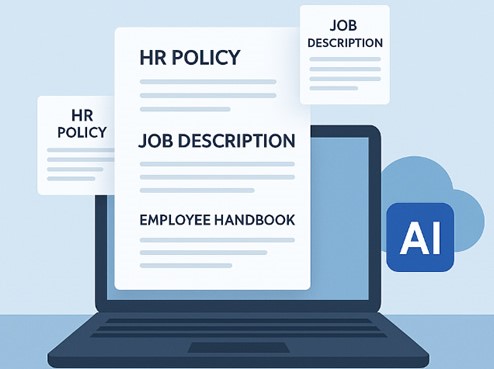


In an era where clouding and digital storage have become the norm rather than the exception, small and medium businesses are looking for affordable digital document management platforms to handle their HR needs.
An organization with twenty employees is a quiet but significant threshold.
A business owner or office manager handles contracts, offer letters, and the occasional warning letter using whatever templates exist, stored in a shared drive folder that everyone can sort of find. It is not ideal, but when the number of employees is below twenty, the cracks don’t show.
When the number of employees is above twenty, the cracks show. More hires mean more contracts, more onboarding packages, more performance conversations, and more documentation that needs to be consistent across people who didn’t all join in the same month from the same template.
SHRM’s Human Capital Benchmark data puts the average HR-to-employee ratio at roughly 1.7 per 100, which means a 25-person company is very likely operating with less than one dedicated HR function, often a fraction of one person’s time, trying to keep documentation standards consistent across a headcount that has just started to require it.
This is exactly why digital document management solutions stop being a luxury-to-have and start being the difference between HR that scales cleanly and HR that accumulates risk quietly in the background.
This article looks at what changes at what human resources software pricing actually looks like across the market, and which solutions are built for businesses at exactly this size.
What Changes When Your Employees Reach Twenty
The way organizations handle twenty employees is not just about volume. It’s about the kinds of documentation gaps that start to arise.
With fewer than twenty employees, an inconsistent offer letter or a handbook that is two years out of date is unlikely to be tested. The relationships are close, communication is informal, and most issues get resolved through conversation before they become documentation problems.
The moment the number of staff grows up to twenty, that informality breaks down. New hires are being onboarded by managers who were not involved in writing the original templates. Performance issues arise in teams the owner is not directly managing.
The employee handbook that was written for a ten-person company does not reflect the leave policy, remote work arrangements, or reporting structure that now exists, and the volume of documents being generated, such as contracts, onboarding packs, performance plans, and warning letters, has reached the point where inconsistency between them becomes visible, and visible inconsistency is exactly what creates legal exposure.
This is the stage where digital document management solutions earn their cost. This is not because the documents themselves become more complex, but because the consistency, retrievability, and review of those documents can no longer depend on one person who happens to remember where everything is.
What “Digital Document Management” Means for HR
In this era, digital document management means more to HR professionals than it mattered decades ago. Some of the reason include:
Storage and Retrieval Systems
At the most basic level, digital document management means moving HR files out of scattered folders and into a centralized, searchable system typically with role-based access control so the right people can find the right documents without everyone having access to everything.
Now, platforms like Zoho WorkDrive, Box, and SharePoint operate with strong storage, version history, and access control, but not document generation. For a company with more than twenty staff, this solves the problem of looking for files on different hard drives.
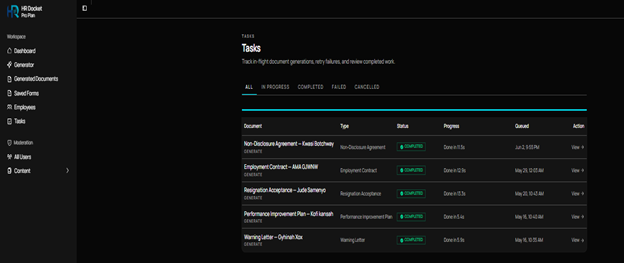
An upgrade on this is a tool that produces the documents themselves from structured inputs rather than blank templates like HR Docket. This is where the consistency problem at an organization with twenty or more employees gets addressed.
If every employment contract, offer letter, and warning letter is generated from the same structured workflow, the documents are consistent by construction, not by someone remembering to follow a style guide.
Review and Compliance Layers
This is perhaps the most valuable part and the one most HR solution platforms in this category don’t fully address. When a platform has a built-in review layer that checks generated documents for completeness, jurisdiction accuracy, and consistency before they are issued.
Companies with more than twenty employees, with multiple people potentially generating documents across different roles and possibly different locations, are where the majority of compliance risk is either revealed or gets missed.
Record-Keeping and Audit Trail
The system needs to keep a complete, employee-linked record of what was generated, signed, and filed in a retrievable way on demand, not reconstructed from email threads when a dispute arises.
The businesses that get the most value from digital document management solutions are the ones that invest in platforms that cover all four layers and not just storage and not just generation, but generation with built-in review filed into a retrievable record.
Top Affordable Digital Document Management Solutions
1. Gusto
If you want to kill two birds with one stone, this is the easiest choice. It pairs payroll with HR document management so everything stays in one place. When you hire someone, it automatically sends them their tax forms and onboarding packets to e-sign before their first day. It is incredibly user-friendly for both you and your employees.
2. Deel HR

This is commonly used by small businesses. Deel offers HR functions including document storage, compliance tracking, and onboarding workflows, for free for teams with fewer than 200 people. It is specifically built for global or remote teams, making it a lifesaver if you are hiring people across different state lines or countries.
3. BambooHR
This is the platform you opt for when you are officially ready to move from a scattered spreadsheet. It is a bit more of a traditional HR system, but it feels fresh and modern. It creates a beautiful, clean digital folder for every employee, tracks asset allocations and automates handbook sign-offs.
4. Folderit
If your organization want a simple HR platform and just need a secure, digital filing cabinet, this is your best bet. It is highly affordable and focuses strictly on document management.
You can easily set up privacy permissions, track document versions, and get alerts before employee certificates or visas expire.
5. PandaDoc
Choose this if your biggest headache is generation and signing of documents. If you are constantly sending out offer letters, NDAs, and contract renewals, PandaDoc automates the whole flow. It lets you build templates, drop in e-signatures, and sends automatic reminders to candidates who forget to sign their paperwork.
Human Resources Software Pricing

Human resources software pricing: differs depending on what category of tool you are looking at, and understanding the categories helps make sense of the range.
Full HRIS platforms: They cover payroll, benefits, time tracking, and HR records and normally cost $4 to $10 per employee per month for small business tiers, rising up to $8–$20 per employee per month for addition like features like recruiting and performance management.
For an organization with employees more than 20, that is roughly $100–$500 per month depending on the tier and add-ons.
Document storage platforms: Planform like Zoho WorkDrive, Box, SharePoint-based systems prices range from around $2.50 per user per month at the low end to $15–$50 per user per month for enterprise tiers.
HR document automation platforms: These tools focused on generating, reviewing, and filing employment documents and tend to charge flat or near-flat pricing structures rather than strict per-employee models, because the value is in the document workflow rather than per-seat access.
The pricing per-employee pricing models punish growth. A platform charging $6 per employee per month costs $120/month at 20 employees and $300/month at 50 which triple in cost as the team grows, even though the document workflows themselves have not tripled in difficult level.
Flat or banded pricing, where the cost increases in steps rather than linearly with headcount, tends to be considerably more affordable for businesses in active growth phases.
Why HR Docket is Best and Most Affordable for More Than Twenty Employees
HR Docket is structured specifically around this growth window and the point where document volume and consistency requirements have outpaced what a single person managing templates manually can sustain.
The pricing reflects this directly. The Starter plan covers up to 15 employees at $19/month. The growth plan extends to 50 employees at $49/month.
For a business with more than 50 employees, the business is your option which cost $99 per month. What the Growth plan covers is the full document workflow described above, applied across the entire employment lifecycle:
Pricing
Simple plans that grow with your team
Start free, then upgrade as your HR workload grows. Every paid plan includes clean PDFs, audit-grade e-signatures, and the full document generator.
Free
$0
Freelancers, solo founders, and businesses testing the platform
- Up to 1 employee profile
- Add 1 company
- 10 AI credits (5 HR documents approx.)
- Limited access to tool templates (warning letters, offer letters, contracts, etc.)
- PDF downloads (watermarked)
- Company profile setup
- Jurisdiction-based document drafting
Starter
$19
/mo
$15.83
/mo
Billed annually ($190) · 2 months free
Small businesses and growing teams
- Up to 15 employees
- 120 AI credits (15 HR documents approx.) per month
- Add up to 2 companies
- Full HR document generator access
- Up to 2 custom templates
- Employee database & profiles
- Auto-fill employee data into documents
- Digital signatures
- Signed & unsigned PDF downloads
- Expiration reminders
- Document storage & history
- AI-assisted document drafting
- Email delivery for generated documents
- Custom HR document builder
Most popular
Growth
$49
/mo
$40.83
/mo
Billed annually ($490) · 2 months free
SMEs managing active teams and HR workflows
- Everything in Starter
- Up to 50 employees
- 250 AI credits (32 HR documents approx.) per month
- Up to 5 custom templates
- Add up to 3 companies
- AI compliance & risk assessment checks
- Incident logs
- Asset/property tracking
- Leave management
- CSV employee import
- Document uploads/attachments to employee profiles
- Bulk document generation
- Employee self-service portal
- 15 company-wide message broadcasts per month
- Advanced HR records & operational tools
- 5 distribution & acknowledgement tracking
Business
$99
/mo
$82.50
/mo
Billed annually ($990) · 2 months free
Established companies and HR-focused organizations
- Everything in Growth
- Unlimited employees
- 600 AI credits (75 HR documents approx.) per month
- Up to 7 custom templates
- Add up to 4 companies
- Advanced compliance workflows
- 40 company-wide message broadcasts per month
- Request custom HR document builder tuning
- Ask HR Docket admins for a custom generator tool (1)
- Multi-user management
- Advanced audit logs
- Reusable company templates
- Signature authorization without login
- Unlimited policy distribution & acknowledgement tracking
- Dedicated support
Guided drafting: generates employment contracts, offer letters, warning letters, PIPs, NDAs, resignation acceptances, promotion letters, employee handbooks, and onboarding documents from structured inputs rather than blank templates, so consistency is built into the generation step rather than dependent on whoever is drafting that day.
Risk-aware review: runs on every document, which helps reveal unclear clauses, missing fields, inconsistent terms, and jurisdiction gaps before anything is shared, and the compliance layer that most document storage platforms don’t include at all.
US, UK, and local statutory compliance checks: It apply automatically based on jurisdiction, which is vital at this stage as growing companies start hiring across state lines or internationally.
Employee-linked records: keep every draft, signed version, and filed PDF organized under the correct profile, with audit-grade e-signature and tracked delivery.
Reusable templates by department and location: This means that as the organization grows to more than twenty employees and starts to include multiple departments or locations, the documentation standard scales with it rather than fragmenting.
A Practical Comparison of Cost at Different Headcounts
To have a view of how the prices look when choosing the right platform for document generation and compliance, not full payroll/HRIS, which is mostly a separate cost regardless of platform. This article has compared competitive pricing on the market against HR Docket pricing.
| Headcount | Per-employee model ($6/emp/mo) | Document storage tier ($15/user/mo) | HR Docket (banded) |
| 15 employees | $90/month | $225/month | $19/month |
| 25 employees | $150/month | $375/month | $49/month |
| 45 employees | $270/month | $675/month | $99/month |
The gap is wide because of the banded structure. An organization that grows from 15 to 45 employees sees its document management cost increase from $19 to $49 once and then stay flat through the rest of that growth band.
The per-employee and per-user models scale linearly with headcount, which means the cost of document management compounds at exactly the moment a growing business is trying to control costs elsewhere.
What to Prioritize When Evaluating Options
For an organization with more than twenty employees, when evaluating digital document management solutions, the priority list looks different than it would for either a five-person startup or a five-hundred-person enterprise.
Consistency across generators: If different people in the organization are generating documents, a manager issuing a warning letter, an HR coordinator drafting a contract, or a founder sending an offer, the platform needs to produce consistent output regardless of who is using it.
Built-in compliance review: At this size, the organization is generating enough documents that manual review of every one becomes impractical, but the legal stakes are high enough that skipping review is not safe either. An automated risk layer is the only way to maintain both volume and quality.
Also Read: 10 Best Employee Documentation Software for Small Businesses
Jurisdiction handling: Companies in this growth phase are increasingly likely to be hiring outside their original location, that is, remote employees, satellite offices, or expansion into new states or countries. Document generation needs to reflect this without requiring someone to manually verify jurisdiction-specific clauses every time.
Pricing that does not punish growth: A platform whose cost scales linearly with headcount causes operation expenses to increase as every new hire makes the HR tooling marginally more expensive, on top of the cost of the hire itself.
Full lifecycle coverage: Documentation needs at this stage span the entire employment relationship, including onboarding, performance management, promotions, and exits, not just hiring. A platform that covers offer letters but not warning letters or resignation acceptances leaves gaps that someone else has to fill.
Frequently Asked Questions
What is the average cost of HR document management software for a 25-person company?
It depends on the category of the software. Full HRIS platforms with document features normally cost $150–$500/month for 25 employees at standard per-employee pricing.
Document-focused platforms with banded pricing, such as HR Docket’s Growth plan at $49/month for up to 50 employees, offer slower costs for businesses whose primary need is document generation and compliance rather than full payroll and benefits administration.
Do small HR teams really need document management software, or can spreadsheets and shared drives work?
Shared drives and spreadsheets can work for employees below twenty, when document volume is low and one person is handling everything.
What’s the difference between document storage and document management for HR?
Document storage centralizes where files live and controls who can access them, while Document management is a full package which includes generation, producing the documents from structured inputs, review of draft and audit trail.
How does pricing typically change as a company grows from 20 to 50 employees?
With per-employee pricing models, cost scales increase and sometimes as headcount increases. With banded or flat pricing models, cost increases in steps rather than continuously, which is generally more predictable and often considerably cheaper for businesses in active growth phases, since the document workflows themselves don’t become proportionally more complex just because headcount increases.
Is it worth switching document management platforms during a growth phase, or better to wait until things stabilize?
The growth phase is generally the right time to make this change, not the wrong time. Switching platforms is more disruptive at higher headcounts, when more people are using the existing system and more historical records need to be migrated.
Implementing a scalable system while the team is at twenty to thirty employees means the platform grows with the company rather than requiring a more disruptive migration later.
Summary
The point at which a growing business needs to think seriously about digital document management solutions is not when things have already gone wrong. The moment the number of employees exceeds twenty and when document volume has outpaced what informal processes can handle.
Human resources software pricing at this stage does not need to mean enterprise HRIS costs. The right category of tool, the one focused on document generation, built-in compliance review, and employee-linked records, with pricing structured in bands rather than per-employee multipliers, covers the need that emerges at this headcount without the cost curve that punishes the very growth the business is trying to sustain.
For a team moving from twenty toward fifty employees, that is the combination worth prioritizing: consistency, compliance review, jurisdiction handling, and a cost structure that does not increase every time someone new joins the organization.
Every document becomes part of the employee’s permanent record
Spend less time buried in HR paperwork and more time growing your business. Generate documents, organize employee records, and simplify HR operations; all from one place.
No credit card required · Cancel anytime · Set up in under 5 minutes