

Running HR in a small business used to be a normal practice without much legal compliance. However, employment lawsuits have increased 400% over the last two decades. Pay transparency laws are expanding state by state. Termination requirements vary by jurisdiction, and the penalties for documentation failures such as missing records, non-compliant contracts, and improperly issued warnings have grown alongside them.
According to SHRM’s 2025 State of the Workplace Report, 57% of HR leaders said compliance-related workloads increased year-over-year, largely driven by new pay transparency laws and AI-driven regulatory oversight. For large organizations, that responsibility lands on a compliance team. For a small business, it lands on whoever is available.
The best HR document management software doesn’t replace legal judgment. It removes the structural issues such as the missing fields, the outdated templates, and the documents sent without review that turn manageable HR situations into expensive ones.
This guide breaks down what strict legal compliance actually requires from HR software, how the leading platforms compare on that specific axis, and which option is purpose-built for small businesses that can’t afford to get it wrong.
Why Small Businesses Face a Steeper Compliance Curve
Large organizations have compliance infrastructure built into their operating model. The legal department reviews every contract, human resources (HR) run checklists, and the policy updates go through a system that identifies any error or missing feature.
Sadly, small businesses do not have such infrastructure. When a warning letter is drafted by a manager who has never done it before, from a template last updated years ago, it is sent without structured review. An employment contract is copied from the previous hire; the only change is the name of the hire, nothing else, regardless of whether the new employee works in a different state. An employee handbook is given to the new employee at onboarding, signed, and never touched again until something goes wrong.
None of these are failures of intent. They are failures of process, and they are exactly where most small business compliance exposure lies.
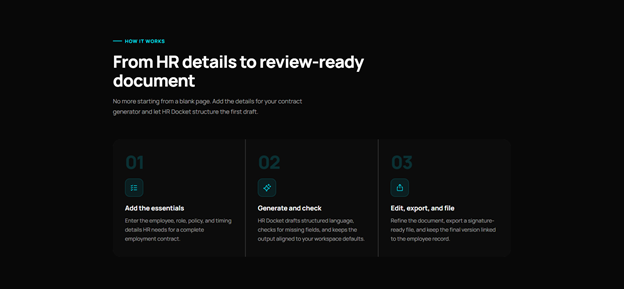
The strongest HR software for small business compliance addresses this at the structural level, not by providing legal advice, but by building the prompts, validation checks, and review layers into the document workflow itself so the gaps that create exposure don’t make it through in the first place.
What Strict Legal Compliance Requires from HR Software
Before comparing platforms, it is worth establishing the specific features that compliance-first HR documentation actually demands. Not every HR platform is built around these. Many HR platforms prioritize payroll automation, benefits administration, or performance analytics, which are valuable but different from what a small business needs when the legal record of an employment relationship is what is being tested.
Structured Input Workflows, Not Blank Templates
Free-form drafting is the single biggest source of document errors in small business HR. When someone fills in a generic template from memory, they are making decisions about jurisdiction, clause language, and required fields that they may not be qualified to make.
Software that structures input before generating the document changes this entirely. Required fields cannot be skipped. Jurisdiction-specific terms apply automatically. The output reflects a complete information set rather than whatever the drafter remembered.
Risk-Aware Review Built Into the Workflow
In most small business HR processes, there is no structured second review before a document goes out. The right software replaces that missing step with an automated check that reviews and identifies unclear clauses, missing dates, inconsistent terms, and jurisdiction gaps before the document is finalized.
Jurisdiction-Aware Compliance Checks
Employment law varies by location. Notice periods, non-compete enforceability, at-will language, PTO accrual, and salary transparency requirements are all jurisdiction-specific. A contract correct for a New York employee is not automatically correct for a California worker. Software that captures jurisdiction as a required input and applies location-specific checks before generating the document removes one of the most common sources of small business legal exposure.
Employee-Linked Records with Full Audit Trail
When a dispute arises, the question is not whether you followed the right process. It is whether you can prove it. That proof lives in the document record, the specific signed version of the agreement, the date of execution, the check-in records that followed, and the decision letter that closed the process. The way to get out of a situation like this is when you have HR records with tracked delivery, automatic filing, and version history.
Full Document Suite Coverage
Compliance exposure does not live in one document type. It covers employment contracts, offer letters, warning letters, PIPs, NDAs, resignation acceptances, promotion letters, employee handbooks, and onboarding packs. Software covering this full suite from a single workspace with consistent review standards across every document type removes the division that creates blind spots.
How The Best HR Document Management Software Compares on Legal Compliance

There are various HR document management software options in the market, but getting the one that meets legal compliance is another problem.
Here is how the main best HT software in this space measures up specifically in the compliance and document-management domains.
BambooHR
BambooHR is a well-established HR platform built for small to medium businesses. It handles employee data, onboarding workflows, performance management, and reporting. Its onboarding tools are among the best in the category.
On the compliance and document management, BambooHR is solid but limited. Document storage is centralized, and e-signatures are supported. However, document generation is not a core feature of BambooHR; it is primarily an HRIS (Human Resources Information System) rather than a document automation platform. It does not offer guided AI drafting, structured input validation, or built-in risk review of document content before it is issued. For businesses whose primary HR compliance concern is the quality and completeness of their employment documents, then BambooHR may not be your option.
Pricing is custom, typically starting around $10–$25 per month depending on the package.
Best for: Businesses that want a clean, centralized HRIS with strong onboarding and people analytics and whose compliance needs are met by document storage rather than document generation.
Gusto
Gusto is one of the most popular HR platforms for US-based small businesses. It is good for its payroll automation, benefits administration, and tax filing features. For businesses whose primary compliance challenge is payroll and tax accuracy, Gusto is a strong fit.
On employment document compliance, Gusto covers the basics. Offer letters can be generated and signed within the platform. However, Gusto’s document generation is limited in scope; it does not cover the full range of employment documents a growing business needs, including warning letters, PIPs, NDAs, promotion letters, and employee handbooks, and it does not include structured risk review of document content. Compliance features are payroll- and benefits-focused rather than documentation-focused.
Pricing starts at $40/month plus $6 per employee per month for the Simple plan. The Plus plan goes for $80/month plus $12 per person, and the premium plan goes for $180/month and $22 per person.
Best for: US-based small businesses where payroll compliance and benefits automation are the priority and whose employment documentation needs are basic.
Rippling
Rippling is an HR platform that combines HR, IT, and finance management. It strong for fast-scaling companies that need to manage devices, software access, and global payroll alongside people operations. Its breadth is its defining feature.
For small businesses with straightforward structures, that breadth can also be its limitation. Rippling is not built primarily around employment document compliance; it is built around operational scale. Document storage and basic e-signature are supported, but structured document generation with built-in compliance review is not a core part of the product. The pricing for Rippling depends on the plan you are subscribing to.
Here are their module costs:
- Core HR (HRIS): Starts at $8 PEPM + $35/month base fee
- Domestic Payroll: ~$35 PEPM (when added to Core HR)
- IT Management: Estimated ~$8 to $20 PEPM (covers app and device management)
- Finance & Spend: Estimated ~$10 to $15 PEPM (for corporate cards and expenses)
- Global Payroll: ~$29 PEPM (for international contractors and employees)
- Employer of Record (EOR): ~$499 to $599 PEPM (for hiring abroad without local entities)
Best for: Tech-focused, growing companies that need to combine HR, IT, and finance operations, whose compliance needs are met by process automation rather than employment document quality.
Zoho People
Zoho People is a cost-effective HRIS with feature sets such as leave management, attendance, performance reviews, and document storage. It handles the core HR record-keeping functions and integrates well with other Zoho products.
On employment document compliance, Zoho People offers document storage and basic e-signature but not structured document generation or built-in risk review. It is an affordable system for managing HR records, but its document capabilities do not address the generation-side compliance gap that small businesses most commonly encounter.
Best for: Businesses already in the Zoho ecosystem, or those needing affordable HRIS features with document storage as a component of a broader platform.
HR Docket
HR Docket is built for small businesses and growing people teams around the problem that none of the platforms above fully solve. That is producing legally sound employment documents consistently, without a legal team or a compliance department to check the process.
Where other platforms treat document management as a storage and signing layer on top of an HRIS, HR Docket treats it as the core workflow. Every document is generated through structured guided inputs, and required fields are validated before the first draft is produced. A built-in risk review checks every draft for unclear clauses, missing fields, inconsistent terms, jurisdiction gaps, and sensitive language before anything is shared. US, UK, and local statutory compliance checks are applied at the jurisdiction input stage. Every generated document is filed to the employee record automatically, with an audit-grade e-signature and tracked delivery.
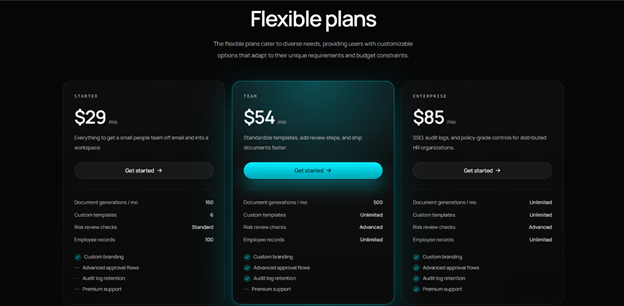
The full document suite includes employment contracts, warning letters, PIPs, offer letters, NDAs, resignation acceptances, promotion letters, employee handbooks, and onboarding documents at a pricing structure that reflects how small businesses are actually resourced. The starter plan is priced at $19/month, the growth plan is $49/month, and the business plan is $99/month.
Best for: Small businesses and growing people teams where employment document compliance is the primary risk — and where consistent, legally sound documentation needs to be achievable without a legal team.
Where Most Small Businesses Lose
Understanding which platform fits your business needs requires understanding where small businesses actually face compliance exposure, and it is not primarily in payroll or benefits, where Gusto and BambooHR excel. It is in employment documentation.
Proper documentation forms the foundation of HR compliance. These records not only satisfy legal requirements but also protect your business in case of disputes or audits. The warning letter was issued with the wrong policy reference, and the employment contract was copied from the last hire and applied to someone in a different jurisdiction. the employee handbook that was last updated two years ago and no longer reflects current leave policy, and the PIP with vague goals that gave the employee nothing measurable to work toward and gave HR nothing defensible to stand behind when the situation escalated.
These are not payroll problems. They are document quality problems, and they are the category most small business HR software either doesn’t address or addresses as an afterthought.

The best HR document management software for businesses where this is the primary risk is the one built to solve it at the source with structured generation, built-in review, jurisdiction-specific compliance checks, and records that are organized and retrievable before anyone asks for them.
How HR Docket Works in Practice
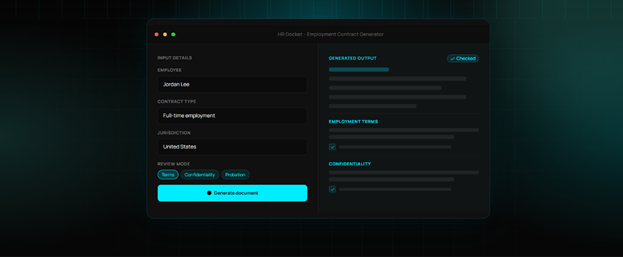
For a small business generating an employment contract for a new hire in California, the HR Docket workflow looks like this:
The HR partner or operations manager logs into HR Docket, clicks on generator, and chooses employment contract generator in the workspace. The guided prompts collect the required inputs, including name of employee, role, compensation, start date, reporting line, jurisdiction (California selected), benefits eligibility, and probation terms. California-specific compliance settings apply automatically, at-will language is formatted correctly, non-compete restrictions reflect state law, and the PTO accrual method is aligned to California statute.
The generator completed the first draft in around four minutes. The risk review runs automatically, identifying all errors or missing inputs and confirming all required clauses are present. The HR partner corrects the date, reviews the output, and routes it for e-signature. The candidate signs digitally. The signed version files automatically to the employee record, timestamped and linked to the onboarding profile.
Total time from input to filed, signed contract are under fifteen minutes.
The employee handbook generator follows the same process with guided inputs capturing company details, work model, leave policy, conduct standards, and acknowledgement requirements, producing a structured, review-ready handbook first draft in the same four-minute window for the new hire.
Summary
The best HR document management software for a small business facing strict legal compliance requirements is not the one with the most features. It is the one built to solve the specific problem where small businesses lose employment document quality.
BambooHR, Gusto, Rippling, and Zoho People are all credible platforms with genuine strengths in payroll automation, benefits administration, people analytics, and HRIS record-keeping. For businesses whose primary compliance risk lives in those areas, they are the right tools.
For businesses whose compliance exposure is in employment documentation, the contracts that do not reflect the right jurisdiction, the warning letters that would not survive a tribunal, and and the handbooks that have not been updated in two years, HR Docket is the right tool built specifically for document generation, review, and record-keeping.
That is what HR software for small business compliance at the document level looks like. Structured inputs, built-in risk review. Jurisdiction-specific compliance checks, a full document suite, and records that are organized and retrievable before anyone asks for them.
Every document becomes part of the employee’s permanent record
Spend less time buried in HR paperwork and more time growing your business. Generate documents, organize employee records, and simplify HR operations; all from one place.
No credit card required · Cancel anytime · Set up in under 5 minutes