

No matter how good an organization treats or takes care of its employees, a time will come that one or two of your employees will be leaving the organization to join a different organization and sometimes your major competitor.
As per the current practice, the departing employee must notify their employers in writing through a resignation letter. Once the employer receives the resignation letter, the employer must write a resignation acceptance letter to the departing employee.
Writing a formal resignation acceptance letter is not just a respective gesture but an important administrative procedure confirming that an employee is departing an organization. The procedure, like all HR and administrative functions, must be discharged with utmost transparency, follow due process, be legally solid, and be devoid of any emotions. Because the process can be emotional, especially when it involves one of your best employees.
To ensure the process is fair and devoid of emotions, legal solid to protect your business operations use HRDocket. HRDocket is currently the best modern automated documentation platform that generates jurisdiction-based, well-structured, and compliant resignation acceptance letters.
How to Draft a Resignation Acceptance Letter in Less Than 15 Minutes
Fellow the steps outlined below to draft a jurisdiction-based, legally solid, well-structured, and compliant resignation acceptance letter in les than 15 minutes with HRDocket:
Step 1: Select Jurisdiction and Recipient
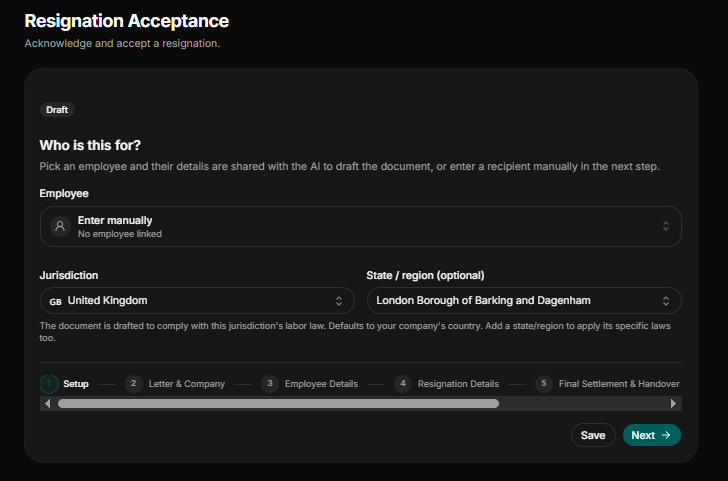
Employment and labor laws differ across country, region, and state. Selecting the right jurisdiction ensures that the resignation letter drafted complies with the labor laws of the employee residing in the country.
Selecting Recipient: Select an existing employee profile from your employee database on HRDocket or choose Enter manually if the employee is not in the database.
Establish Jurisdiction: Select the jurisdiction the employee is residing in (e.g., the United Kingdom).
State/Region: Select the state or region the employee is residing in (e.g., London Borough of Barking and Dagenham) to ensure regional or state labor laws and statutes are complied with when the letter is finally generated.
Step 2: Provide Document and Details
For the purpose of records management and audit trails, provide accurate details.
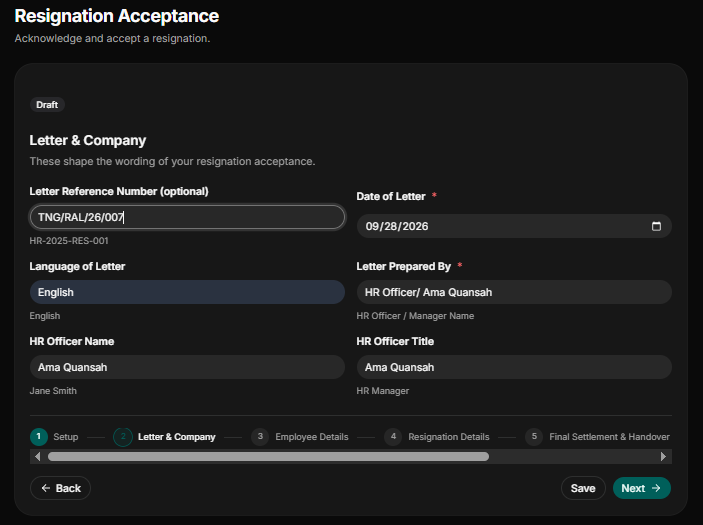
Letter Reference Number: State accurately the reference number of the letter.
Date of Letter: State precisely the date of the letter in month-day-year format (e.g., 09/28/2026).
Language of Letter: Specify the language the letter will be written in (e.g., English)
Letter Prepared by: State the title and the name of the company official who prepared the resignation acceptance letter (e.g., HR Officer/Ama Quansah).
Step 3: Provide Employee’s Details
It is very important for the purpose of misrepresentation and labor disputes to provide the accurate and legal details of the employee for whom the resignation acceptance letter is for. The detail must include his full name, residential address, and other important details required in these steps.
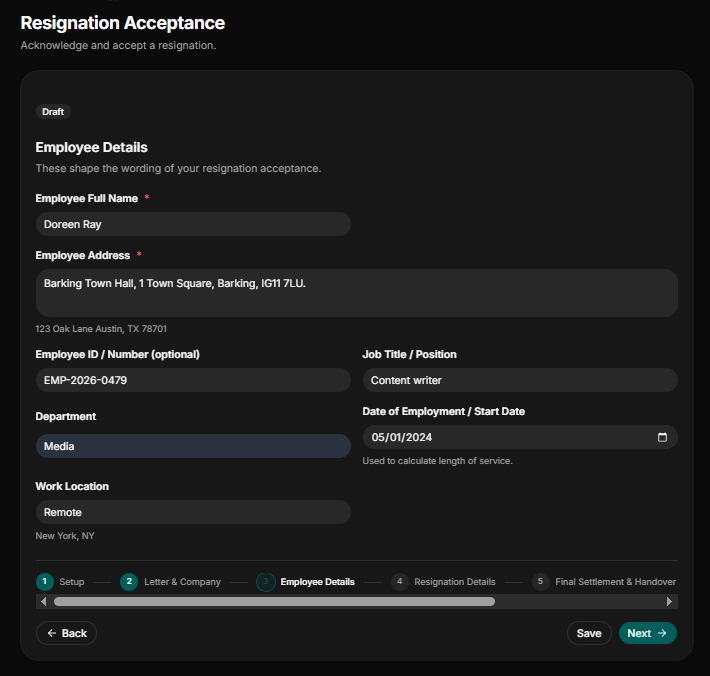
Employee Full Name: State employee’s full legal name as it appears on his government-issued ID (e.g., Doreen Ray).
Residential Address of Employee: State employee residential address (e.g., in our case, the employee resides in London, so the address is Barking Town Hall, 1 Town Square, Barking, IG11 7LU).
Employee ID/ Number: State the employee staff ID.
Job Title: State the job title of the recipient of the resignation acceptance letter (e.g., Content Writer).
Date of Start of Employment: State the date the employee started work with your company in month-day-year format (e.g., 05/01/2024).
Department: State the department the employee was assigned to (e.g., Media).
Work Location: State the location the employee was working (e.g., working from home).
Step 4: Document Resignation Details
Clearly state the resignation timeline and the reasons for the resignation for the purpose of records management and future labor disputes. The notice period, type of resignation, and reason for resignation as started by the departing employee in his resignation letter must be started.
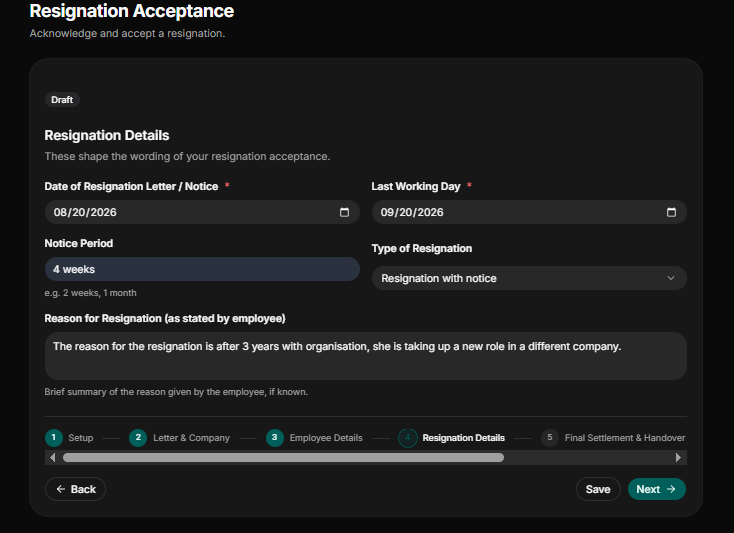
Date of Resignation Letter/Notice: State precisely the date the employee gave you his resignation letter in month-day-year format (e.g., 08/20/2026).
Notice Period: State the notice period per the resignation letter received from the employee in month-day-year format (e.g., 4 weeks or 3 weeks).
Resignation Type: Select the resignation type (e.g., whether it is retirement, resignation with notice, intermediate resignation, mutual separation, or voluntary resignation).
Last Working Date: State the departing employee’s last working day with your organisation in month-day-year-format (e.g. 09/20/2026).
Reason for Resignation: State clearly based on the employee’s resignation letter the reason for his resignation.
Step 5: State Final Settlement, Asset Return, and Project Handovers
Provide in detail all final settlements to be made to the departing employee and the date of payment. Also list clearing all company property and assets in the employee’s possession that he must return.
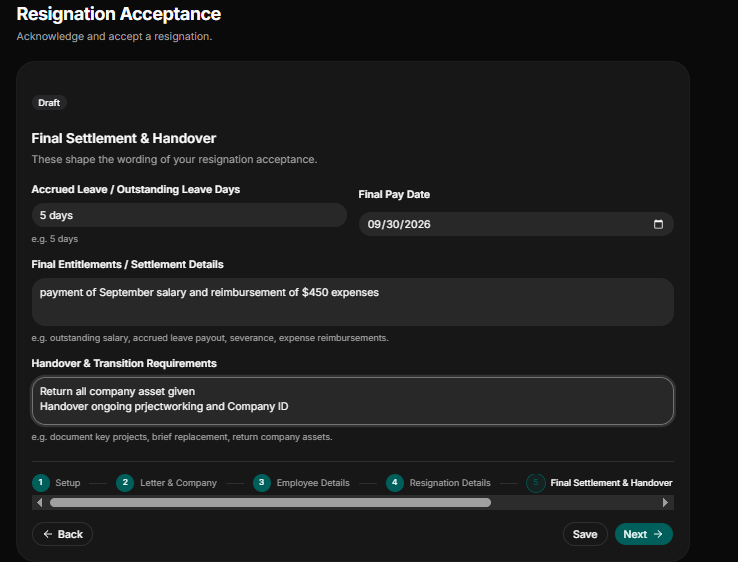
Accrue Leave/Outstanding Leave Days: State if the departing employee has any outstanding leaves (e.g., 5 days).
Final Pay Date: State when the departing employee will receive his final pay in month-day-year format (09/30/2026).
Final Entitlement/Settlement Details: State the details of any final settlement made to the departing employee (e.g., reimbursement of $450 expenses).
Handover and Transition Requirement: State the projects and assets the departing employee must hand over to the organization before leaving.
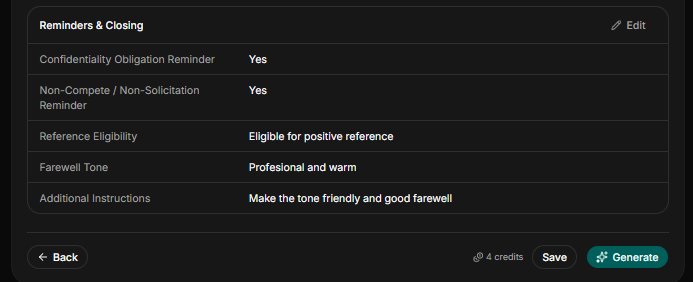
Step 6: Select Restrictive Remainders and Farewell Tone
At this stage, you must remain the departing employee of the enforcement of post-employment obligations while giving the employee a good farewell tone
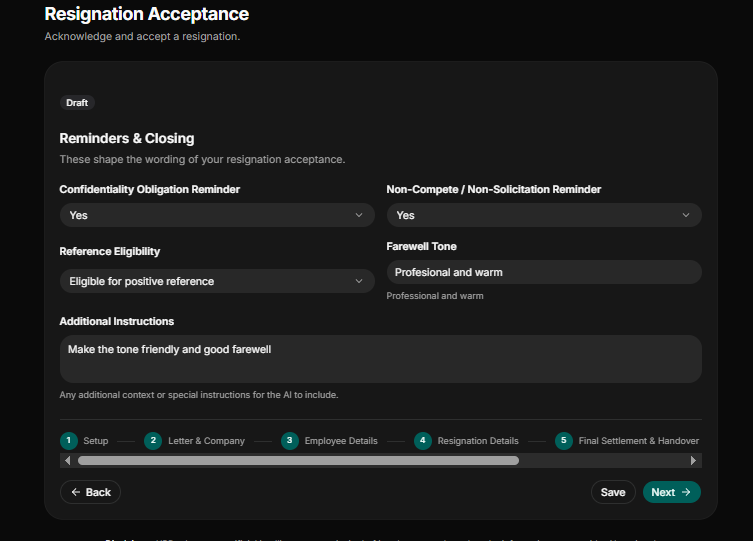
Confidential Obligation remainder: Indicate “yes” or “no” to remind the employee of ongoing obligations regarding proprietary information, trade secrets, and internal data.
Non-Compete/Non-Solicitation Remainder: Indicate “yes” or “no” to reinforce whether the departing employee can start the same business, join a competitor, or poach a client or staff.
Reference Eligibility: Select the type of reference the employee is eligible for, whether he is eligible for positive reference, employment verification only, or reference at company discretion.
Farewell Tone: State what the tone of the resignation acceptance letter is (e.g., professional and warm).
Additional Instruction: State or list any additional or special instructions you want the AI to include.
Step 7: Review and Confirm
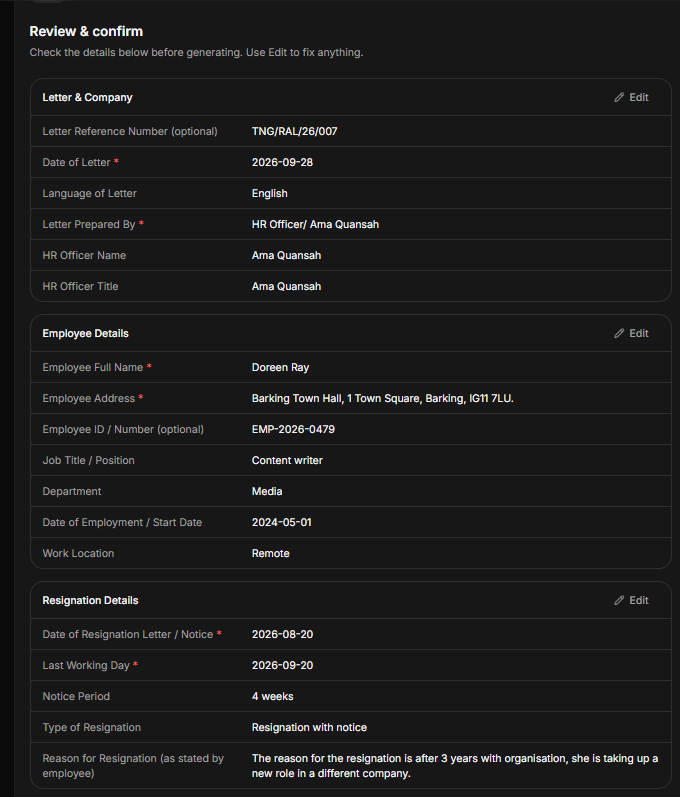
Review to ensure that the information and details provided are accurate. The helps you to identify missing date, poor date format, wrong and misspelled names, wrong title or position, and jumping a section.
Once you have confirm that all the information and details correct, proceed to generate your resignation acceptance letter.
Step 8: Review and Edit
After generating your resignation acceptance letter, you are left with one more steps to follow to ensure that your letter is not just well written items of grammar, spelling and construction but is legally complaint.
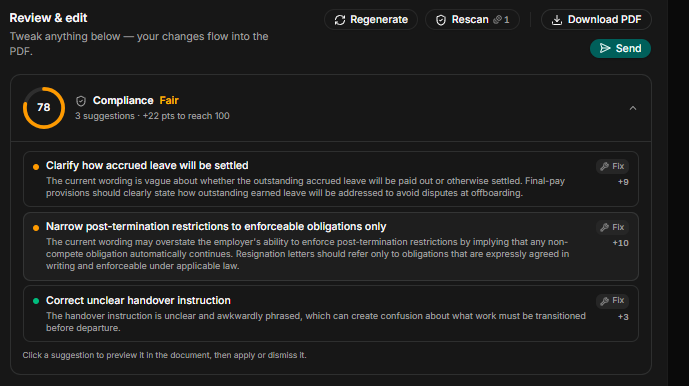
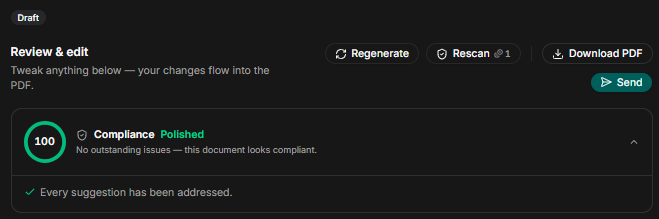
Run the rescan function to check for any compliance , jurisdiction and legal gaps. Alter applying the rescan function and the letter is now 100% polished with no legal and compliance issues, the resignation acceptance letter is ready to send out for digital signature, or filed to the employee record.
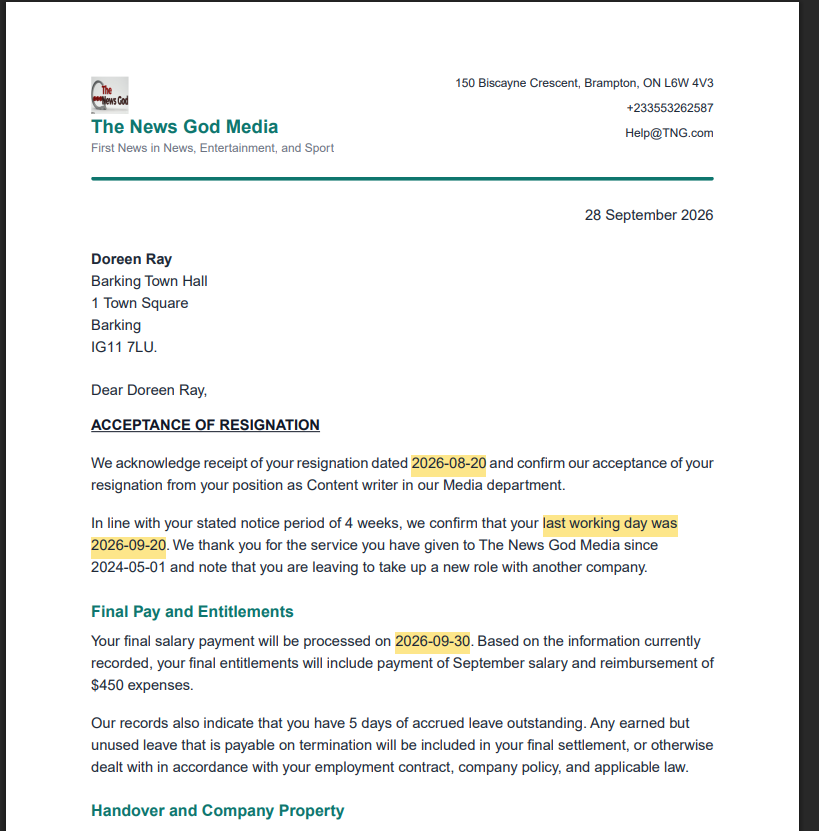
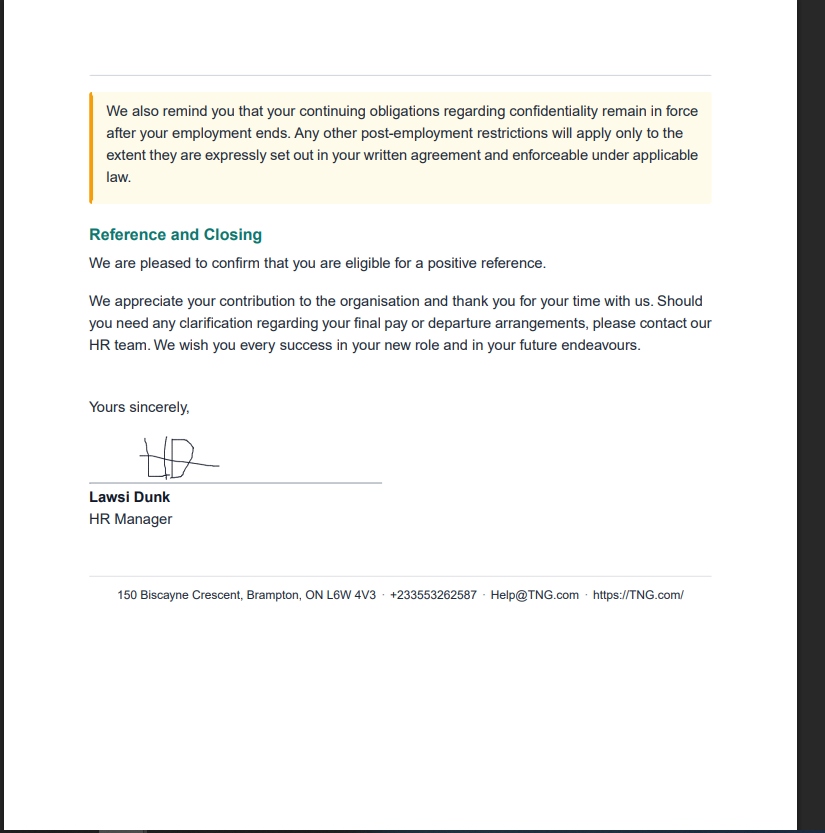
Sample of Resignation Acceptance Letter
After you have successfully generated your document with HRDocket, below is how your Resignation acceptance letter will look like:
Conclusion
I’m sure after reading the article you might probably be thinking, “How did writing of resignation acceptance letters become that easy?” Don’t be surprised that what HRDocket Resignation Acceptance Generator does is a resignation acceptance letter written in less than 15 minutes.
Don’t be left out; join the list of businesses that streamline their HR workflow with HRDocket. The platform is affordable with incredible features.