

Managing people is one of the hardest parts of running every organization. Employees leave organizations day in and day out, either voluntarily or involuntarily. Handling these delicate situations with empathy and consistency is essential for ensuring a clean and compliant separation process.
When confronted with an employee departure, most HR professionals rush to Google to search for termination letter or offboarding templates, hoping it will make their job easier. But here is the problem: offboarding is not just employees leaving the company. The real challenge is the compliance trail that follows, such as the termination letter, the final pay documentation, the offboarding requirements, and the separation records.
What is employee offboarding, and why is it risky?
Offboarding is the process of transitioning an employee out of an organization, whether they resign, retire or are fired. An effective offboarding process ensures a smooth transition for the employer, the departing employee, and their immediate colleagues.
While most organizations spend more energy on job postings, interviews, background checks, and other onboarding processes, offboarding is often handled under pressure and sometimes with minimal documentation. Termination often feels heavy, even when managers are deeply aware of the risks that might arise from poor documentation.
According to an article published on SHRM, terminating an employment agreement can lead to vicious shouting matches or violence. Some reports indicate the period leading up to a dismissal is physically and emotionally draining, considering the interactions, performance reviews, and attempts to support the struggling employee.
Many HR managers also worry about what happens after the employee finally exits: their family, the team left behind, and the things that could go wrong.
Terminations often come with high stakes both legally and operationally. For instance, a single misplaced phrase, a missed final pay deadline, or an overlooked offboarding requirement can trigger disputes, unemployment claims, lawsuits, or regulatory headaches.
On the other hand, if the offboarding process is managed effectively, former employees are more likely to speak positively of the organization.
Termination Letters
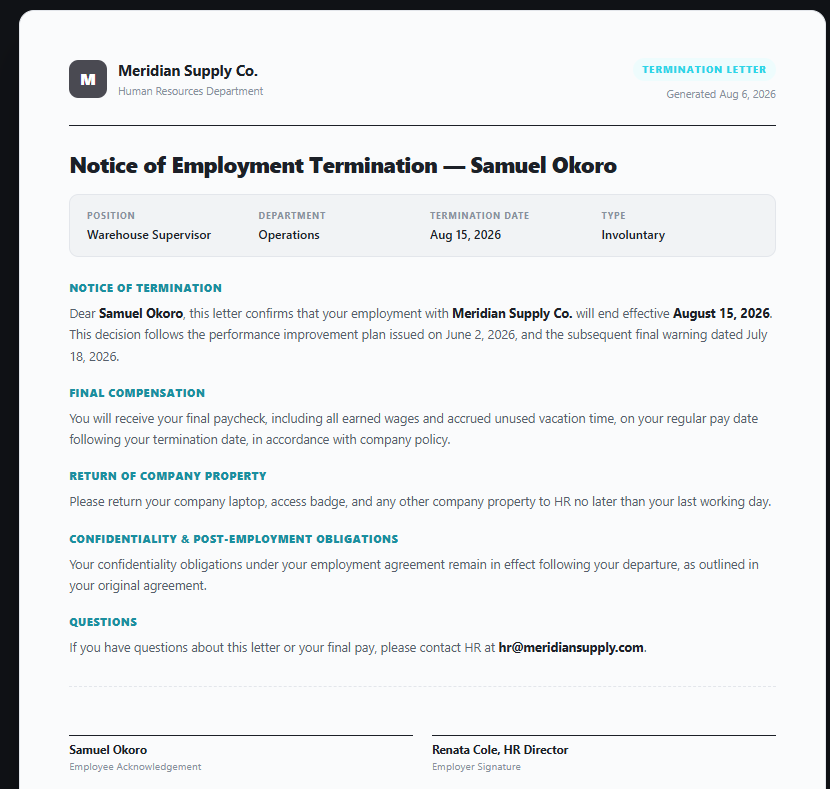
A termination letter is an official document that formally ends an employment relationship. It is not just a formality; it serves as a permanent, written record of the dismissal. It documents what happened, why it happened, and the terms agreed upon.
Because termination is a delicate situation and must be handled with extreme care. Even a minor mistake can lead to severe legal consequences, damaged team morale, lost institutional knowledge, and even reputational harm.
Modern AI-powered termination letter generators are designed to guide managers through this the right way: with empathy for the person leaving and with clean, documented, legally defensible processes that protect everyone involved.
It can be the single most important document in your file if a former employee later disputes the nature of their separation, files for unemployment, or pursues legal action.
Key Components of a Professional Termination Letter
A professional termination letter template should include the following:
- The employee’s full name, title, and department: The termination letter must state the employee’s full name, title, and department.
- The effective date of termination: It is important to clearly state the date of termination. This helps with the final pay calculations, benefits, and unemployment eligibility determinations.
- The reason for separation: This is where many managers try to be vague to avoid conflict. Depending on whether the separation is a layoff, a termination for cause, or an at-will separation, the reason must be stated clearly, objectively, and without emotional language.
- Information about final pay: The termination letter must state when the employee will receive their last paycheck.
- Return of company property: The letter must also state the deadline by which company properties, such as laptops, key fobs, credit cards, and parking passes, need to come back.
- Confidentiality reminders: Employees who signed an NDA or confidentiality agreement should be reminded that obligations continue post-employment.
- Information about benefits continuation, such as the Consolidated Omnibus Budget Reconciliation Act (COBRA), retirement account options, and the timeline for losing employer-sponsored coverage.
- Contact information for questions: You can’t just assume everything will be fine. You must include a contact person in case of a problem. For instance, if something goes wrong with the final paycheck.
How to create a professional termination letter using an AI-powered HR document generator
Building a professional termination letter from scratch is no easy task. It requires much more than just saying, “You are fired.” Well, you might think a termination letter template sounds good, but then a single mistake in the document will cost you a lot.
In order to make termination and offboarding less of a burden to HR managers and teams, modern HR platforms introduced various HR document generators, including offer letter generators, Performance Improvement Plans, salary increment generators, termination letter generators, resignation acceptance letters, Reference letter generators and more.
These powerful tools ensure that HR professionals never miss a legally required element, maintain consistency across separations, and dramatically reduce the time between making decisions and getting the documentation ready. They also cut the time human resources teams use in handing paperwork.
With a dedicated termination letter generator, all you need to do is input the key details and the platform will handle the complex structure for you.
Follow these simple steps to generate a standardized termination letter in minutes using HRDocket
Step 1: Create a profile
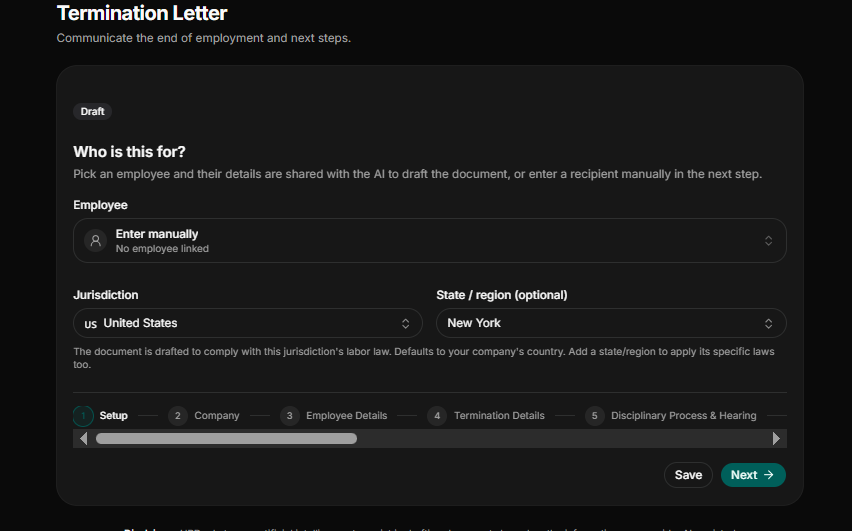
Every new user needs to set up a profile. Start by signing up and creating a profile for your organization. Once configured, you can invite all your employees and start your document generation workflow.
You can enter the details of your employee manually or import a CSV file of your employee database onto the platform. Setting up your profile helps with company branding and standard employment laws applicable to your jurisdiction.
Step 2: Add the essentials
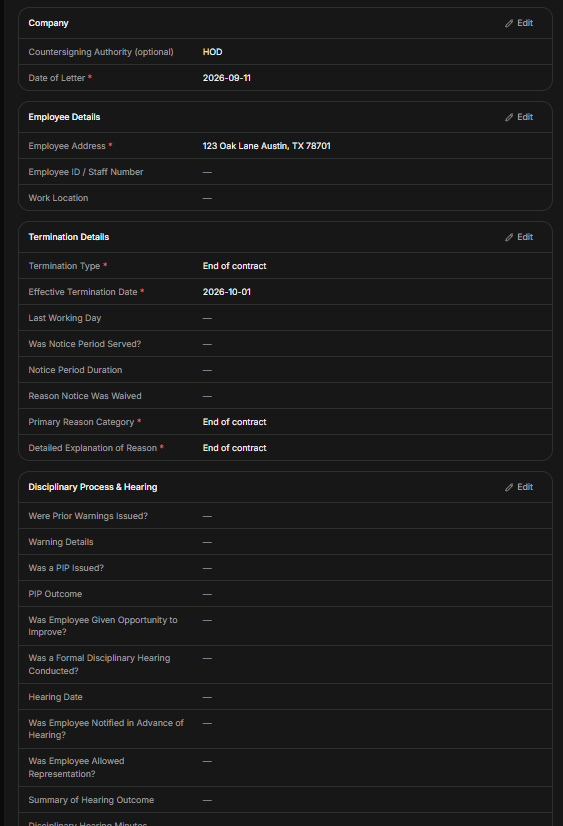
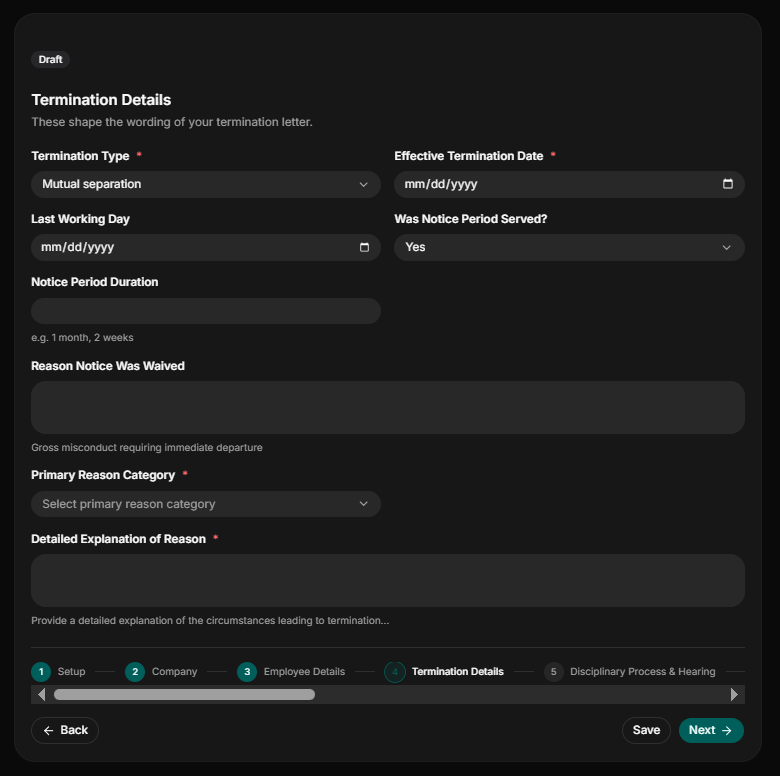
Add essential information such as employee details, role, department, employment type and location. From employee details, you move to termination details such as termination type, effective date, last working date, primary reason, and a detailed explanation of the reason.
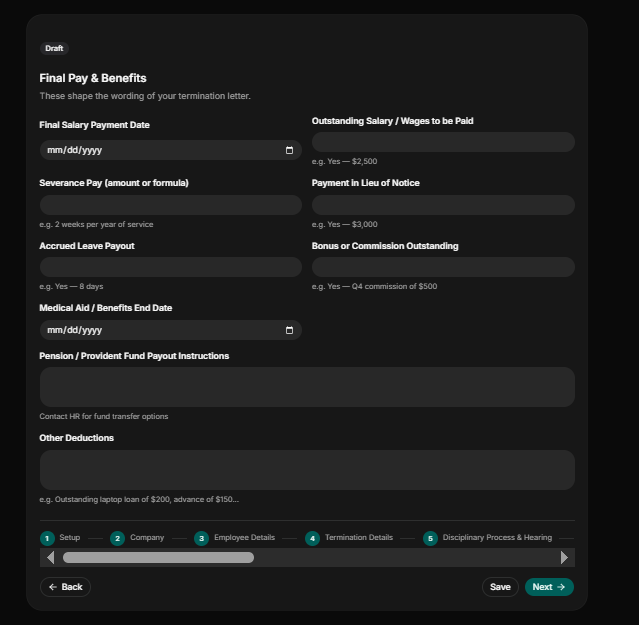
Some terminations might require documentation of disciplinary hearings and processes. You might also need to complete legal and compliance information such as applicable labor laws, union membership, and grievance rights clauses. After which you will have to deal with final pay and benefits as well as company property and access, if any.
Step 3: Generate and check
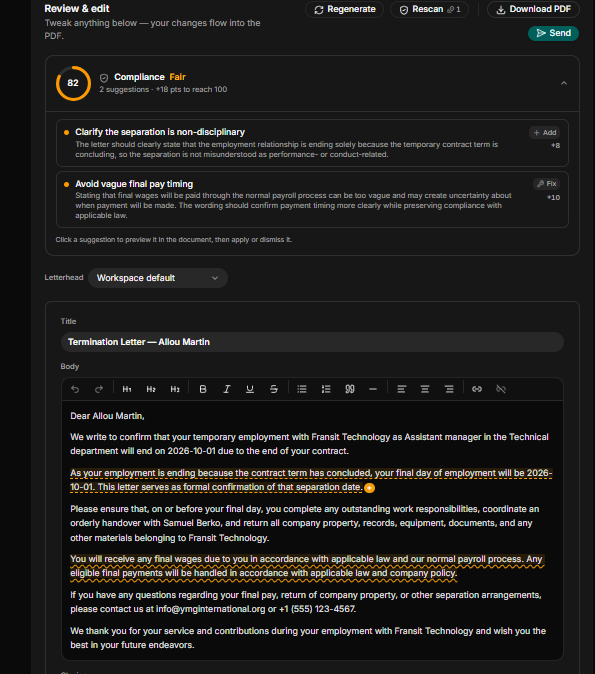
After filling in all the required information, HRDocket does all the weight lifting and drafts structured language, checks for missing fields, and keeps the output aligned to your workspace defaults. During testing, I was able to generate a standardized termination letter under three minutes.
The draft always comes with a risk-aware assessment suggesting all the areas that need to be improved. After generating the document, don’t ignore the risk scanner at the top right side of the draft. It flags compliance issues or outdated wording that you might otherwise miss.
Step 4: Edit and export the file
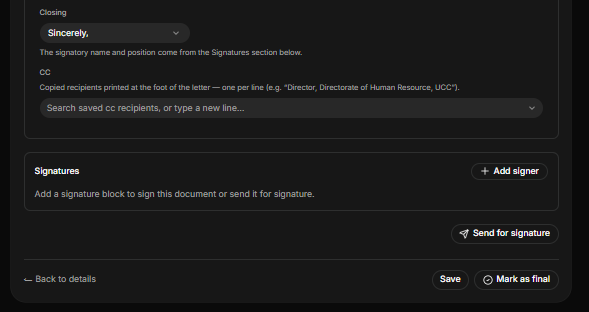
Refine the document, export a signature-ready file, and automatically link to the employee’s permanent records. You can sign the document electronically or send it for e-signatures without leaving the platform.
Why HR Docket Termination Letter Generator Stands Out
The HR Docket’s termination letter generator provides many unique features that cannot be found on any other template. Some of these unique features include:
- Guided AI drafting: This generator does not produce generic AI text. It turns your structured HR inputs into a polished termination letter.
- Risk-ware review: With HR Docket, you do not need to worry about missing key information. The platform flags unclear clauses, missing dates, inconsistent terms, and sensitive language before the document is shared.
- Compliance coverage: HR Docket highlights the details that usually slow review: missing fields, unclear dates, policy gaps, and document-specific terms.
- Reusable templates: The platform standardizes approved wording by document type, department, location, and workspace policy. You do not need to spend hours surfing the internet for a good termination letter template.
- Employee-linked records: HR Docket helps you organize your desk by keeping generated drafts, saved versions, PDFs, and signatures organized under the right employee profile.
- Export-ready formatting: The platform produces clean documents your team can review, download, share, or route for signature.
Why compliance is non-negotiable
Employment laws are changing rapidly, and employees are highly aware of their rights. A disorganized termination process doesn’t just look unprofessional; it leaves a paper trail of liabilities.
An unprofessional termination can lead to:
- Legal issues: a mistake made in the termination process can result in wrongful termination claims, discrimination lawsuits, and retaliation charges. This could cost your organization a lot of money to defend the case, even if the court finds nothing wrong.
- Financial penalties: Failing to deliver final wages on time or omitting mandatory state disclosures can trigger automatic regulatory fines that multiply daily.
- Brand reputation: A viral complaint for a formal employee can damage your brand reputation.
What clean separation actually looks like
It is important for HR managers to approach separations with the same structure they bring to performance reviews or project planning. The whole process should be based on clarity and respect for the departing employee. Proper documentation and compliance to protect the organization as well as team continuity to minimize disruption.
A clean separation is professional and gives the employee clear answers about what happens next. It has the following features:
- The reason for the separation is clearly documented.
- The employee receives a formal termination letter that outlines the decision, the effective date, and any relevant terms.
- Final pay is calculated accurately and delivered on time, with proper documentation.
- Offboarding requirements are completed systematically, from access revocation to benefits notification.
- Separation records are stored in a format that’s organized, retrievable, and complete.
The Final Pay Documentation
In the case of termination, final pay is one of the highest-risk areas. Most jurisdictions have strict deadlines, and errors can lead to legal issues. Sometimes, final pay errors are a result of confusion, miscalculation, or simply not knowing the rules.
Here are some things to consider in your final pay documentation:
- The calculation of regular wages through the termination date
- Any overtime owed
- The treatment of accrued, unused paid time off
- Commission or bonus payouts, if applicable
- Any deductions, clearly itemized and legally authorized
The timing of the final pay is not optional. You cannot decide when you want to pay the employee on the termination date. There is a law governing how and when the final pay should be made. Some jurisdictions require final paychecks on the employee’s last day, while others allow you to wait until the next regular payday.
Also, all records of calculations must be kept safe in case of any dispute. It is also important to note the difference between final pay documentation and benefits documentation.
Offboarding Requirements
Offboarding is a coordinated process and a risk management. Steps must be taken to ensure that the right procedure is followed. A proper offboarding checklist should cover:
- IT and Access:The organization must take back all IT devices and revoke all access to internal systems and emails in order to avoid a data security gap after termination.
- Physical Offboarding:Retrieve physical keys, keycards, access badges,and company vehicles.
- Payroll and Benefits Administration: Update payroll immediately to avoid accidental additional payment. It is also important to notify benefits carriers of the termination date.
- Documentation: Ensure the signed termination letter is on file.File final pay documentation with payroll records and update the employee’s HR file to reflect separated status.
- Knowledge transfer: Documented handoff of projects, contacts, passwords (where appropriate), and ongoing responsibilities.
How to protect your future with separation records
The best way to protect your organization in any future review, audit, unemployment hearing, or litigation is to build strong separation records. The statute of limitations on employment claims can extend years beyond the termination date. Which means the documentation you create today may need to speak for you in a legal proceeding you cannot yet anticipate.
Separation records are the complete file associated with an employee’s departure. A well-maintained separation record includes the following:
Pre-Termination Documentation:This includes performance reviews, PIPs, written warnings, and disciplinary records. It may also include any relevant email correspondence, meeting notes from performance conversations, and attendance records.
Termination-Date Documentation: These includethe signed termination letter, final pay calculation sheet, benefits notification documents (COBRA, etc.), and any property return receipts.
Also Read: HRDocket vs HR Acuity vs Workpro Comparison
Post-Termination Documentation: Signed severance agreements, references to unemployment claim responses, and any post-employment correspondence.
The HR Docket assists you with your separation records by automatically documenting information related to the employee. These include:
- The termination letter and all versions.
- Signed acknowledgments.
- Performance documentation.
- Offboarding checklist completion.
- Audit logs showing who edited what and when.
With a modern AI-powered HR documentation platform like the HR Docket, you don’t have to navigate separations alone with scattered emails and outdated templates. Equip yourself with tools designed for exactly these moments. Protect your team, your organization, and your own peace of mind.
Create termination letters with clear next steps today
HR Docket exists specifically to close the gap between what managers know they should do and what actually gets done under the pressure of a real separation.
Ready to make separations less painful and far more compliant? You can start today with the HR Docket Termination Letter Generator. You do not need a credit card to start; sign up for free today. The platform offers flexible plans based on your needs. Explore the full library of HR documentation and compliance tools.
Every document becomes part of the employee’s permanent record
Spend less time buried in HR paperwork and more time growing your business. Generate documents, organize employee records, and simplify HR operations; all from one place.
No credit card required · Cancel anytime · Set up in under 5 minutes