

The conversation was one of the best a manager can have. The employee found out they were being promoted, the terms were explained, the excitement was genuine, and everyone left the room feeling good about what was ahead. Then the letter arrived.
The title was right, the effective date was right, but the salary figure was a hundred dollars off from what was discussed. The reporting line described the old structure, not the new one. The compensation section made no mention of the revised bonus eligibility that had been a huge part of the conversation, and the tone is clinical and templated, reading like it had been written for someone else and lightly edited and did not match the warmth of the conversation it was supposed to confirm.
The employee did not say anything immediately, but the disconnect was lodged. The letter that should have been the formal affirmation of a smooth conversation instead raised quiet questions about whether what was agreed in the room was actually what was being put in writing.
This disconnect is one of the most avoidable problems in HR and it happens constantly.
Why the gap exists
The promotion conversation and the promotion letter are produced by different processes in most organizations, and those processes don’t talk to each other reliably.
The conversation happens in the flow of management: a decision is made, a meeting is scheduled, and terms are discussed. The manager knows the details. The employee knows the details. HR may or may not have been in the room.
The letter happens separately: a request reaches HR, sometimes as a forwarded email, sometimes as a verbal note, sometimes as a bullet-pointed summary that captures some of what was discussed and misses the rest. HR drafts from that input, using a template that may not have been updated since the last round of promotions, and produces a document that reflects what they were told, which is not always the same as what was agreed.
The gap between those two processes is where the errors live. Not errors of bad faith but errors of incomplete information, interpreted through a template that was not built to identify them.
The solution is not better communication between managers and HR, though that helps. It is a structured input workflow that forces the relevant details to be captured completely before the letter is generated so the document that comes out reflects the actual conversation, not an approximation of it.
What a promotion letter needs to confirm
A promotion letter is not a congratulations note with a signature line. It is a formal document that updates the employment record and establishes the new terms of the employment relationship from the effective date forward.
Every material change agreed upon in the promotion conversation needs to appear in the letter precisely, not approximately. That means:
The new title is in both its public-facing form and internal grade, where they differ. An employee promoted to “Senior Manager” who discovers six months later that their internal band has not moved has a legitimate concern that starts with what the letter said.
Compensation changes in full, including base salary, any revision to variable pay targets, changes to bonus eligibility windows, and equity adjustments where applicable. A letter that confirms the new base salary but omits the revised commission structure does not capture the agreement, it captures part of it, and the part it omits becomes the source of the dispute.
The effective date, stated unambiguously. Not “from the next pay cycle” or “with effect from the beginning of next month.” The employee’s own records reference a different date. The ambiguity creates downstream errors in every system that touches the employment record.
The new reporting line should reflect the actual structure as of the effective date. If the promotion changes who the employee reports to, which it frequently does, the letter needs to name the new reporting manager and reflect the new team structure. A letter that still lists the previous manager is not a document confirming the new arrangement. It’s a document describing the old one.
Any changes to role scope or responsibilities that are stated with enough clarity to distinguish the new role from the previous one. This matters for future reference, for performance conversations, and for any situation where the boundaries of the role need to be established.
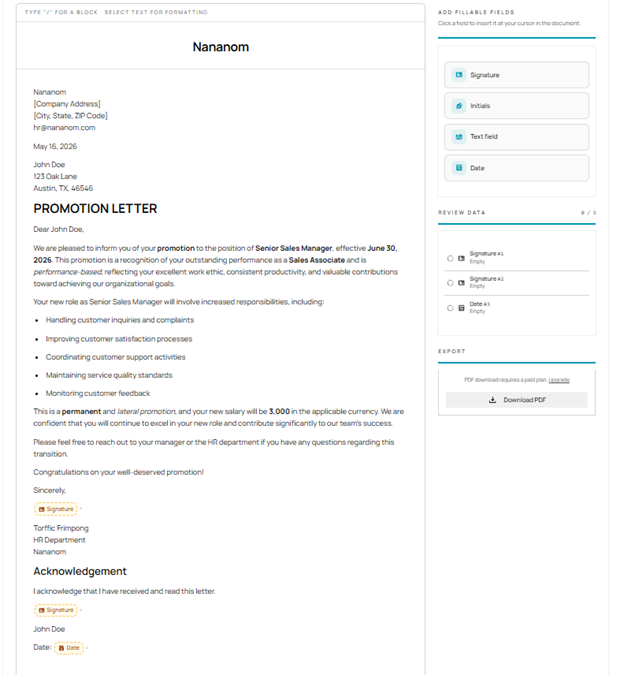
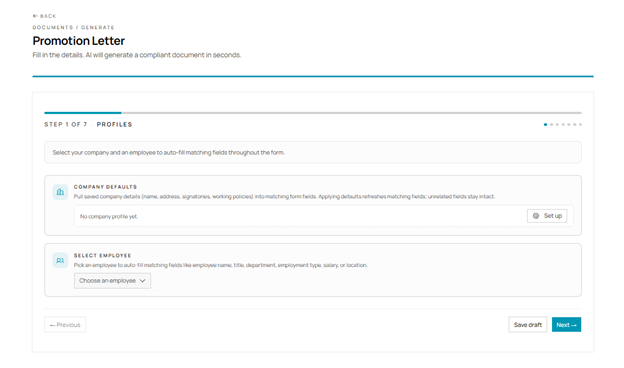
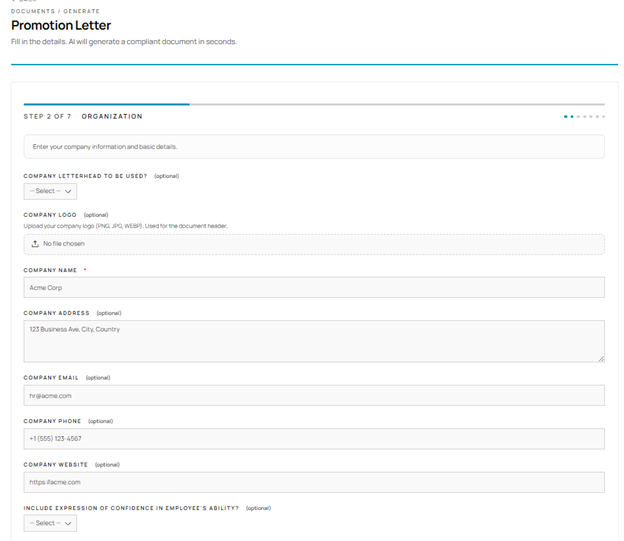
The HR Docket Promotion Letter Generator structures these as required fields before the first draft is generated , new title, compensation details, effective date, reporting changes, and recognition. None of these fields can be left blank or approximated. The document that comes out is complete because the inputs were complete, not because someone remembered to add them on review.
Why Promotion Letters Must Match the Conversation to Capture the Human Moment
There is a functional dimension to a promotion letter, and there is a human one, and both matters, but most templates were designed for the functional dimension alone.
The operational details like title, compensation, effective date, and reporting line need to be precise. However, a promotion is also a significant moment in an employee’s career, and the letter that documents it is part of how that moment is celebrated. An employee who has worked hard for a promotion, received it in a genuine and warm conversation with their manager, and then opened a letter that reads like a payroll notification has experienced a small but real deflation.
That deflation is not trivial. It shapes how the employee talks about the organization to colleagues, to candidates, and to their network. It shapes how they remember the transition when they reflect on their tenure. And it sits in contrast with everything the organization says about valuing its people because the document that was supposed to be the formal expression of that value communicated something considerably more transactional.
The recognition section of a well-constructed promotion letter does not need to be long. A few sentences that specifically acknowledge what the employee has contributed, name the qualities or achievements that drove the decision, and express genuine confidence in what comes next is the difference between a letter that lands and one that does not.
HR Docket’s guided AI drafting captures both the operational structure and the recognition tone in the same workflow. The congratulations element is built into the document structure, not included afterward as an afterthought. So, the letter that goes out is complete in both dimensions. precise on the terms, genuine in the acknowledgment.
The consistency problem at scale
For organizations with multiple locations, distributed teams, or high internal mobility, promotion letters are one of the most variable documents in the HR function.
When letters are drafted individually by different HR partners, from templates that have diverged over time, with inputs that vary in quality depending on how the promotion was communicated, the output varies significantly. An employee promoted in one office receives a detailed, warm letter that covers every material change. An employee promoted in another office at the same time receives a letter that lists the new title and salary and not much else. Both were promoted. One was documented professionally. The other was processed.
That inconsistency is not just an employer brand concern. It creates legal and operational exposure. Employees in equivalent roles who received materially different promotion letters may have different understandings of what was agreed and when disputes arise, those letters are the documentary record of the terms.
HR paperwork management built around standardized, structured generation, same workflow, same required fields, same review standard regardless of who is processing the promotion or which department is involved closes this gap. The letter generated for a promotion in the engineering team looks structurally identical to the one generated for a promotion in the finance team: complete, consistent, and professional. This is not because the content is the same, but because the process that produced it is.
Reusable templates in HR Docket allow approved wording to be standardized by document type, department, and location, so the baseline is always right, and refinements happen within a structure that maintains consistency rather than around it.
What happens when the letter and the conversation don’t match
Most of the time, a discrepancy between the promotion conversation and the promotion letter goes unremarked. The employee notices but does not raise it. The manager assumes the letter is accurate. HR files the document and moves on.
Then, six months later, a review conversation references the compensation terms, or a reorganization changes the reporting structure, or a dispute about variable pay eligibility surfaces, and the letter becomes the evidence of what was agreed.
If the letter doesn’t match the conversation, the organization is in the difficult position of arguing that the document it produced does not accurately reflect the arrangement it made. That is not an impossible argument, but it is a significantly weaker position than having a letter that captured the agreement correctly from the start.
The risk-aware review built into HR Docket’s generation workflow identifies the most common sources of this mismatch before they leave the workspace, including common mismatches such as missing compensation fields, effective dates that do not align with the payroll record, reporting lines that reference the previous structure, and vague language in the role scope section that would need to be interpreted rather than read. These are the discrepancies that create disputes, and they are the discrepancies the review layer is built to surface before the document is shared.
The promotion letter as a record of internal mobility
There is a longer-term value to getting promotion letters right that organizations frequently underestimate: the quality of the historical employment record.
Every promotion letter becomes part of the employee’s file. It documents the trajectory of the employment relationship, the roles held, the terms at each stage, and the effective dates of each change. This record matters when former employees provide references, when HR needs to reconstruct the history of an employment relationship, when internal equity reviews assess whether compensation has tracked role progression appropriately, and when disputes arise years after the fact.
A file that contains complete, accurate promotion letters with each one reflecting the actual terms at the time of the change, with the correct title, compensation, effective date, and reporting line is a clean record. A file that contains a mixture of complete letters, partial summaries, and email threads trying to explain what the letter didn’t say is not.
HR Docket’s employee-linked records keep every generated draft, signed version, and filed PDF organized under the correct employee profile which is accessible and retrievable as part of a complete employment history rather than scattered across systems. The Promotion Letter Generator produces export-ready, signature-tracked documents that file automatically at the point of execution, so the record is complete from the moment the promotion takes effect.
Matching the moment with the document
A promotion is an important event in an employee’s experience of an organization. It’s the moment the investment they have made, the extra hours, the expanded responsibilities, and the delayed gratification of working toward something is formally recognized. The conversation that delivers the news is one part of that recognition. The letter is the other.
When the letter matches the conversation, complete on the terms, precise on the dates, and genuine in the acknowledgment, it confirms everything the conversation started. When it doesn’t, it introduces a note of doubt that sits quietly in the employee’s experience of the organization long after the promotion itself has become routine.
Getting it right is not complicated. It requires a workflow that collects every material detail before generation begins, a review layer that reveals discrepancies before the document is shared, and a record system that keeps the final version linked to the employee it concerns.
HR paperwork management built around that workflow is what makes the letter worth the conversation that preceded it. And that is exactly the standard a promotion and the employee receiving one deserve.
Every document becomes part of the employee’s permanent record
Spend less time buried in HR paperwork and more time growing your business. Generate documents, organize employee records, and simplify HR operations; all from one place.
No credit card required · Cancel anytime · Set up in under 5 minutes