

Drafting or signing contracts is just one aspect of the contract management cycle. Finding the right employment contract management software can make the difference between an efficient hiring process and a growing collection of Word documents, email attachments, spreadsheets and unsigned contracts. Small businesses need a practical way to create agreements, reuse templates, manage employee documents, control access, track signatures and keep signed contracts available after onboarding.
The best employment contract software for small businesses depends on the needs and size of your organization. HRDocket is purpose-built for businesses that need a system that drafts, signs, and files standardized employment contracts inside a broader employee-records platform. PandaDoc and DocuSign are more established for organizations needing fast e-signatures on documents they already draft. Factorial combines HR management with employee documents and contract workflows. Deel and BambooHR connect employment documentation with their broader HR functionalities.
This guide compares employment contract management platforms across pricing, drafting, and compliance so you can match the platform to the job.
Quick comparison
| Platform | Best for | AI Contract Drafting | Jurisdiction Check | E-Signature | Employee Records | Starting Price |
| HRDocket | HR documentation, employee records and compliance management | Yes, guided | Yes | Yes, audit trail | Core feature | Free / $19 month |
| PandaDoc | Document workflows and eSignatures | Templates, not guided | No | Yes | Integrations only | Free / $19 user/month |
| DocuSign | Electronic agreements and signatures | No (eSign focus) | No | Yes | Not included | $11/mo nth (Personal) |
| Factorial | Core HR functionalities and payroll | Templates | No | Yes | Core feature | $8/employee/month |
| BambooHR | Broader HRIS functionality | No | No | Add-on/Payroll tier | Core feature | $10/employee/month |
| Deel | Global hiring and employment | EOR legal templates | Yes, via EOR | Yes | Free HRIS tier | Free HR / $49 contractor |
What is employment contract software?
Employment Contract Management Software is a platform that helps HR managers and teams create, sign, organize, track and store employment agreements throughout the employee lifecycle.
According to a 2024 World Commerce & Contracting study, an organization managing a team of 10 can lose thousands of dollars a year due to unsigned contracts left in email threads or to manually tracking renewal dates in spreadsheets.
A Standardized employment contract generator helps HR professionals draft legally binding contracts using AI and jurisdiction-aware drafting while reusing repetitive information such as employee and company details. Strong employee contract management platforms can also generate standardized HR documents such as offer letters, Non-Disclosure Agreements (NDAs), policy documents, and other employment-related paperwork using reusable templates and AI.
Dedicated platforms make it easier for HR teams to automate their HR workflows without having to constantly seek legal counsel. However, choosing the wrong software can lead to additional problems, such as inflated prices, a learning curve that kills adoption before it takes root, or features your team might not need.
Stages of Employment contracts
Contract management has stages such as
Pre-contract: This is usually the beginning of the contract agreement and involves management trying to put things together.
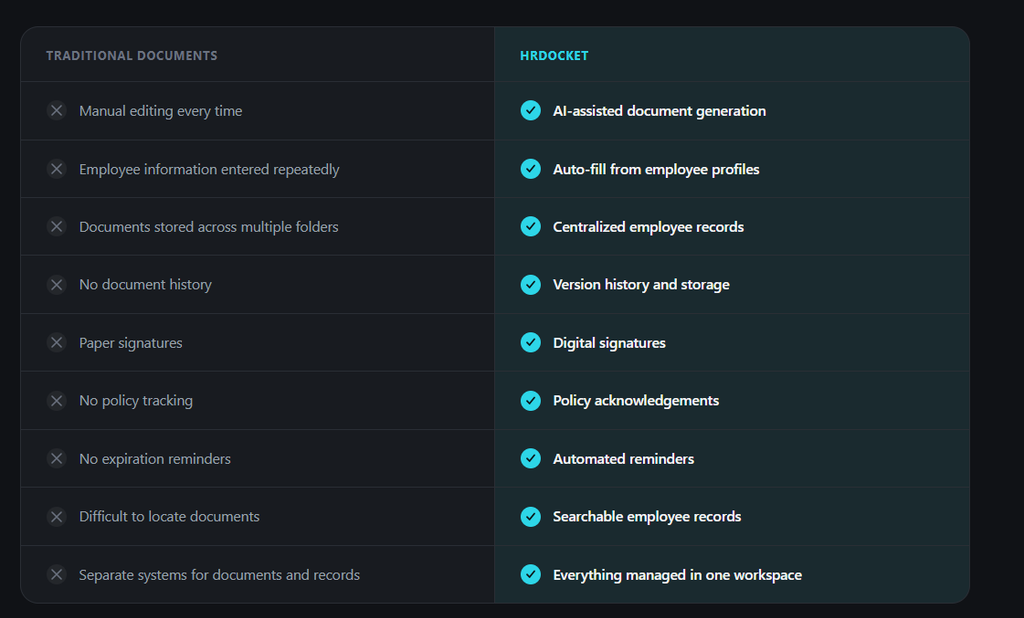
Templating and creation: This is one of the critical stages where employment contract generation software comes into play. Most small businesses still rely on old Word document templates for drafting contract letters. The traditional drafting system takes teams hours to create contract letters, which are exposed to compliance risks such as outdated clauses and copy-paste errors.
Negotiation: This stage has to do with discussing working conditions, redlining, internal reviews and version control. All the versions of the contract need to be stored in case of future disputes.
Approval and signature: At this stage, some HR teams are chasing signatures by email and storing signed copies in desktop folders or filing cabinets. However, contract management software has been made to request signatures electronically and store the final document in the right employee profile.
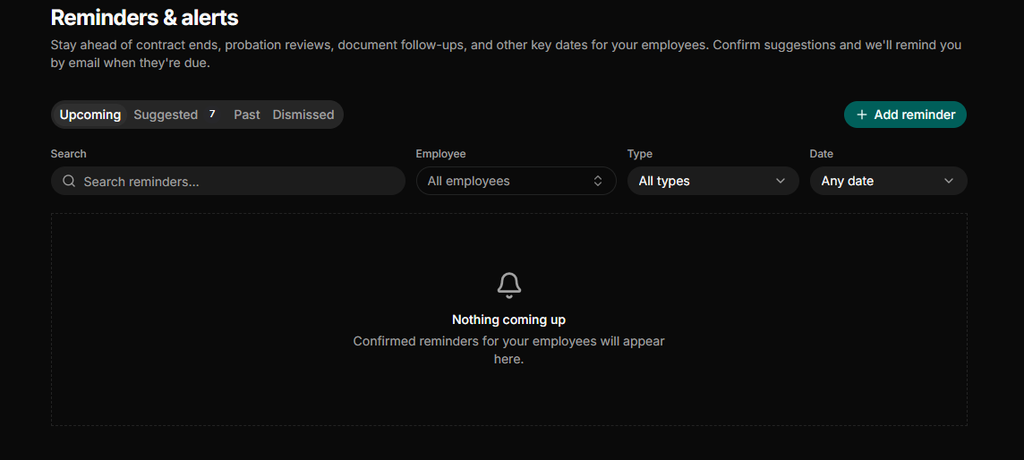
Renewal and termination: Employment contracts are time-bound. Strong platforms have expiration alerts that can remind you to review contracts that are about to expire.
Types of employment contracts
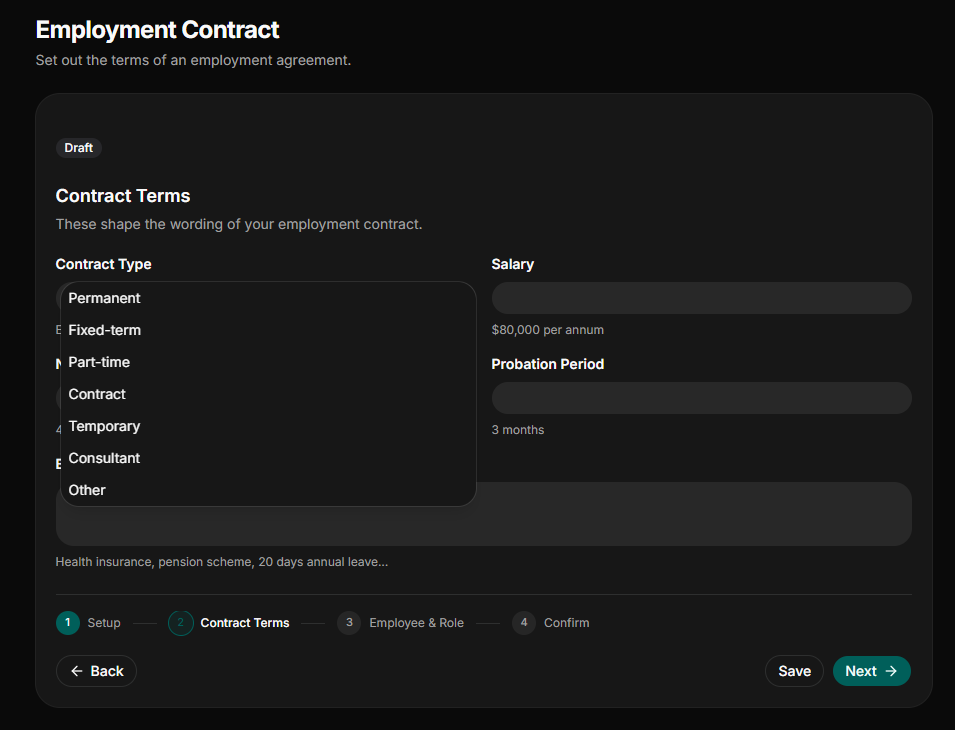
Employment contracts define the legal relationship, expectations, and financial terms between an employer and an employee. Some of the common types of contracts include
- Permanent full-time contract: This is mostly the standard employment model offering long-term job security. Full-time contracts do not have a specified end date and require the employee to work standard full-time hours. In return, employees receive full statutory benefits, including paid annual leave, health insurance and retirement contributions.
- Fixed-term agreements: Contracts under this category automatically expire on a predetermined date or upon completion.
- Part-time contracts: This is a long-term contract where employees work fewer hours than a standard full-time week. These contracts provide the same statutory protections as permanent full-time roles, but benefits, paid time off, and salaries are scaled down pro rata based on the hours worked.
- Probationary roles: These are mostly trial period clauses embedded at the start of a permanent or fixed-term contract. Probationary roles typically last 3 to 6 months and allow both parties to assess suitability.
- Temporary contracts: Short-term contracts are used to fill immediate, non-permanent gaps in a workforce. These are often managed directly by the company or through a third-party staffing agency.
- Internship agreements: These types of contracts are generally meant for students or recent graduates seeking practical work experience. They focus primarily on training and professional development.
- Seasonal contracts: A specialized form of temporary contract designed for industries with predictable, recurring peaks at certain times of the year.
Why small businesses need contract management software
Contract management platforms are important to every small and growing business. Strong platforms help to manage workflow, boost efficiency and ensure compliance. Some reasons why small and growing businesses patronize modern employment contract platforms include:
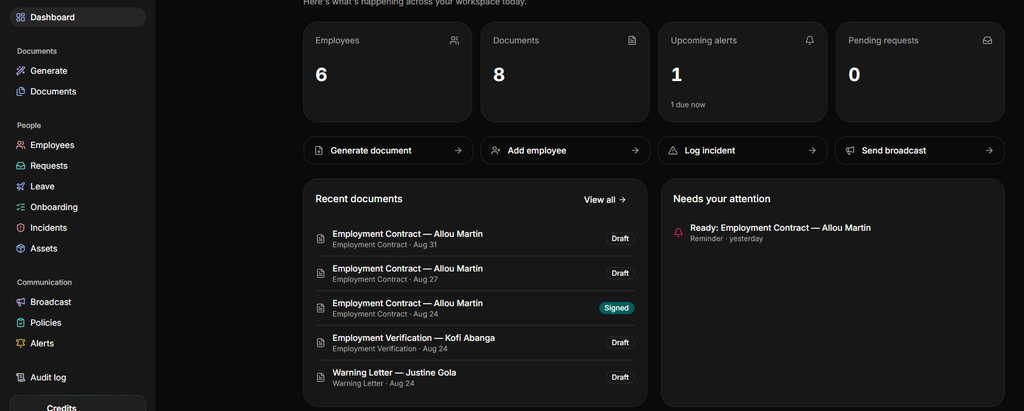
It simplifies HR workflow: The standardized AI employment contract generator simplifies contract drafting by providing AI assistance and jurisdiction-aware drafting. Strong contract management platforms reuse employee and company details where necessary and automate repetitive tasks.
It promotes self-service among employees: Contract management platforms with employee self-service portals allow HR teams to send documents for signatures and acknowledgement without chasing emails.
It reduces operational costs: Modern employment contract platforms come with capacity management tools. These tools help to allocate human resources effectively, increase productivity and minimize unnecessary expenses.
Key features every employment contract software should have
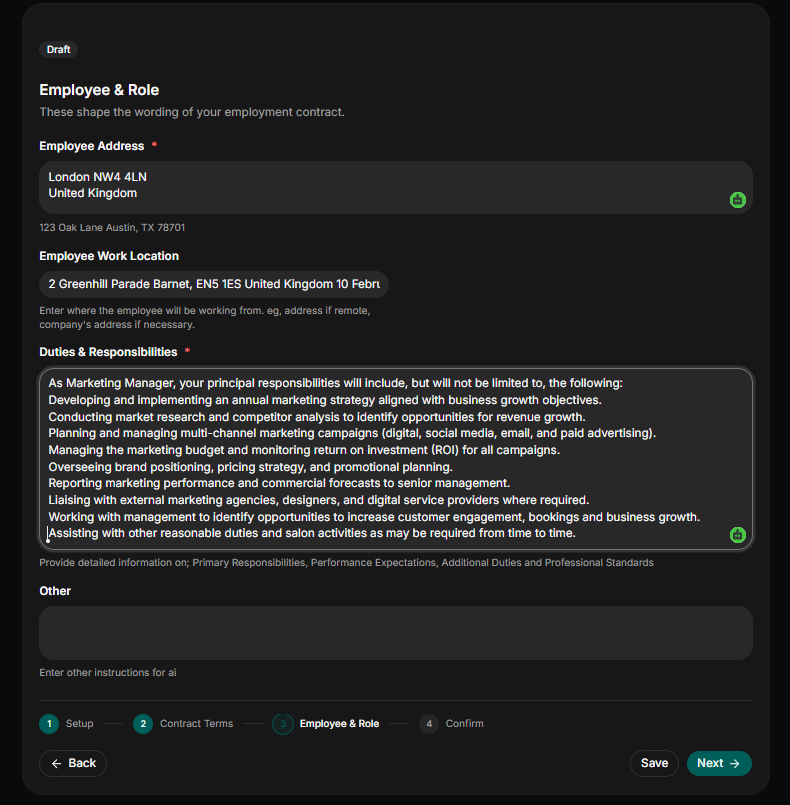
Contract generation: Small and growing businesses need platforms with the ability to create and store employment contracts electronically. Modern platforms have specialized features such as AI-assisted and jurisdiction-aware drafting to ensure that your document has the right and up-to-date employment clauses.
Approval workflow and e-signatures: The strong contract software must have built-in e-signatures. This enables HR managers and teams to sign and send contracts for signature without having to hit the print and scanner or engage a third-party software.
Reusable templates: This feature helps HR teams to create employment agreements without having to start from scratch.
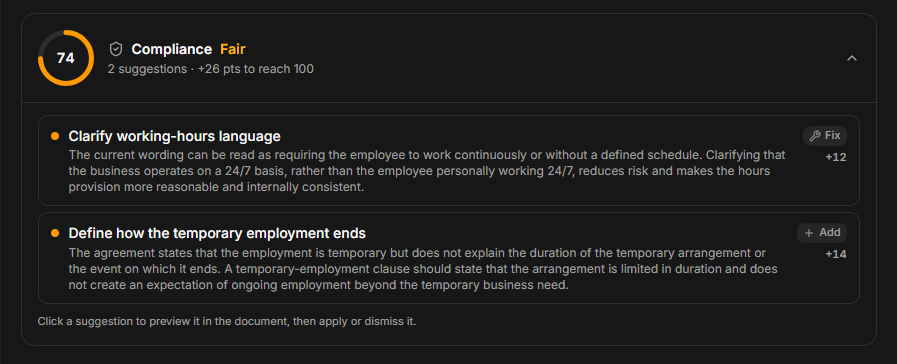
AI compliance review: Modern contract software enables HR teams to check compliance risks, such as missing clauses, outdated clauses and other deviations. They also flag non-standard terms and suggest revisions that align with legal guardrails.
Role-based access control: An Employment contract contains sensitive information and strong platforms need to define who can view such information.
Renewal reminders: You should look for platforms that have automated renewal reminders. This feature helps you track your contracts and reminds you of upcoming deadlines. It saves teams time spent on manually tracking contract deadlines through spreadsheets and emails.
Centralized employee profiles: Every contract needs to be stored in a secure location. This location is no other place than the right employee profile. Modern platforms such as HRDocket automatically file your contracts and other HR documents generated on the platform to the right employee.
Audit logs: Modern contract management platforms should have timestamped audit logs. The audit logs are to know who accessed what and when.
What an employee contract letter should contain
| Section | What It Covers |
|---|---|
| Parties & Effective Date | Legal names of employer and employee, and the date the agreement takes effect |
| Position & Duties | Job title, reporting line, and a summary of core responsibilities |
| Compensation & Benefits | Salary or wage, pay frequency, bonus structure, and benefits eligibility |
| Work Schedule & Location | Expected hours, remote/hybrid/on-site status, and worksite jurisdiction |
| Confidentiality & IP | Protection of company information and ownership of work product |
| Termination Terms | Notice periods, at-will status (where applicable), and grounds for termination |
| Governing Law | Which state or country’s employment law applies to the agreement |
| Signatures | Dated signatures from both employer and employee, ideally with an e-signature audit trail |
Top employment contract management platforms this month compared
Some organizations manage contracts on shared folders, cloud storage vaults, and filing cabinets. But these traditional contract management methods usually end up causing compliance gaps. It consumes much time when tracking and retrieving HR documents.
Some of the top HR contract management software growing businesses need include HRDocket, PandaDoc, DocuSign, Factorial, BambooHR, and Deel HR.
Comparison methodology
Each platform was evaluated against its own public product pages and published documentation. We considered features like document generation, templates, approvals, signing, employee profiles, permission, and how closely the contract workflow connects with broader HR processes. Feature claims reflect what each vendor markets for employment contract-related workflows.
HRDocket’s Employment Contract Generator
HRDocket is a purpose-built AI-powered HR document automation, employee records and compliance management platform. The platform focuses on the key areas of HR documentation that are often ignored by broader Human Resource Integration Systems (HRIS).
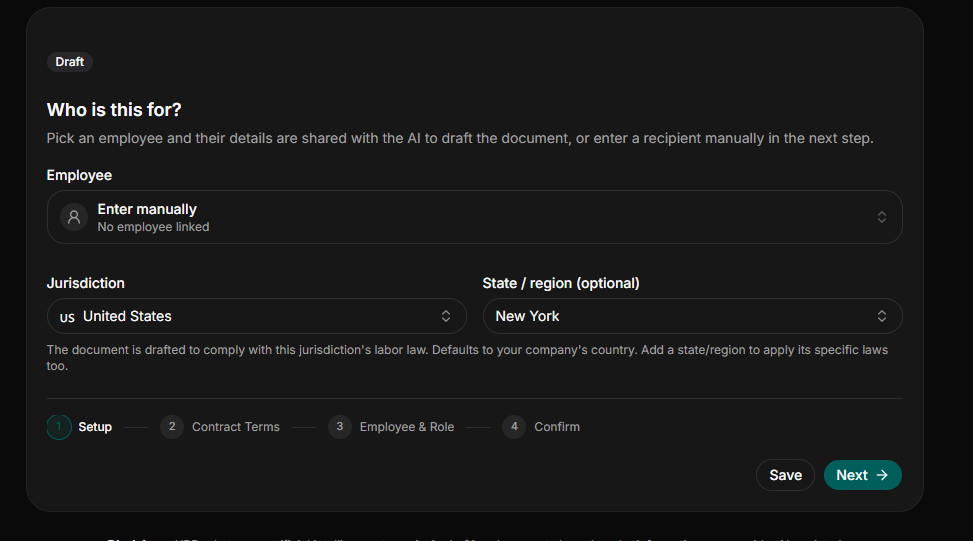
It helps HR managers and teams to generate standardized employment contracts and other HR documents using an AI assistant. With HRDocket’s employment contract generator, you can generate drafts based on your jurisdiction. The platform also has AI compliance features that flag non-standard clauses and outdated and missing compliance features.
HRDocket has an HR documentation library with over 21 AI document generators, including warning letters, performance letters, and salary increase letters. It connects the final document with the employee’s broader documentation history.
Best for: HRDocket is best for small and growing businesses that need a standardized HR document.
Key features
- AI employment contract generator
- Jurisdiction-aware drafting
- Centralized employee profiles
- Time-stamped audit trails
- E-signature
- AI compliance review
- Policy acknowledgement and tracking
Pros
- Transparent pricing
- AI-powered drafting
- Reusable templates
- Jurisdiction-aware contracts
- Version control
- Approval workflow
- Centralized employee profiles
Cons
- It does not process payroll.
- It might not be suitable for large enterprises.
- Free-plan documents are watermarked.
PandaDoc’s Contract Template
PandaDoc is a sales-focused e-signature and document automation platform. Like Oneflow, PandaDoc is not exclusively an HR contract platform. However, it has contract management features such as employment contract templates, document generation and e-signatures.
Its employment contract template includes common provisions such as duties, compensation, confidentiality, termination and signatures.
Best for: PandaDoc is best for growing businesses that need e-signatures and automated document workflows.
Key features
- Employment contract templates
- At-will employment agreements
- Compensation agreements
- E-signatures
Pros
- Employment contract templates
- Document automation
- E-signatures
- Document tracking
Cons
- Some advanced capabilities require higher plans.
- It is not built around employee records.
- Large enterprises may need HRIS.
DocuSign’s Electronic Agreement Execution
DocuSign is best known for its e-signature capabilities. It helps businesses get documents signed quickly with strong audit trails across over 180 countries. While the platform does not draft contracts, it can facilitate the signing process.
Its workflow includes electronic signatures, reusable templates, agreement storage, audit trails and integrations. It also supports bulk sending, web forms and additional workflow functionality.
Strengths
- Established electronic signature workflow
- Reusable templates
- Agreement storage
- Strong audit trails
Limitations
- It lacks contract drafting and jurisdiction checks.
- It has no employee records features.
- Not specialized in employment contract generation
Factorial’s Contract Workflow
Factorial is a full Human Resource Information System (HRIS) that handles employee contracts as part of its broader HR functionality. Its features include employee document storage, templates, e-signatures, and granular permission controls.
The platform allows HR teams to create employment contracts using customizable templates populated with employee and company details. It also provides granular document permissions enabling organizations to control access to sensitive employee documentation.
Strengths
- Comprehensive employee document management
- Seamless contract and employee onboarding workflow
- All-in-one HR platform functionality
- Integrated electronic signatures
Limitations
- Lacks jurisdiction-aware drafting and AI compliance reviews
- Requires a custom quote for tiers above entry-level pricing
BambooHR: Best for core HRIS functionality and integrated onboarding
BambooHR is a well-established HRIS for small and mid-sized businesses. The platform supports employment contracts and electronic signatures, including customizable templates that automatically populate candidate information.
Its contract-related documentation is part of a broader records and onboarding toolkit rather than a dedicated drafting engine. However, advanced e-signature and payroll capabilities are locked behind higher tiers or paid add-ons.
Strengths
- Established core HRIS with strong reporting and employee data management
- Onboarding workflows and document storage tied to the employee profile
- Centralized employee documentation alongside day-to-day HR reporting
Limitations
- Lacks AI-assisted contract drafting or jurisdiction-aware clause generation
- Rigid customization options for modifying default templates, routing logic or local workflows can feel restricted.
- Complex initial setup for global profiles, permissions, and multi-country tax or benefit compliance
Deel HR
Deel HR is a global payroll and record management platform. Its contract management software forms part of a large international hiring service. Unlike HR-optimized platforms like HRDocket, Deel does not have AI-assisted or jurisdiction-based drafting. It automates contract templates you supply and does not also flag compliance risk.
Key features
- International hiring
- Payroll and benefits administration
- Employee onboarding
- Contract and contractor management
Cons
- It is too complex for small businesses.
- Less focused on general HR documentation
- Too expensive for small businesses
Features by feature comparison of top contract management platforms
| Feature | HRDocket | PandaDoc | DocuSign | Factorial | BambooHR | Deel |
| Best fit | HR documentation and employee records | Document workflows | eSignatures | HRIS + documents | HRIS | Global employment |
| Employment contract creation | Yes | Yes | Templates/workflows | Yes | Yes | Yes |
| Employment contract automation | Yes | Yes | Yes | Yes | Yes | Yes |
| Employment contract templates | Yes | Yes | Yes | Yes | Yes | Yes |
| Electronic signatures | Yes | Yes | Yes | Yes | Yes | Yes |
| Employee document storage | Yes | Yes | Yes | Yes | Yes | Yes |
| Employee records | Yes | HR document workflow | Agreement-focused | Yes | Yes | Yes |
| HR document generation | Yes | Yes | Limited | Yes | Some | Yes |
| Policy acknowledgement | Yes | Yes | Workflow-dependent | Yes | Yes | Yes |
| Expiration reminders | Yes | Workflow-dependent | Workflow-dependent | Yes | Yes | Yes |
| Incident documentation | Yes | No dedicated HR incident system | No | HR platform-dependent | HR platform-dependent | HRIS-dependent |
| Custom HR document builder | Yes | Templates | Templates | Templates | Templates | Templates |
| Global employment/EOR | No | No | No | Limited | Via integrations/products | Yes |
Price comparison
| Platform | Free Plan | Entry Paid Price | Pricing Model |
| HRDocket | Yes | $19/month (Starter, 15 employees; $15.83/month billed annually) | Flat tier by employee count + AI credits |
| PandaDoc | Yes, e-signature only | $19/user/mo annual ($35 monthly) | Per seat + paid add-ons |
| DocuSign | No | $11/month (Personal, 1 user, 5 envelopes/month) | Per plan + per-envelope limits |
| Factorial | No (free trial only) | $8/employee/month (Core) | Per employee; higher tiers custom-quoted |
| BambooHR | No | $10/employee/month (Core); $250/month flat for 25 or fewer employees | Per employee, tiered |
| Deel | Yes | $49/contractor/month (Contractors); $599/employee/month (EOR) | Modular, per product |
Which employment contract software is the right platform for your business
- Choose HRDocket if you need standardized HR documentation, employee records, and workplace compliance management.
- Choose PandaDoc if you need flexible document creation and electronic signatures.
- Choose DocuSign if you need e-signatures on documents your team already drafts and you have no interest in contract generation.
- Choose Factorial or BambooHR if you prefer to contract as one module inside a larger, full-featured HRIS with time tracking and performance management.
- Choose Deel HR if you want to hire and manage employees or contractors across borders.
Frequently Asked Questions
What is employment contract management software?
A contract management platform helps organizations to create, sign, track, and store contract agreements in a centralized system. Modern platforms replace manual contract drafting and signing with a digitalized, searchable, and centralized workflow.
How does an AI employment contract generator work?
An AI-powered contract generator uses employee and role details entered into guided fields to generate a complete contract draft. Purpose-built platforms like HRDocket use jurisdiction-aware drafting and an AI compliance checker to ensure that employment clauses are based on the right jurisdiction.
Are AI-generated employment contracts legally binding?
AI-generated contracts can be legally binding once properly signed. The organisation still remains responsible for reviewing content before sending.
Do I still need a lawyer if I use contract management software?
A strong employment contract generator can cover most of the drafting and formatting work. However, complex situations such as multi-jurisdiction hiring and disputes require a legal review regardless of the platform used.
Can contract management platforms track contract renewals and expirations?
Modern contract software like HRDocket, Oneflow and Juro can track contract renewals with automated reminders.
Start generating HR documents today
Every generator is included on every plan. Add the essentials, review the draft, and keep the final document linked to your HR records.
Free plan available · No setup fees · Cancel anytime