
Business policies are essential because they set clear rules to help organisations with legal and compliance risks. They also help organisations navigate the complexities of HR compliance, regulatory change and updates across departments.
Manually distributing and tracking policies can lead to compliance risks, inconsistent enforcement, and wasted time. Policy Acknowledgement software helps businesses avoid these problems. These platforms assist in drafting, collecting employee acknowledgement, managing policy versions and maintaining auditable records.
The internet is flooded with many policy management platforms. Some are enterprise-level policy governance, while others are also primarily designed for employee handbooks. However, HR-focused platforms like HRDocket ensure that policy management connects with employee records and broader HR documentation.
In this guide, we compare features of some of the best policy management platforms. We will consider their capabilities, version tracking, document management, strengths, limitations and pricing.
Best policy acknowledgement software at a glance
| Software | Best for | Audit Trails and Reporting | Employee records | HR documentation | Pricing |
| HRDocket | Growing HR teams | Real-time, audit-ready acknowledgement logs with exportable reports | ✓ | ✓ | $19/month (Transparent pricing tiers) |
| Folderit | General document management | Standard document activity logs | — | ✓ | Custom pricing |
| AirMason | Employee handbooks | Basic acknowledgement tracking | — | Limited | $149/month |
| DocTract | Enterprise policy governance | Goverance grade audit trails | — | Limited | Custom pricing |
| PowerDMS | Policy and training workflows | Accreditation-focused audit trails | — | Limited | Custom pricing |
| Sprinto | Security and compliance | Compliance reporting | — | Limited | Custom pricing |
| Mitratech | Enterprise policy governance | Enterprise-grade audit and reporting | — | Limited | Custom pricing |
What is Policy Acknowledgement Software?
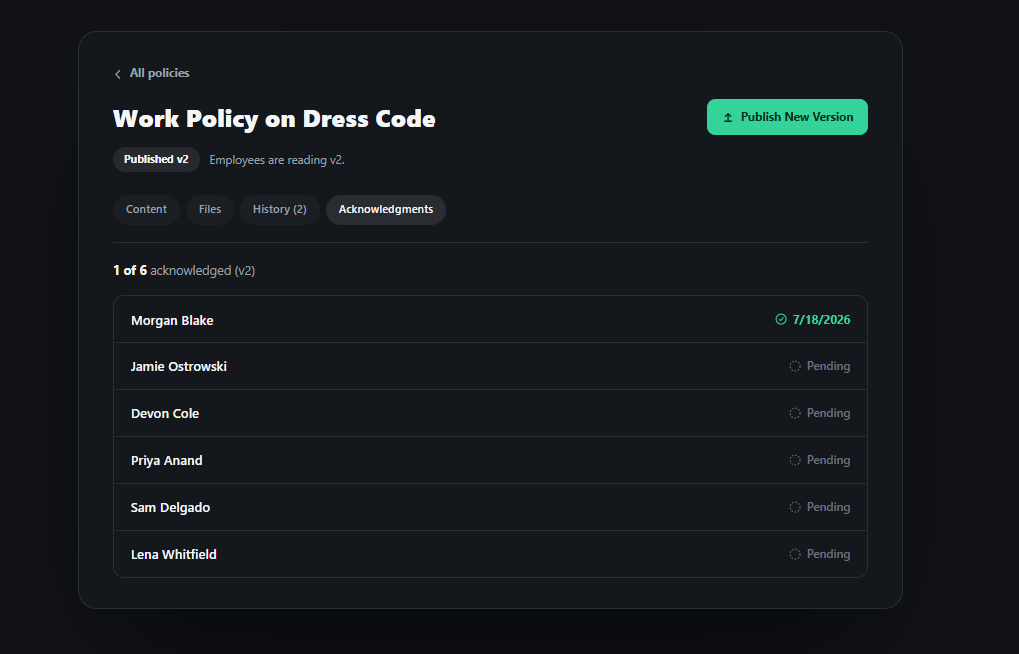
Policy acknowledgement software is a platform that helps organisations distribute workplace policies to employees and collects timestamped employee signatures to prove compliance. Modern platforms also record whether employees have received and acknowledged them.
These platforms help HR departments, especially remote and hybrid teams, distribute and acknowledge policies without relying on printed handbooks or email confirmations.
Manual policy management creates several problems, including:
Employees acknowledging the wrong version: Employment and labour laws change all the time, and these changes must also be reflected in business policies. Manual policy management usually does not have version control and this can lead to employees signing the wrong version.
Policy update issues: Organisations that are still managing policies through printouts, digital files, emails, and shared drives; policy updates create additional administrative work. Every significant update requires a new distribution campaign and acknowledgement.
Difficulty in retrieving acknowledged policies: HR teams may find it difficult to track policy acknowledgement when policies are managed in email threads or spreadsheets.
Disconnected HR documentation: Policy acknowledgement should be part of the employee records. However, manual policy management disconnects them from the employee records by storing them in separate folders or file cabinets.
Difficulty identifying outstanding acknowledgements: HR teams may struggle to determine who has completed the process if acknowledgements are recorded in email threads or spreadsheets.
Why small businesses need policy tracking software
| Manual problem | Business impact | How software helps |
| Wrong policy version | Compliance risk | Version control |
| Missed acknowledgements | No proof of receipt | Automated tracking |
| Email-based records | Difficult retrieval | Centralised records |
| Paper sign-offs | Administrative burden | E-signatures |
| Scattered employee records | Poor visibility | Employee profiles |
Key features to look for in policy acknowledgement software
These are some of the key features you need to evaluate before choosing a policy management platform.
| Capability | Why it matters |
| Policy distribution | This feature ensures policies reach the right employees. Modern platforms like HRDocket allow you to send policies to all employees at once or to specific employees, statuses or departments. |
| Employee acknowledgement | Policy management platform should also track acknowledgement. This creates evidence that employees completed the sign-off. |
| Version control | Shows which policy version was acknowledged. Strong keeps the various policy versions for future preference. |
| Automated reminders | Reduces manual follow-up. Automated reminders let you schedule policy distribution time. It also allows you to set a reminder as to when to track acknowledgement. |
| Policy history | Preserves previous versions and changes. |
| Audit trail | Creates accountability around policy activity. Strong platforms like HRDocket keep timestamped audit logs of policy distributions and updates. |
| Employee portal | Let employees access policies themselves. This feature allows HR teams to send policies directly to the employee portal when they can read and acknowledge them. The employee eliminates the risk of the employee missing due to manual distribution errors, such as wrong emails. |
| Digital signatures | Removes paper-based sign-off. Platforms with built-in e-signatures allow employees to acknowledge policies directly from their portals without needing third-party software. |
| Employee records | A platform with centralised employee profiles connects policy activity to the employee records. This makes it easier and faster to find documents. |
| Access controls | Strong policy management platforms protect confidential HR information using role-based access control and other secured means. |
| HR document management | Keeps related documentation together. In additional to policy management, HR-focused platforms feature document management tools such as AI-powered document generators, employee records management and workplace incident records. |
Best policy management software this year
The best platform depends on the policy management capabilities your organisation values most. The top seven policy management platforms this year include HRDocket, AirMason, Folderit, Mitratech, Sprinto, PowerDMS, and DocTract.
We selected these platforms based on policy distribution, acknowledgement tracking, version control, auditability, employee access, integrations, HR documentation capabilities, pricing transparency, and suitability for different business sizes.
HRDocket: Best Policy Acknowledgement Software for HR Documentation
HRDocket is an AI-powered HR documentation software purpose-built to help businesses create, sign, manage, and organize HR documents and employee records throughout the employment cycle. Its policy management features allow businesses to publish policies digitally, request acknowledgement, and maintain timestamped audit logs.
The platform treats policy management as part of a large HR documentation system. In addition to policy management, HR teams can create over 21 standardized HR documents from hiring to offboarding, including employee handbooks, offer letters, employee contracts, warning letters and more. With HRDocket, you can also manage employee leave records, company asset assignment and tracking, and workplace incidents.
Best for: HRDocket is best for small and growing businesses that want policy management, connecting with employee records and broader HR documentation.
Key features
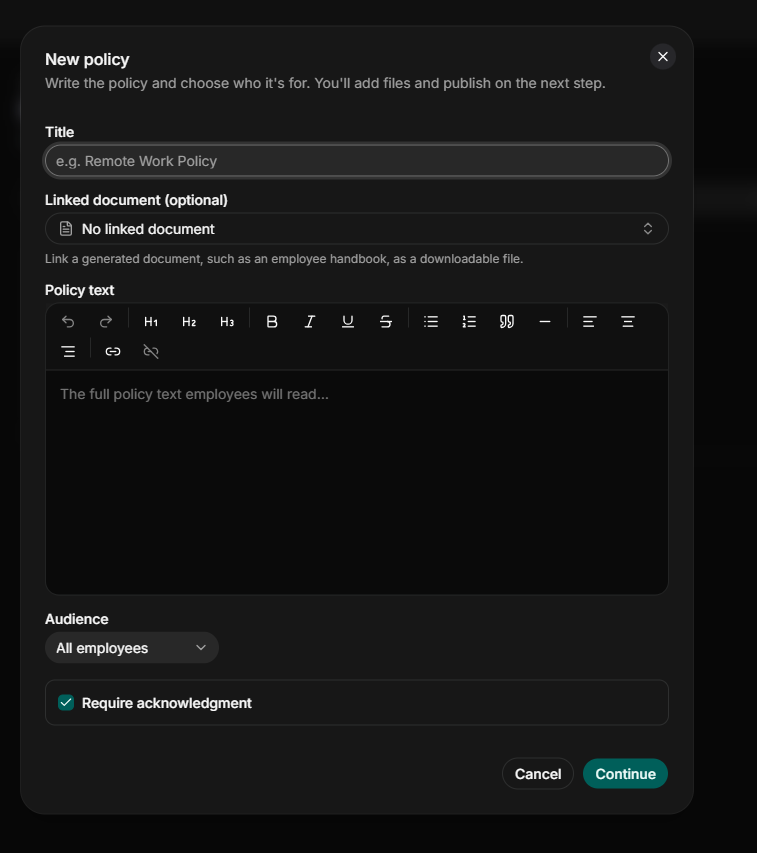
Publishing digital policies: HRDocket allows all HR teams to publish company policies such as employee handbooks, codes of conduct, remote work policies, confidentiality policies, and many more.
Employee policy sign-off: HRDocket’s employee portal helps employees to receive and acknowledge policies. It also allows them to review selected employment documents and information and complete HR requests digitally.
Policy acknowledgement tracking: The platform helps HR teams to determine whether employees have completed the required acknowledgement. It helps to ensure that employees acknowledge mandatory policies and updates.
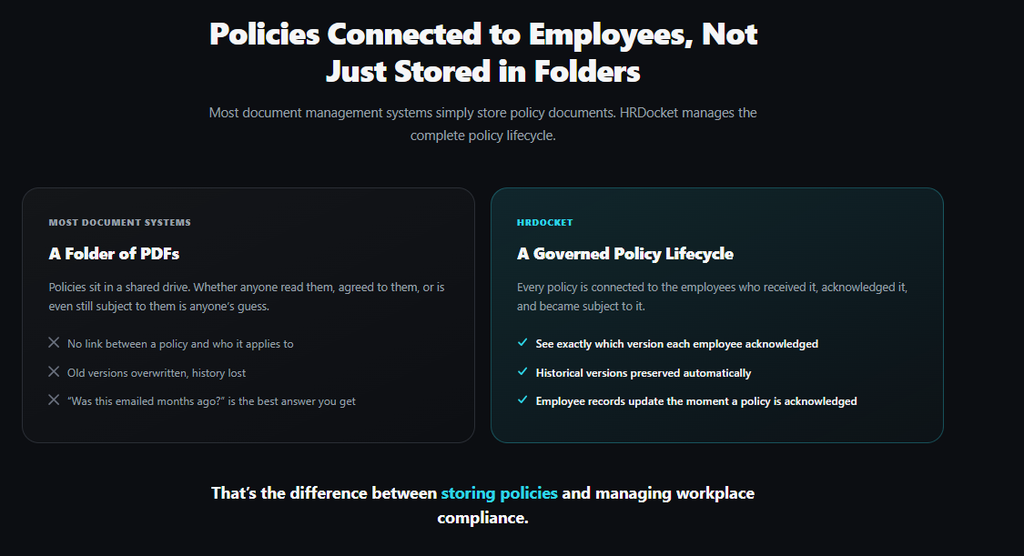
Policy version history: The platform distinguishes the latest policy from the previous one by maintaining a clear version history.
Electronic signatures: HRDocket has built-in e-signatures that allow employees to acknowledge policies without leaving the platform. This feature eliminates printing, manually signing and scanning HR documents.
Centralised employee records: HRDocket auto-files all employee documents to a centralized employee profile. A centralized employee profile serves as a single source of truth for the employee. It contains employee details, employment information, generated documents, signed agreements, assigned assets, leave records, and other supporting documents
Pros
- Creating and publishing company policies
- Employee handbook generation
- Policy tracking
- Policy version history
- Employee policy sign-off
- E-signatures
- AI HR document generation
Cons
- It might not be suitable for large enterprises
- It is HR documentation-focused
AirMasion: Best for Digital employee Handbooks
AirMason helps HR teams to design and publish employee handbooks with built-in policy acknowledgement features.
Its visual handbook builder makes it easy to produce professional and branded employee handbooks. The platform is less focused on policy acknowledgement tracking and broader HR document workflows.
Best for: AirMason is best for creating, publishing and managing digital employee handbooks.
Key features
- Employee handbook generation
- E-signatures
- HRIS and SSO Integrations
- Employee self-service portal
Pros
- Employee-friendly interface
- Employee handbook customization
- Electronic handbook signing
- Policy communication
Cons
- More focused on employee handbook creation
- It might be too complex for small businesses
- Lacks transparent pricing
Folderit: Best for general document management
Folderit is a document management system with e-signature capability. Unlike HRDocket, Folderit is not a dedicated policy acknowledgement platform.
It covers approval workflows, acknowledgement workflows, version control, retention automation, audit trails and e-signatures.
Best for: Folderit is best for organizations looking for document management rather than specialised policy tracking.
Key features
- Multi-stage approval workflows
- Acknowledgement tracking
- Version control documentation
- Retention automation
- Audit trails
- Built-in e-signatures
Pros
- Centralised document management
- File organisation
- Access control
- Sharing capabilities
Cons
- Not primarily an HR policy acknowledgement platform
- Lack transparent pricing
- Less employee-centred
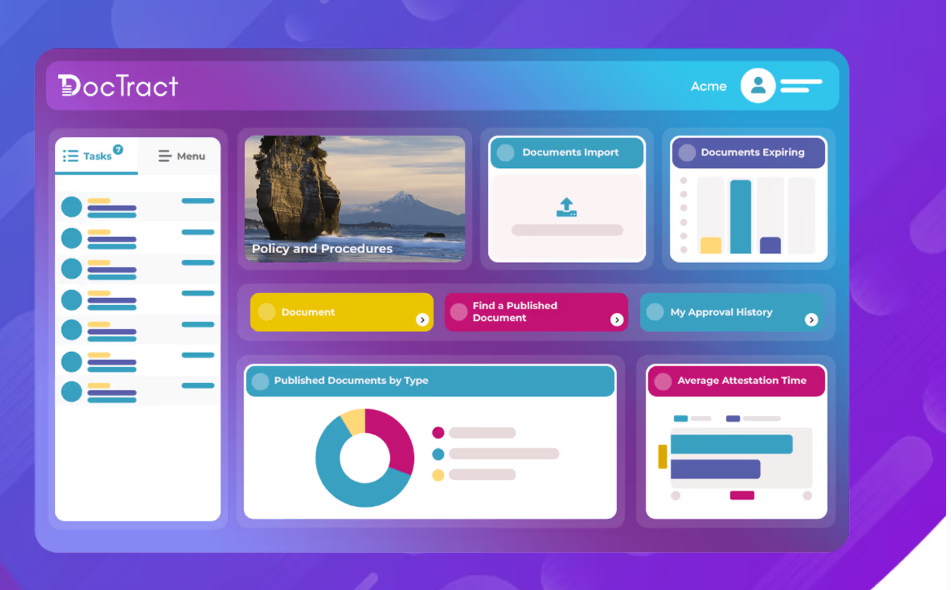
DocTract: Best for Enterprise Policy Governance
DocTract is a cloud-based policy management platform that focuses heavily on policy and procedure management. The platform supports policy distribution, acknowledgement, attestation tracking, version control and audit reporting.
It allows organisations to target specific employees, groups, or roles for relevant policy distribution and tracking. DocTract’s AI adds intelligent search, automated policy drafting assistance and clause identification.
Best for: DocTract is best for policy governance, compliance and auditability.
Key strengths
- AI document analysis
- Audit-ready reporting
- Native document editing
- Role-based workflow
- Attestation tracking and reporting
- Policy distribution and tracking
Limitations
- DocTract is a standalone SaaS platform.
- Overkill for small businesses
- Less focused on employee lifecycle documentation
PowerDMS: Best for Policy and Training Management
PowerDMS is policy management software specifically designed for public safety organisations, including law enforcement, corrections, fire and EMS, emergency communication and management. The platform provides centralised policy management, version control, acknowledgement tracking, review workflows and audit trails.
Unlike HR-focused platforms, PowerDMS connects policy management with accreditation standards management and training.
Best for: It is best for government agencies and healthcare organisations that require accreditation.
Pros
- Accreditation management
- Policy acknowledgement
- Version control and comparison
Cons
- It might not be suitable for small businesses.
- It is not centered on general employee management.
- It can be too expensive for small and growing businesses.
Sprinto: Best for security and compliance policies
Sprinto is a compliance automation platform for governance, risk, and policy management. The platform’s automated compliance workflow connects to policy acknowledgement certification and audit requirements.
It allows organisations to create or import policies, maintain version history, assign ownership, and manage views and approvals. It also supports helping organisations to track approvals and acceptance status.
Best for: Sprinto is best for tech organisations that need security compliance frameworks.
Key strengths
- Strong compliance orientation
- Policy version control
- Acknowledgement tracking
- Automated reminders
- Audit trails
Limitations
- It is too complex for small businesses
- Lacks transparent pricing
- It is less focused on the employee documentation lifecycle
Mitratech: Best for Enterprise Policy Management
Mitratech is designed for automated and streamlined policy distribution, attestation, tracking and reporting. The platform offers an enterprise-level legal and compliance suite with strong reporting infrastructure.
Best for: Mitratech is best for large organisations with sophisticated governance, compliance and policy management.
Pros
- Enter policy management.
- Policy distribution
- Governance-orientated workflows
- Audit trails
Cons
- It is not suitable for small businesses focusing on HR documentation.
- It lacks transparent pricing.
- It is more focused on policy management rather than employee documentation.
Feature-by-feature comparison
| Feature | HRDocket | AirMason | DocTract | PowerDMS | Sprinto | Folderit | Mitratech |
| Policy management | ✓ | ✓ | ✓ | ✓ | ✓ | ✓ | ✓ |
| Employee acknowledgement | ✓ | ✓ | ✓ | ✓ | ✓ | ✓ | ✓ |
| Employee policy sign-off | ✓ | ✓ | ✓ | ✓ | ✓ | ✓ | ✓ |
| Version control | ✓ | ✓ | ✓ | ✓ | ✓ | ✓ | ✓ |
| Policy history | ✓ | ✓ | ✓ | ✓ | ✓ | ✓ | ✓ |
| Automated reminders | ✓ | ✓ | ✓ | ✓ | ✓ | ✓ | ✓ |
| Employee portal | ✓ | ✓ | — | ✓ | ✓ | — | — |
| Employee records | ✓ | — | — | — | — | — | — |
| HR document generation | ✓ | — | — | — | — | — | — |
| Electronic signatures | ✓ | ✓ | ✓ | ✓ | ✓ | ✓ | ✓ |
| Incident documentation | ✓ | — | — | — | — | — | — |
| Asset management | ✓ | — | — | — | — | — | — |
| HR lifecycle documentation | ✓ | Limited | Limited | Limited | Limited | Limited | Limited |
Price comparison
Policy management pricing varies across various platforms. Some vendors offer plans, while others use custom pricing based on employee count, policy volume, integrations, compliance requirements, and implementation services.
| Software | Free Plan | Starting price | Enterprise | Pricing Model | Best pricing fit |
|---|---|---|---|---|---|
| HRDocket | Yes | Pricing starts from $19/month. Billed annually ($190) · 2 months free | $99/month Billed annually ($990) · 2 months free | Subscription / plan-based | Growing businesses that want multiple HR documentation tools in one platform |
| AirMason | Trail available on request | $149 per month $999/year | Enterprise-grade, custom-tailored for global organizations | Quote-based | Companies focused on digital handbooks |
| DocTract | No | $5 per user/month for standard | Custom | Quote-based | Enterprises with complex policy governance |
| PowerDMS | No | Custom quote | Custom quote | Quote-based | Public safety and regulated organizations |
| Sprinto | No | Custom quote | Custom quote | Subscription/quote-based | Technology companies managing security compliance |
| Folderit | Free trail | $52/month for 5 users | Custom tailored for larger organisations | subscription | Businesses needing general document management |
| Mitratech | No | Custom quote | Custom quote | Quote-based | Large enterprises with governance requirements |
How to choose the right policy management software
In order to select the best policy management platform for your organization, you need to first assess your organization’s compliance and team capacity. For small and growing businesses balancing HR documentation and employee records management, HRDocket offers unified policy management and HR document automation in one secured platform.
It is also important to evaluate user experience and pricing.
- Choose HRDocket if you want policy management to be part of a broader HR documentation workflow.
- Choose Folderit if your main goal is centralized document management.
- Choose AirMason if your primary goal is the creation and distribution of a modern employee handbook
- Choose DocTract if you want sophisticated policy governance, attestation and audit reporting.
- Choose PowerDMS if you operate a public safety organization.
- Choosing Sprinto is your primary concern, which is the security compliance framework
- Choose Mitratech if you need enterprise-level policy governance and compliance management.
Why HRDocket stands out as the best HR policy management software for small and growing businesses
HRDocket connects policy management to employee document workflow, such as onboarding paperwork, contracts, and performance records. This helps HR teams to obtain complete and audit-ready policy documentation.
Platforms like AirMason and Folderit track sign-offs inside their own app. This implies that HR teams still have to link these records to employee profiles. Enterprise suites like PowerDMS and Mitratech are too complex and expensive for small and growing businesses.
Frequently Asked Questions
What is policy acknowledgement software?
Policy acknowledgement software is a platform that helps businesses publish and track policies. The modern platform replaces manual policy management processes with timestamped, audit-ready logs, automated reminders and version control.
Why should businesses track policy acknowledgement?
Tracking company policies gives HR teams records of distributed policies and employees who signed off. It makes it easier to identify outstanding acknowledgements.
Can employees sign company policies electronically?
Modern policy management platforms allow employees to sign policies directly in their employee portals. These acknowledged policies form part of the employee’s employment history.
Can policy management platforms track different policy versions?
Dedicated policy management platforms can track versions through version control. This allows organisations to maintain a history of policy change and determine which version is current.
How much does policy management cost?
Policy management pricing varies across various platforms and markets. The HR-focused platform provides policy management as part of a broader HR documentation package and pricing starts from $19 per month (flat). Platforms like Folderit offer subscription-based pricing, while DocTract, PowerDMS, and Mitratech generally require custom quotes.
Every document becomes part of the employee’s permanent record
Spend less time buried in HR paperwork and more time growing your business. Generate documents, organize employee records, and simplify HR operations; all from one place.
No credit card required · Cancel anytime · Set up in under 5 minutes