What the NAACP vs EEOC Lawsuit Means for Your HR Documentation Strategy

Corporate data privacy as we know it is undergoing a fundamental transformation that every scaling business must acknowledge. For decades, organizations have treated their equal employment opportunity filings as confidential snapshots intended strictly for government oversight.
The prevailing assumption was that workforce diversity metrics and demographic breakdowns were shielded from the public eye. That traditional shield is currently being dismantled in a federal courtroom.
The NAACP has recently initiated a lawsuit against the Equal Employment Opportunity Commission regarding the public disclosure of diversity data from federal contractors. This litigation argues that the government is unlawfully withholding vital information that would allow the public to evaluate whether businesses are meeting their obligations for equal opportunity. This specific case regarding demographic data is a signal to every scaling business that workforce information is no longer a private internal matter.
Draft Free warning Letter
What am I saying? In short, transparency is shifting from a passive corporate choice into an active operational liability. For the modern people operations leader, this means the era of treating paperwork as a disconnected, secondary chore is over. We are entering a period where public data access can either be a strategic tool or a significant legal trap. When external organizations demand to see your workforce patterns, your defense does not live in your good intentions—it lives entirely inside your archive. The goal of automating this workflow is to clear out the administrative chaos before the public numbers start speaking for themselves.

The Legal Conflict: Transparency vs. Trade Secrets
The core of the legal battle involves a clash between the public right to information and the corporate desire for confidentiality. The NAACP argues that the commission is preventing the public from assessing whether federal contractors are fulfilling their equal employment opportunity obligations. A critical quote from the litigation states: “The public has a right to know how federal contractors are performing when it comes to diversity and inclusion.”
Historically, the commission has protected these records by citing specific legal exemptions. One primary defense involves an exemption meant to safeguard trade secrets and confidential financial information. As your strategic advisor, I see a utility trap in this legal posture.
Companies often attempt to argue that diversity data is a trade secret to avoid public scrutiny. However, if the NAACP wins this lawsuit, hiding behind such exemptions will no longer be a viable strategy for organizations.
You cannot manage what you do not document, and you cannot defend what you cannot prove. The shift from flat, disconnected PDF templates to intelligent document management is no longer a luxury.
It is now essential for organizations to move away from scattered spreadsheets and build an airtight, compliant filing infrastructure. The goal is to move beyond simple document generation toward a state where every record is legally aware and geographically fit.

The Operational Risk - When the Numbers Speak for Themselves
The operational risk of this transition is significant for small and medium businesses that lack structured systems. When workforce numbers become public, they often speak for themselves without the benefit of context. A snapshot of a company with low diversity in a specific department might look like systemic bias even if the underlying processes were fair.
This is the danger of the naked number. If an audit occurs because of these public metrics, your only defense is the chronological timeline of your documentation. Most small businesses currently manage their hiring and promotions through a messy web of shared drives and email threads.
This fragmented approach creates compliance debt that compounds over time. Inconsistency in how attendance issues, conduct problems, or promotions get documented is an operational nuisance that creates liability.
When one manager writes a careful letter and another sends a one-sentence note, you do not have a disciplinary record. You have a patchwork that is very hard to defend if an employee argues they were treated differently than their colleagues.
This inconsistency is what regulators and legal challengers look for during an investigation. Poor and inconsistent documents can cost a company millions in a court of law. Fair documentation must be direct, firm, and completely unambiguous about consequences while remaining factually grounded.
The HRDocket Solution - Building a Defensible Record
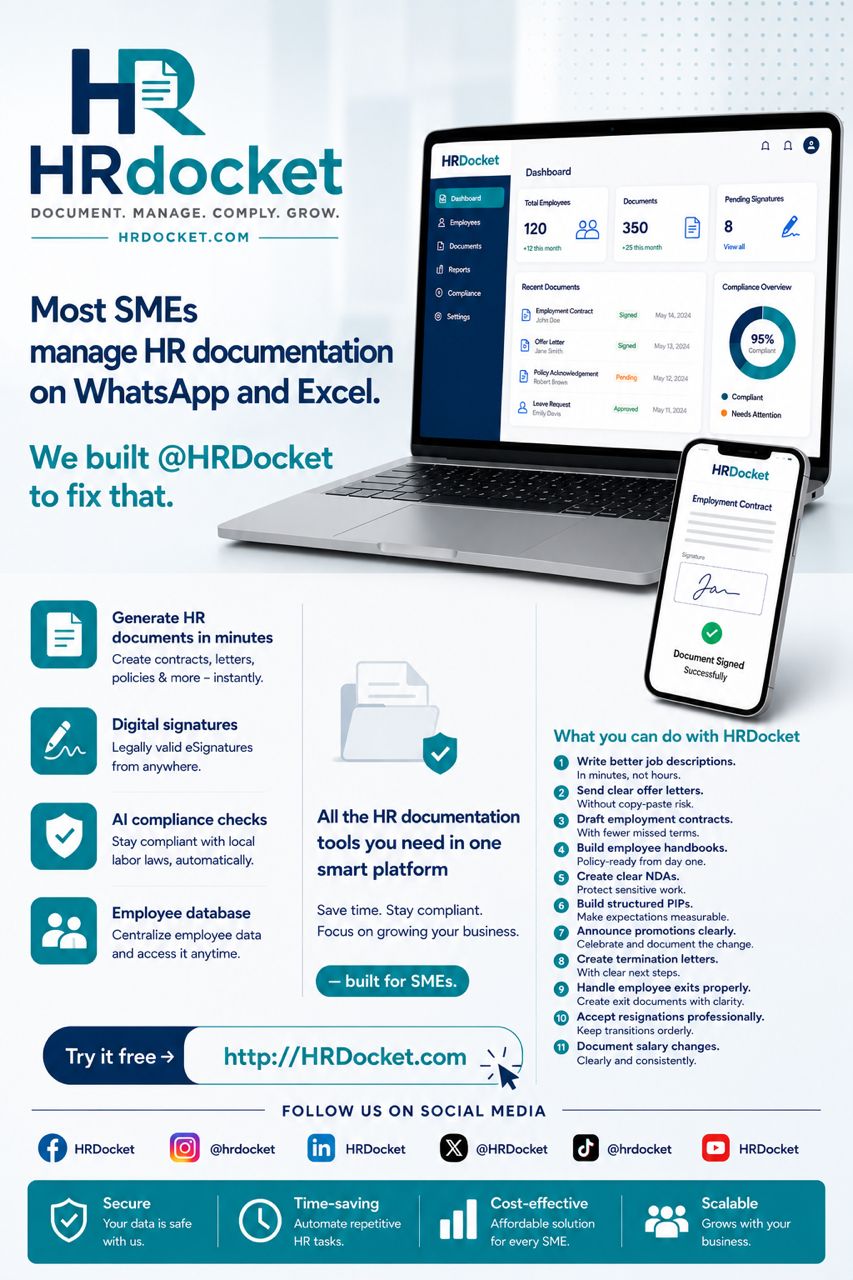
When workforce data becomes public, your digital employee file becomes your primary legal instrument. HRDocket was designed as a solution to this exact kind of administrative chaos. It transforms the process from a manual burden into an intelligent command center that acts as a compliance shield. The platform moves beyond the simple creation of documents to focus on centralizing intelligence around the workforce.
1. Outcome-Focused Documentation
Outcome-focused documentation is the first pillar of this solution. HRDocket is built to absorb policy nuance so that your company does not fall into a legal trap. If your diversity data is questioned, you must be able to produce job descriptions that were compliance-aware and promotion letters that document the reasons behind every change. The job description generator ensures that every posting is role-ready, inclusive, and aligned to policy. This prevents the wishlist problem where job descriptions become unrealistic and exclusionary.
2. The AI Risk-Aware Review System
The second pillar is the AI risk-aware review system. This feature acts as a second pair of legal eyes that scans every draft to flag inconsistent clauses, missing fields, and policy gaps. It specifically detects template drift, which happens when businesses reuse outdated Word documents that have lost critical legal clauses over time. This check ensures that every document you ship matches the latest standards and is geographically fit.
3. Audit-Grade Tracking & Centralized Employee Files
The third pillar is audit-grade tracking and the centralized digital employee file. Every generated draft and signed copy is automatically organized under the right employee profile. This transforms the system into a structured HR file manager that saves you during lawsuits or audits. You can pull out one employee record and disclose all documents linked to them in seconds. This is invaluable for documenting a disciplinary and termination trail that protects your business from administrative slip-ups.
Check why we are the Pandadoc Alternative
Is Transparency a Threat or a Tool?
Transparency is a threat only to businesses with poor documentation. If your hiring workflow is signature-ready and your policies are moved out of scattered documents into one clear source, transparency becomes a tool for proving professional standards. While the NAACP seeks accountability, businesses fear that uncontextualized data will be weaponized. The balanced take is that organizations must move from reactive panic to proactive management.
For a scaling people team, the focus should be on utility over variety. You should avoid bloatware products that assume a large company hierarchy and instead focus on high-frequency features that provide daily value. These include centralized digital files, simple leave management, and automated onboarding checklists. By standardizing core employment terms as teams grow across departments, you ensure that your documentation remains consistent and defensible.
Managing contractor misclassification is another area where transparency increases risk. Regulators use an economic reality test to determine if a worker is a contractor or a de facto employee. Proof of a correct relationship lives in the documents created before the work ever started. A well-built freelance contract is an active legal instrument that establishes the nature of the relationship and defines its boundaries. HRDocket helps keep these agreements airtight by guiding users through simple prompts to capture project scope and payment terms.
Conclusion
The litigation between the NAACP and the EEOC serves as a loud wake-up call for the modern business landscape. It proves that tracking employee metrics via memory, scattered text strings, or unverified desktop files is an unnecessary gamble. When the ground rules of data privacy shift, your administrative backend must adapt just as fast to keep your team protected.
Scaling operations require a centralized workspace that handles the heavy lifting of compliance tracking automatically. By moving your records into an organized environment, managers can finally stop wrestling with formatting layouts and spend their energy on the actual human work of coaching and growth. Don't wait for an official data request or an unexpected audit to find out your documentation has critical gaps or missing clauses.
If you want to look deeper into building an airtight layout for your personnel files, analyzing our specialized breakdown of the 10 Best Document Automation Software Solutions for Scaling People Teams will help you map out your overarching operational workflows.
Take Control of Your Records
True compliance is about being prepared long before a dispute or investigation ever targets your company. Start building your single source of truth now so that your organizational records remain a secure corporate asset. Visit HRDocket today to generate your first document and experience how a unified, intelligent command center can transform your day-to-day operations for free. For companies looking to manage complex data-merging tasks alongside their core filing setups, exploring the advanced external routing pipelines over at HR Docket's NDA can help streamline your wider database integrations.