From Verbal "Yes" to Signed "Welcome": How to Stop Losing Candidates to Slow Paperwork
Getting the top candidate to accept your offer can be a bit more difficult than expected. And slow paperwork makes it even worse. Most candidates received more than one offer letter before deciding which organization to join. Therefore, receiving a verbal response does not guarantee that your favorite candidate will join the team.
Draft Offer Letter for Free
The gap between a verbal yes and a professional offer letter is where most top candidates slip away. Due to workflow pressure, some hiring managers might end up sending letters with mistakes, such as a missing benefits paragraph, incorrect candidate information, and others, which lead to a decline.
Organizations also lose great talent to competitors day in and day out because their hiring workflow breaks down at the exact moment speed matters most. To speed up your onboarding process, HR Docket has developed a faster, cleaner, and signature-ready way to send a professional offer letter without the risk of copy-paste.
Why organizations lose top candidates after verbal responses
The hiring workflow is not complete until the applicant accepts the job offer. Some recruiters often assume that once the candidate verbally responds, the deal is closed. Unfortunately, at this stage, most candidates are still weighing job offers to see which one best suits them.
At critical times like these, the least mistake or delays might cost you your top candidate. Lengthy hiring processes cause applicants to accept faster offers. When your hiring workflow drags after the verbal acceptance, you signal disorganization.
When high-caliber specialists decide to move on from their current roles, they rarely interview with a single organization. While you are still working on the perfect offer letter, your favorite candidate is also busy attending interviews.
Sometimes recruiters and hiring managers burn hours fixing formatting, hunting for the right clauses, double-checking compliance, and chasing approvals. And by the time the offer letter is ready, the candidate might have landed a job elsewhere.
HR teams also lose dream candidates over delays in getting an employment offer template finalized. Many HR teams still rely on scattered Word files and manually edited templates, which often slows down the hiring workflow.
Slow paper often leads to wastage of sourcing investments, prolongs vacant roles, and overburdens existing engineering and operational teams. It also degrades your reputation in a highly transparent professional community.
What is an offer letter?
A job offer letter is an official document sent by an employer to a potential employee formally inviting them to join their organization. A professional job offer letter details the terms and conditions discussed or agreed upon at the interview stage. It can also serve as a document for negotiations.
A verbal acceptance is not enough for a complete hire. It shows a positive signal that the candidate is willing to accept the job offer. Until the potential employee receives a professional offer letter, reviews the terms, and signs the agreement, the hiring process is far from complete.
Features of an offer letter
Professional job offer letter contain the following key information:
Company logo: An official job offer should be sent on the organization's letterhead displaying the company’s name and logo. This will prove to the candidate that the letter is genuine or a serious offer.
Date and contact information of the candidate: A job offer must contain the candidate’s full name, address, and date in the top-left corner. It mostly appears in this format: Candidate's full name, address, city, state, postcode and date.
Duties: You can list certain specific duties, but be sure to emphasize that they do not constitute a complete and exclusive list and that they are subject to change.
Job details: The offer letter must contain all the relevant job details, such as the formal title, a brief description of the role and responsibilities, and the supervisor they report to. It should also specify if it is a full or part-time job, if it has remote options, and if it would involve travel.
Compensation: The offer letter should also include the annual total pay, the breakdown, and how often they get paid (weekly, bi-weekly, or monthly). It should also indicate other forms of compensation, such as stock options or commissions and equity, if applicable, alongside the salary package.
Benefits: Other benefits, such as paid leave, medical and insurance coverage, flexible working hours, and remote work options, should be mentioned on the offer letter. Most candidates accept offers based on the other benefits aside from their main compensation.
Expiration date: It is important to set a deadline for the candidate to respond. This ensures a faster onboarding process.
Why traditional offer letters fail
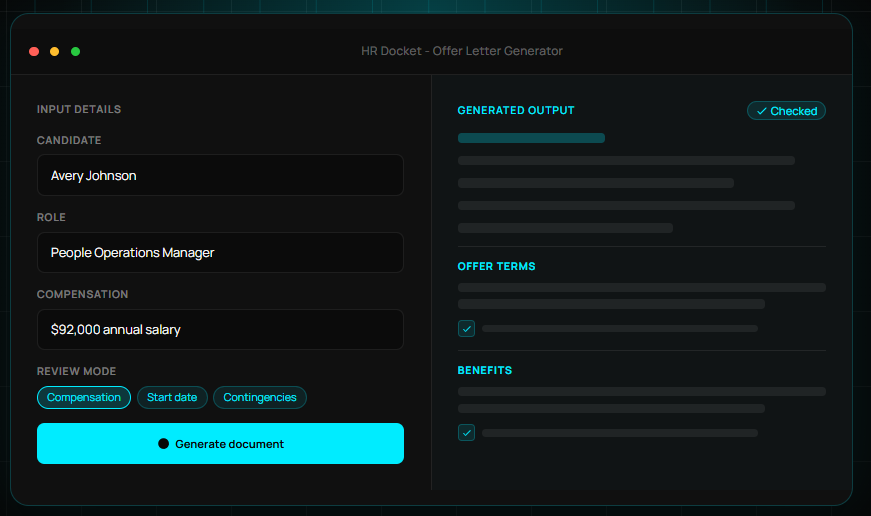
Most organizations still rely on outdated methods such as copying from old Word docs, piecing together emails, or waiting on legal for every variation. Some also download an old employment offer template from the internet or a shared folder. However, these approaches often fail to deliver the best results at the right time.
Traditional offer letters often face a series of problems, including missing critical sections like contingencies, equity details, or benefits summaries. Also, there is the issue of formatting, which makes the document look unprofessional. When a candidate experiences a sluggish, error-prone offer letter, they immediately generalize that friction to your daily HR culture, tool stack, and even management style.
Nowadays, the hiring workflow is no longer just about sourcing candidates. It is about operational efficiency. Modern HR documentation platforms like the HR Docket provide HR solutions by centralizing the process into one streamlined workflow.
How to Stop Losing Candidates to Slow Paperwork
Did you know that you can generate a signature-ready professional offer letter in minutes? The HR Docket’s offer letter generator guarantees you polished offer letters with role details, compensation, benefits, contingencies, and signature-ready formatting in less than five minutes. Now is the time to avoid losing top candidates by sending clear offer letters on time.
This offer letter generator bridges the gap between a verbal yes and a signed welcome. The platform supports structured drafting, secure workflows, and signature-ready document management for HR teams.
Instead of starting from a blank or an old employment offer template, you can create a clean offer letter from a guided workflow that builds the document around the candidate's specific details, checks for missing fields automatically, and produces a polished, signature-ready hiring package in minutes.
How HR Docket’s Offer Letter Generator Works
HR Docket is designed specifically for the speed and consistency demands of modern HR teams. Its offer letter generator simplifies complicated HR tools into a simple hiring workflow. Follow these simple steps to create a polished professional job offer letter.
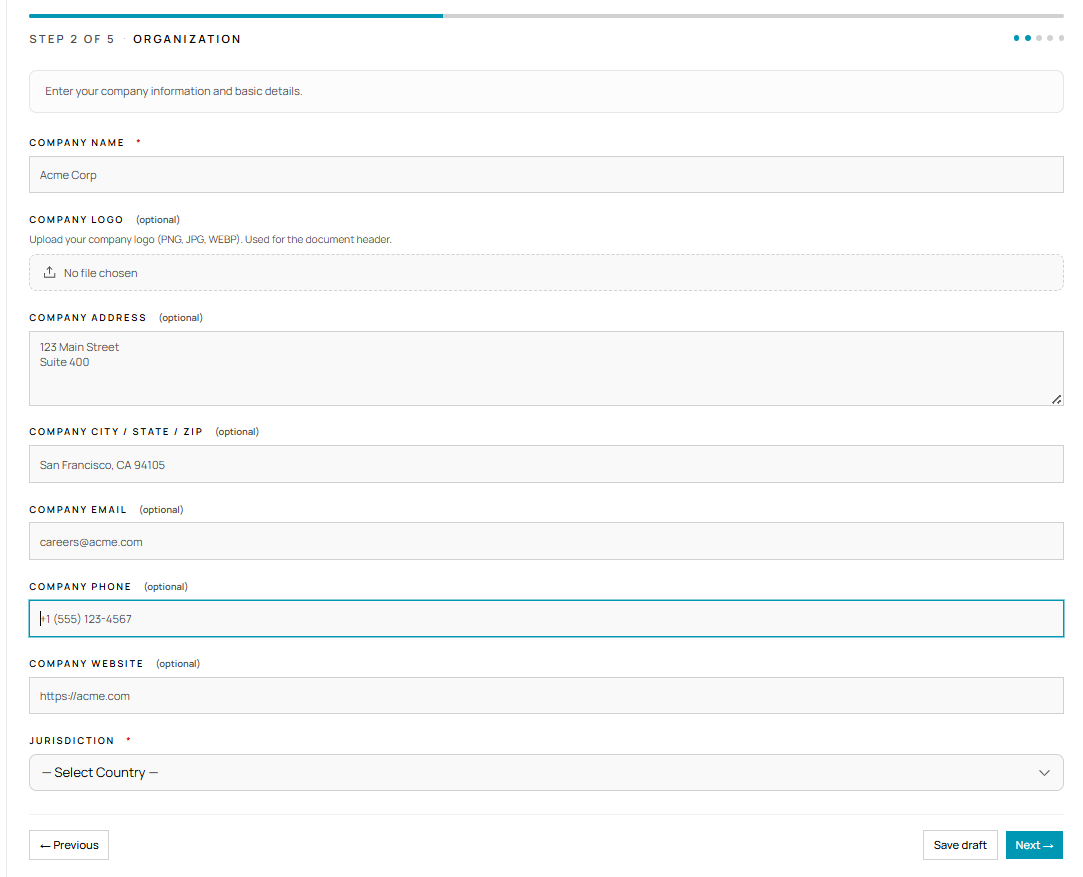
Step 1: Create a company profile
The first step after signing up on HR Docket is to create your company profile. You will need basic information such as company, name, logo, address, state/city, email, phone number, website, and jurisdiction. This information will automatically sync into the document you are working on in the platform.
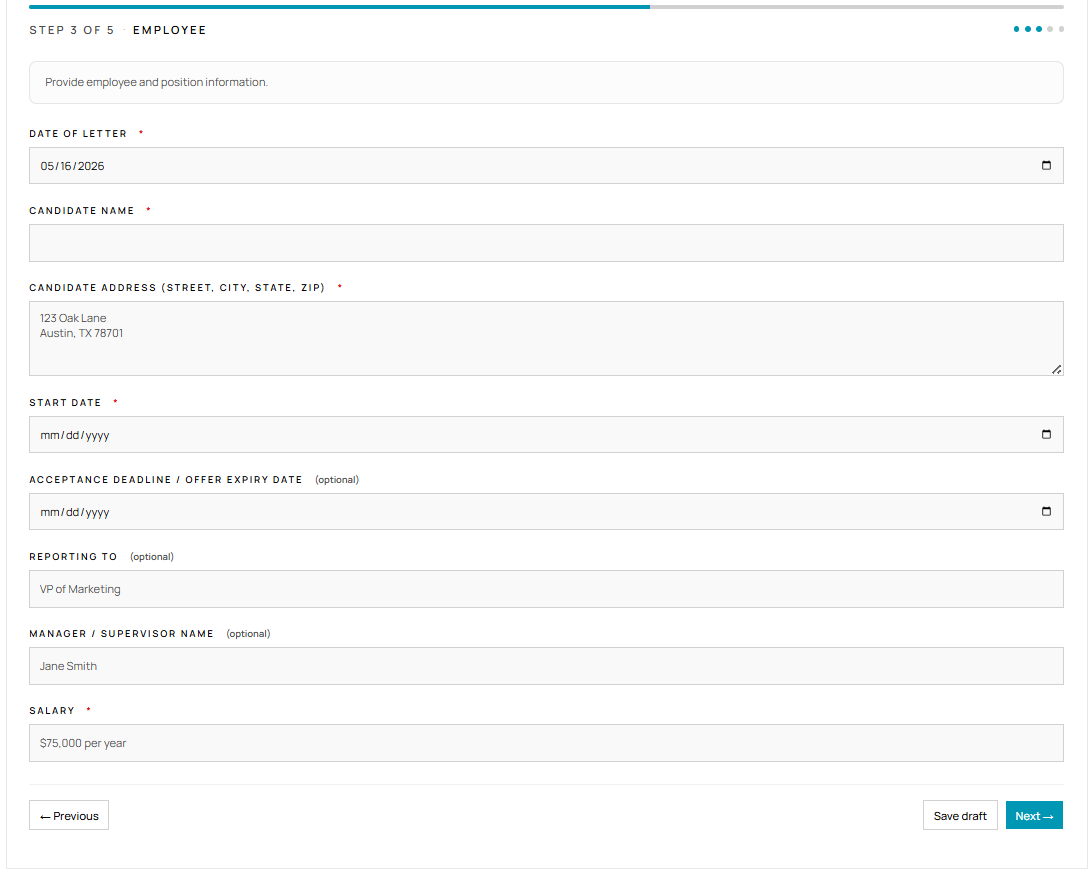
Step 2: Add the essentials
Once your profile is ready, locate the offer letter generator in the document generator library. You will be required to enter basic essentials such as the candidate’s name, role, compensation, start date, contingencies, and any department or location-specific details your offer needs. The guided input flow makes sure you don't miss anything critical before you get to draft mode.
Step 3: Generate and review
HR Docket structures your inputs into a complete, polished first draft within minutes. The platform drafts an editable offer letter with risk-aware review. It flags unclear clauses, missing dates, inconsistent terms, and anything else that would slow down approval or confuse the candidate.
Step 4: Edit, approve, and export
Refine the document, route it through your approval workflow if needed, export a signature-ready file, and keep the final version linked to the employee record.
Key features of the offer letter generator
Guided AI drafting: With HR Docket, you are not staring at a blank page. The platform provides a structure where you input the essentials. The offer letter generator handles all the weightlifting and creates a complete draft aligned with best practices.
Risk detection and compliance support: The platform features an intelligent validation layer that instantly flags potential issues such as missing contingencies, unclear probation language, and inconsistent benefits. These checks dramatically reduce back-and-forth and oversight risks.
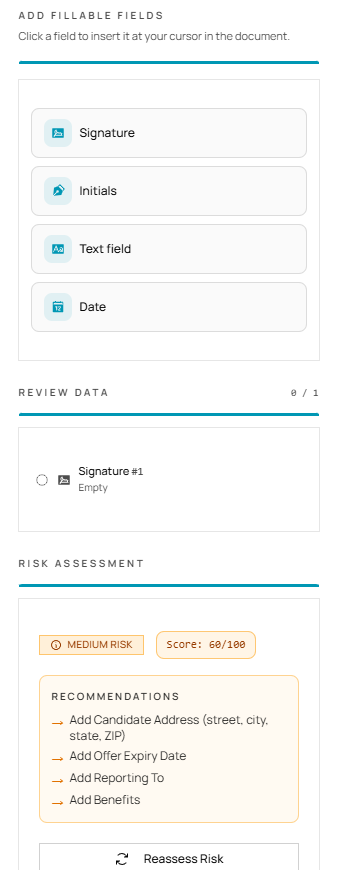
Employee-linked records: The platform provides a user dashboard where you can track every draft, saved version, PDFs, and signature. All these are recorded and organized under the right candidate or employee profile. It makes your HR operations smoother with easy retrieval, audits, and version history.
Signature-ready formatting: Your final document always comes out clean with a professional layout that you can export on any device. HR Docket ensures that your candidates receive documents that feel premium.
Reusable Templates: You don't have to search for an employment offer template anymore. Once you generate your offer letter, you can edit and use it anywhere.
Workspace Collaboration: HR Docket works 24/7. You can log in anytime, and your offer letter will be ready in the shortest possible time.
Difference between HR Docket’s offer letter generator and traditional template
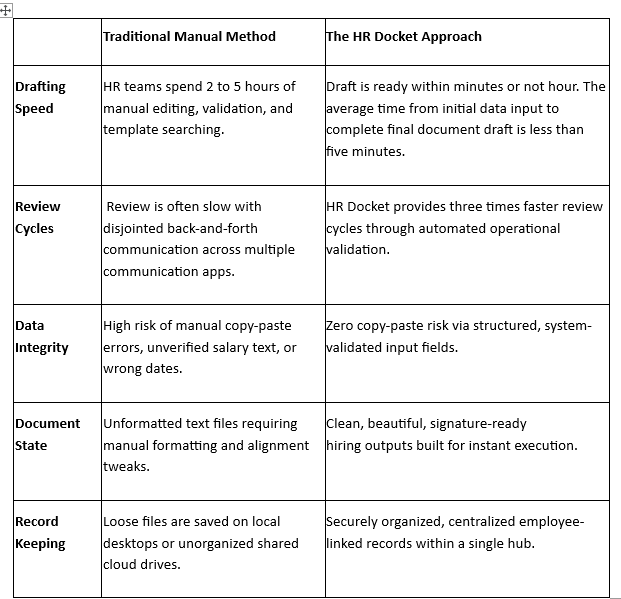
Some HR may think the traditional template works fine until they calculate the hidden hours lost to formatting, revisions, and lost candidates. HR Docket’s offer letter generator amplifies your expertise with speed, consistency, and smart checks.
Some of the key differences between the offer letter generator and the traditional template include
Pricing
An offer letter is one of the many services provided by HR Docket. You do not need a credit card to sign up; start free today and scale as your team grows.
There is a package for everyone, whether you are a scaling startup founder making your very first technical engineering hires or a large corporate enterprise managing a massive regional workforce.
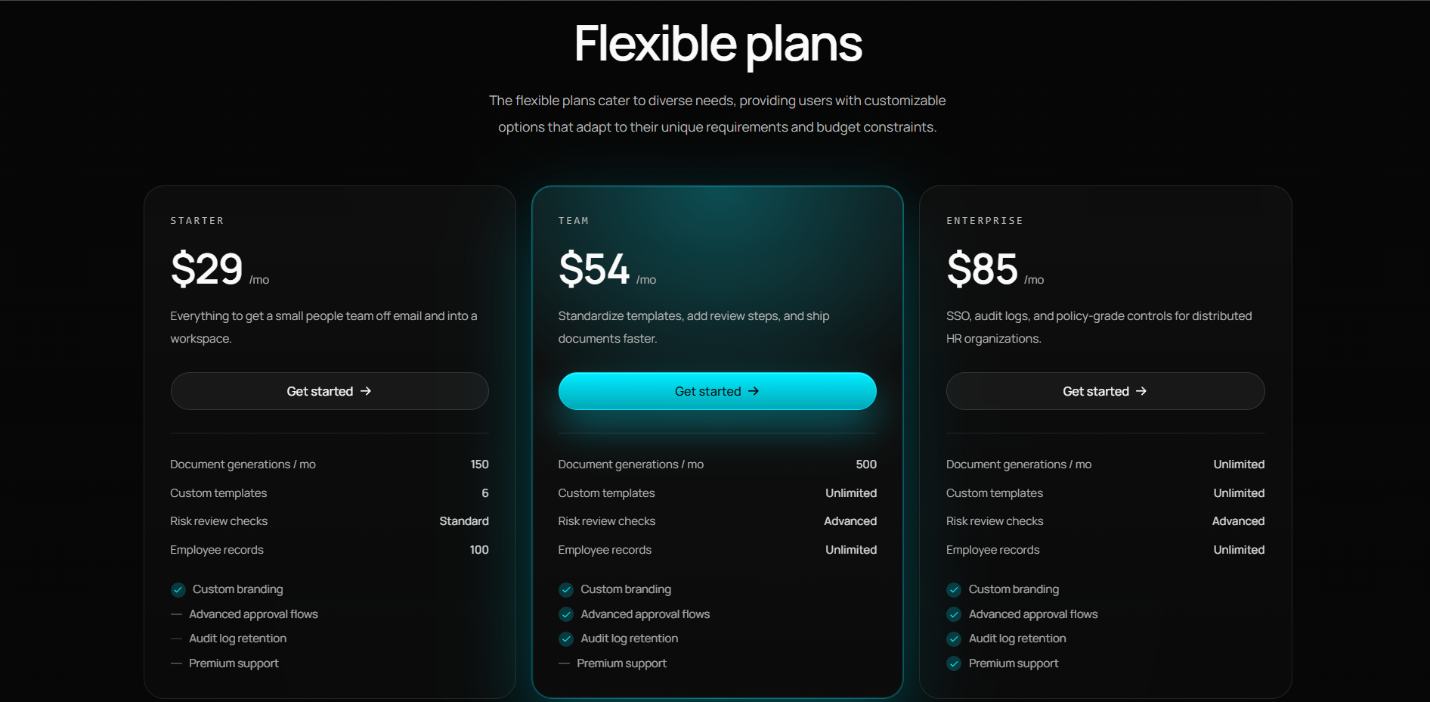
HR Docket offers simple, transparent, and scalable subscription tiers to match your operational volume.
For $29/month, you can create profiles for 100 employees and generate up to 150 documents per month with standard compliance checks. That is not all; you also have access to 6 custom templates, and you can export your final files in Word or PDF form. Sign up today and enjoy this starter pack for $19.99.
Most organizations prefer the Team package, which is $54/month. This package is ideal for growing teams that need unlimited templates and advanced review. It offers up to 500 document generations per month with advanced compliance checks. It also gives you unlimited templates, unlimited employee records, custom branding, and approval workflows. This package is currently going for $39.99; what are you waiting for? Upgrade your package today and enjoy all these premium features.
There is something for the big guys, too. This is called the Enterprise package, which goes for $85 a month. With this package, you enjoy custom integrations, unlimited generations, premium support, full comprehensive data audit log retention log, full Single Sign-On (SSO), and role-based access.
Start building better offer letters today
Do not allow slow administrative tasks to cost you your next transformative hire. Sign up today and start sending polished offer letters without copy-paste risk.
You can activate a completely free account today without a credit card. You can also generate HR documents such as employment contracts, comprehensive employee handbooks, performance improvement plans, termination letters, and many more on the HR Docket.