HR Docket Offers More for Business Than PandaDoc, DocuSign, Alternative Document Automation Platforms
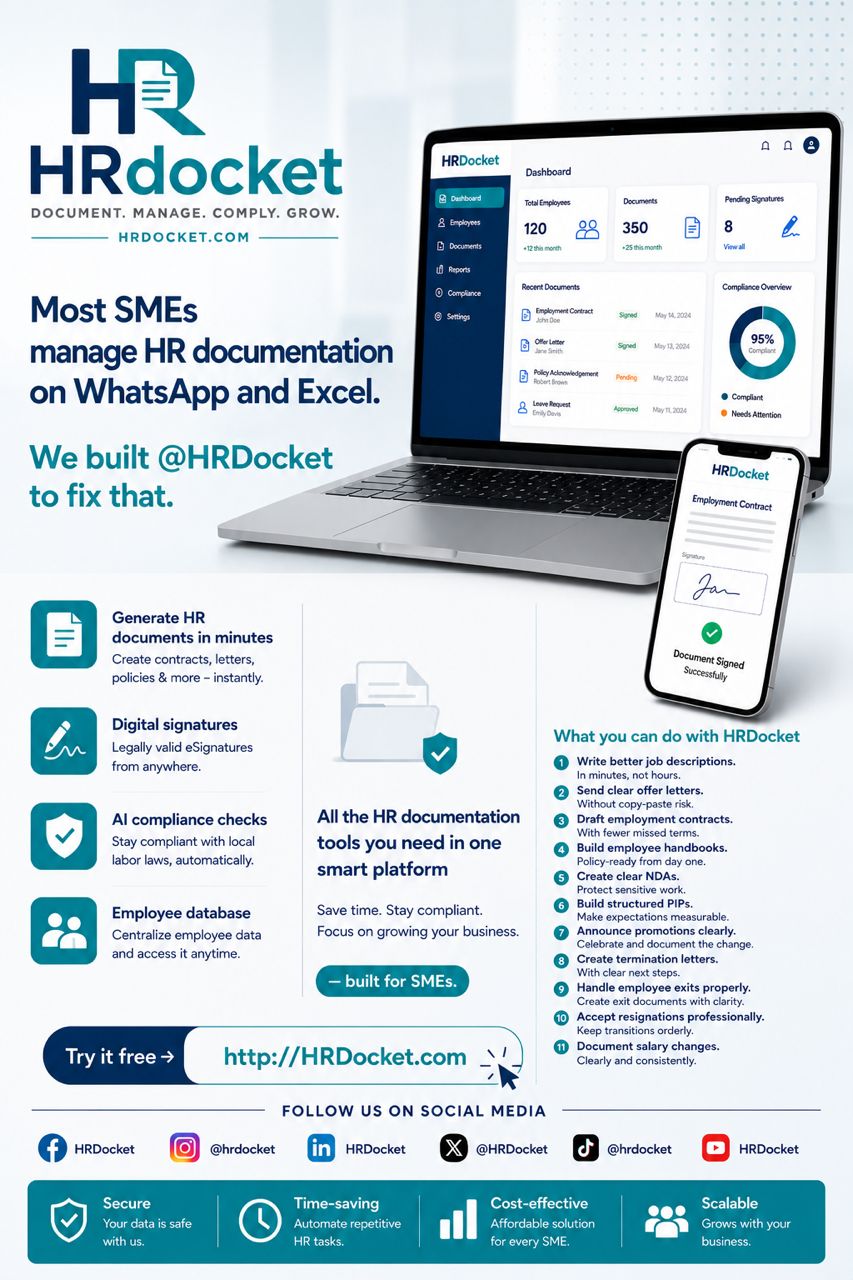
As long as you are on this page, it means you are either a small business owner, an HR professional, or in charge of a working people team. We understand the burden and pressure people in these categories face daily from every angle.
Try Employment Contract Generator for Free
Hiring is not a joke. It requires rapt attention because it has become more competitive and the rules of compliance are more complex than they used to be. That’s not all; employee expectations are fluctuating each day, mainly moving higher than expected. While at it, labor laws and authorities do not care about the business owner; they expect you to be on top of affairs in the area of proper document management for your employees.
Using DocuSign, PandaDoc, and alternatives at the start seems like the perfect solution for companies. Well, who wouldn’t use them? Because they promise digital signatures, automation, and document workflows. But after implementation, many Human Resource professionals and business owners come to the realization that these platforms are mostly built for sales documents, general e-signatures, and contracts.
They were not built for the frequent daily practices of the Human Resource manager or small business owner. But can you blame them? Nope. The duty of every business owner is to choose the right platform for your business, so choosing a general-purpose software while you can choose a specialized platform could be entirely your fault (not blaming you, but that’s the reality).

Read Also: Pandodoc and Docusign Alternatives
Why Specialized HR Documentation Software Matters
The difference between what a general-purpose and specialized software offers your business matters more than most businesses realize. For example, a delay in a sales proposal workflow wouldn’t cause much damage to your business. Compare that to HR documentation problems, they create legal challenges, employee nagging and agitation, compliance issues, delays in onboarding, and operational disorder.
This is where HRDocket stands out.
You see, HRDocket isn’t throwing banter at its competitors. Labeling the obvious, thus, instead of becoming a general-purpose document signing tool, the team chose to pay full attention to small businesses and HR teams. Because the struggles for HR teams are real. Coming up daily with organizing, tracking, and managing employee documentation from recruitment to termination isn’t a joke.
If you haven’t tried it yet, give it a thought to use HR Docket. The result is a more practical, more affordable, and more business-focused solution for companies that want HR systems that work without complexity.

Solve HR Documentation Problems, Not Just Sign Documents
Signing a document isn’t the same as HR documentation. Far from that, and this is one hell of a mistake small business owners make. They mistake penning a signature for HR documentation, and that’s completely false.
For all the correspondents we spoke to, they have the same story to share. The conclusion is that businesses that use generic documentation software sooner or later fall into a pit of problems:
Employee files scattered across desktop folders and random email threads.
Missing onboarding documents when labor regulators come knocking.
No centralized HR record system to verify employment timelines.
Difficult policy acknowledgment tracking when disputes happen.
Manual compliance follow-ups that take hours of manual labor.
Platforms like PandaDoc and DocuSign are excellent at collecting signatures. But HR departments need much more than signatures. What they need is structured systems, and HRDocket is a master of that. No need to say more!
Try PIP generator for Free
What HR Docket Offers Small Teams
Instead of forcing HR teams to adapt a sales oriented platform into an HR workflow, HRDocket gives businesses a centralized HR documentation environment designed specifically for employee management. This changes how businesses operate internally.
1. Designed Specifically for HR Teams
Most document automation software treats employees the same way they treat customers. That is a major problem. Employees require long-term documentation, performance records, and policy acknowledgments that stay linked to their profiles forever.
HRDocket approaches documentation from an HR-first perspective rather than a sales-first perspective. For small businesses without large HR departments, this is extremely important. Most SMEs do not have dedicated software administrators or expensive compliance consultants. They need a tool that works immediately and matches real HR operations.
2. Better Value for Growing Startups
One major frustration with platforms like PandaDoc and DocuSign is pricing expansion. At first, the monthly subscription may appear manageable. But costs rise quickly when businesses need more users, team access, or templates.
HRDocket focuses on practical HR functionality rather than overwhelming businesses with enterprise level upselling. Small businesses benefit because they often need employee document management, offer letters, and staff documentation not hundreds of advanced sales analytics features they may never touch. This focused approach allows businesses to spend money on actual HR operations rather than bloated software subscriptions.
3. Centralized Employee Documentation
One of the most dangerous issues in small businesses is decentralized employee records. Many companies still store HR files in WhatsApp chats, email attachments, on personal laptops, and across Google Drive accounts. This creates major risks, including lost records, compliance exposure, and slow response times during audits.
HRDocket solves this by centralizing employee documentation into a single structured environment. This is one of the biggest advantages HRDocket has over general-purpose document software.
4. Built for Real HR Operations
Many HR professionals discover that generic e-signature platforms still require multiple external tools to fully operate. For example, you end up using one software for signatures, another for employee records, and another for onboarding templates. This creates massive software fatigue.
HRDocket reduces this complexity by acting more like a dedicated HR documentation hub. For small businesses, this simplicity is a true competitive advantage.
Try Employee Handbook Generator for Free
The Strategic Reality
Small businesses often underestimate the importance of organization until problems appear, such as missing contracts during employee disputes, lost warning letters, or difficulty proving policy acknowledgment. Disorganization quickly becomes expensive.
HR documentation is not optional. Employment relationships generate ongoing records that businesses must manage carefully. While enterprise systems exist, they often come with complicated dashboards, long training periods, and administrative overload. Small businesses rarely need massive enterprise complexity—they need speed, organization, and practical workflows that save time.
Summary
PandaDoc and DocuSign are strong alternative platforms for document signing and sales-related workflows. But many small businesses eventually discover they still need a dedicated HR documentation system. That is where HRDocket becomes a smarter option.
Instead of trying to force generic document software into HR operations, HRDocket focuses directly on the real world needs of workforce managers. Its HR-first approach helps businesses stay organized, improve employee documentation, and reduce operational confusion from day one. Managing employees is simply not the same as managing sales contracts, and your software should reflect that reality.
Try Warning Letter Generator for Free
Sign up and Take Charge of Your Employee Records
Stop wrestling with bloated tools that treat your team like client leads. If you are ready to move from manual documentation to a signature-ready workflow that saves hours of work per case.
Check out the specialized features at HRDocket and generate your first contract for free.