Why Your Job Descriptions Are Scaring Away Top Talent (And How to Fix Them in Minutes)
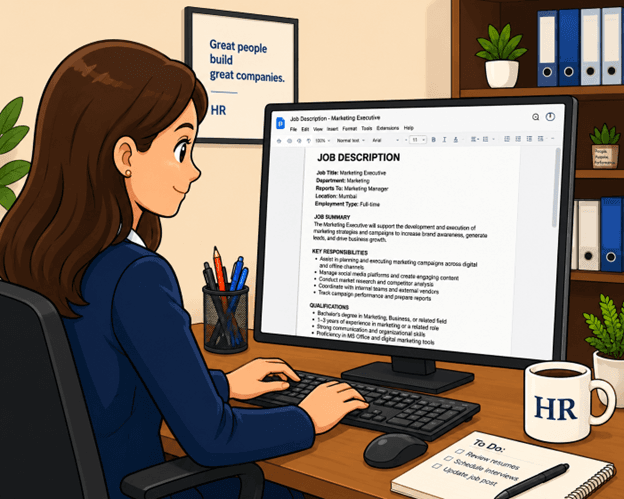
Top talent is what makes every business grow. Getting the right people on board is the first step in building a thriving organization, but some organizations end up losing their top talent to bad first impressions. Why? Because the document that was meant to entice them scared them away.
Generate Job Description for Free
Some hiring managers do not realize that professional job descriptions are not just a checklist of requirements. Before a candidate even speaks to a recruiter or steps into an interview, they have already formed an opinion about your company based entirely on how you write about the role.
There are more than tens of thousands of job description templates on the internet. Most of these require hours of editing, and some of them will still scare your best candidates away. However, the HR Docket has made it possible to write a better job description in minutes, not hours. You can go from details to a professional job description in minutes. Try it for free.
What is a job description?
A job description is a document that outlines the responsibilities, requirements, and expectations of a specific position. It serves as a road map for employees and managers to measure job performance.
A professional job description goes beyond stating the tasks and duties. It also establishes titles, pay grades, and reasonable accommodation controls. The aim of this document is to attract the right candidates and provide clarity on what success looks like in the position.
It supports HR functions like performance management, compliance, career development, and internal mobility by creating clarity around each role. Job descriptions usually include job title, main duties, required skills, and any preferred qualifications. It also adds a chain of command, working conditions, and success benchmarks.
A strong job description attracts top talent by reducing ambiguity and ensuring consistency across recruitment efforts. It also minimizes misunderstandings and improves long-term job satisfaction, helping hiring managers and candidates stay aligned on role expectations.
Objectives of a job description
A professional job description is essential to both employers and job seekers. The primary objective of a job description is to clearly present all aspects of the job role to the prospective applicant.
For the hiring manager, a job description needs to clearly define the role and set clear expectations. It should be able to attract applicants with the right qualifications and levels of experience. Also, the job description should provide a reference point for managers and HR to evaluate a new recruit's performance compared to the responsibilities outlined in the job description.
Professional job descriptions should demonstrate company expectations, allowing the job seeker to judge if their qualifications are sufficient. It should also clearly state the skill set and requirements of the job. Features such as base salary and salary range help job seekers decide whether to apply for the position or keep searching.
How to write a professional job description
A job description is one of the most important onboarding documents of every organization. Preparing professional job descriptions is not difficult, especially when platforms like HR Docket help you with your quest. In order to produce a standard job description, you need to put the following in place.
1. Create the job description structure: To be able to write a professional job description, you first need to create a structure. However, HR Docket already has a structure that best fits every organization.
2. Determine the needs and requirements for the role: You get determine what it takes to get the job done. Sometime you need to interview existing employees about the physical characteristics, environmental factors, skills and abilities.
3. Define essential functions: You have to defined the tasks that are a requirement and sometimes the frequency of the task.
4. Add disclaimer statement: It is also important to add disclaimer statement stating clearly that other duties may be assigned without notice.
Why Your Job Descriptions Are Scaring Away Top Talent
You are leading with requirements instead of opportunity: Most job descriptions open with a list of qualifications. The very first thing a candidate reads is a list of things they need to give you; for instance, degrees, years of experience, certifications, and technical skills.
However, job seekers want to know the opportunities available for them. Before top talent considers a job opening, they first ask, "What's in it for me?" What will I build? What will I become? If your opening paragraph reads like a checklist instead of an invitation, you've already lost the best candidates. The best way is to start with what the role is doing that actually matters. Growth opportunities that await successful applicantsUsing Language That Alienates Qualified Candidates: The wording of the job description speaks volumes. Gendered language, unnecessarily aggressive phrasing, and jargon-heavy descriptions might end up scaring away candidates who might be phenomenally qualified but simply don't see themselves reflected in these words. Inclusive hiring language, such as neutral, welcoming, and focused on what candidates will accomplish rather than who they need to be.
Listing Every Requirement Ever Imagined: Listing too many non-negotiable entry requirements drives away most top talents. Some of the qualified candidates even disqualify themselves before they even start. Exceptional candidates who could learn on the job assume they are not welcome. And you end up with a narrower applicant pool than you needed.
Not Telling Candidates What Success Looks Like: Vague job descriptions are anxiety-inducing. When a candidate can't visualize what their day looks like, what they'll be measured on, or what winning in this role looks like after six months, they feel uncertain — and uncertainty breeds hesitation.
Top performers especially need to know that there is a clear path, clear expectations, and a clear way to demonstrate their value. Ambiguity signals organizational chaos to experienced candidates.The Formatting of the Job Description: Believe it or not, the presentation of the job descriptions matters a lot. A job description that is an unbroken block of text, with no hierarchy or visual breathing room, signals to candidates that your organization might not value their time or experience. Using clear headings, break up bullet points and scannable sections. Scannable helps candidates understand the essence of the role in 60 seconds and then invites them to read more if they're interested.
The Hidden Cost of a Bad Job Description
A poorly written job description causes a whole lot of problems across the entire operation of the organization. A bad hire can cost team morale, lost productivity, the time your hiring managers spend on wasted interviews, and the institutional knowledge you lose when someone doesn't work out.
Bad job descriptions cost organizations in multiple ways, including:
Attract wrong-fit candidates: Poor job descriptions often attract wrong applicants, leading to longer screening times and more wasted interviews.
Loss of best-fit candidates: Some top talent tends to ignore some job openings because the job description is not appealing. They end up clicking away within seconds and going to a competitor.
Slows down hiring process: A poorly written job description delays the hiring process, which in a competitive talent market can cost you your top choice.
Why Drafting Job Descriptions Manually Is Hard to Do
Most HR managers know their job descriptions need work. But writing better JDs is genuinely hard because
It requires understanding what great talent actually wants to hear.
It requires knowledge of inclusive hiring language standards.
It requires balancing brand voice with practical information.
It requires doing this consistently across every role, every department, and every hiring cycle.
It is highly impossible to manually produce craft-level writing for every single role. Therefore, HR teams fall back on templates that don't work or spend hours on rewrites that still miss the mark. In order to save yourself the trouble, smart HR services such as HR Docket exist to help you with all your HR documentation.
How to Fix Your Job Descriptions in Minutes
Most hiring managers believe that templates are their solution to documentation. But the harsh truth is that most job description templates are written like legal contracts or internal memos rather than compelling invitations.
The good news is that with the right hiring manager tools, such as the HR Docket, you can produce a craft role-ready, inclusive, and compliance-aware job description tailored to your company's voice, hiring level, and department in minutes.
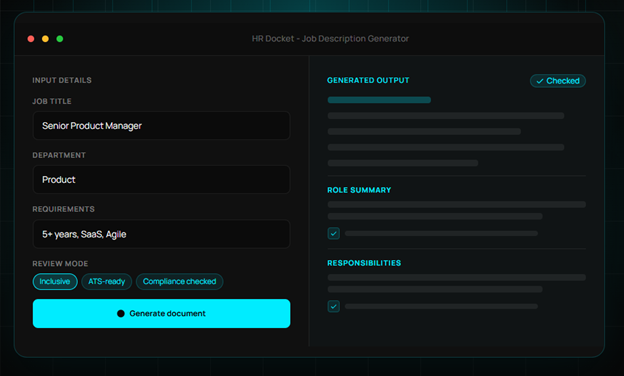
HR Docket's job description generator is built specifically to ensure you hire the best candidates for your organization. This tool is not just a template; it is a smart, intuitive role profile builder that helps you craft professional job descriptions that are clear, compelling, and candidate-ready. With this job description generator, you can write a better job description in about four minutes, which is just a small fraction of the time it takes to do it manually.
Difference between HR Docket’s job description generator and traditional templates
If you are wondering about the difference between this generator and using templates on Google, wonder no more. Here is what makes HR Docket’s job description generator different from copying a template off Google.
1. HR Docket’s Job Description generator is built with inclusive hiring language by default.
You don't need to become an expert in gendered language or unconscious bias in job descriptions. Your job is to input the essentials, and the platform does the heavy lifting. It flags problematic phrases and suggests neutral, welcoming alternatives that broaden your talent pool without watering down your message.
2. It Structures Roles for Clarity and Impact
The job description generator has an inbuilt role profile builder that guides you through the elements of a high-performing job description: the opportunity, the responsibilities, the success metrics, the requirements, and the cultural context. All these components are structured in a way that speaks to how great candidates actually evaluate opportunities.
3. It Produces Consistent, On-Brand Output
One of the hardest things about job description quality is consistency. HR Docket’s job description generator produces professional job descriptions tailored to your company’s voice.
4. It Saves You Hours Per Hire
Manually writing or editing a job description template can be time-consuming. With this generator, your document can be ready in less than 5 minutes.
How HR Docket’s job description generator works
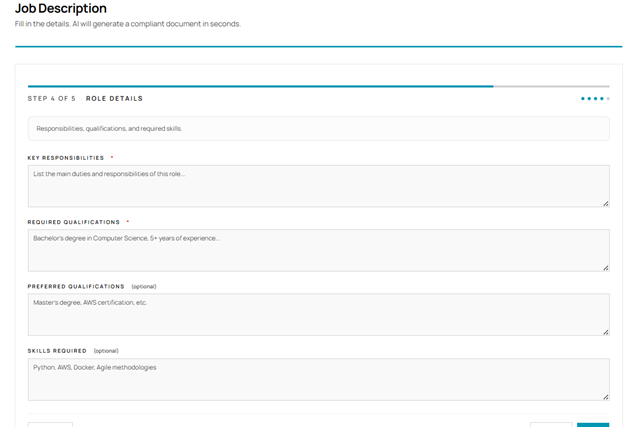
With HR Docket, it is much easier to generate a professional job description in minutes. All you need to do is just follow these simple steps.
Step 1: Input the essentials.
Enter key details such as company profile, role title, department, key responsibilities, required skills, qualifications, and policies.
Step 2: Generate
After inputting the essential information, click on the generate button and let the platform handle the heavy lifting.
Step 3: Review, edit, and export
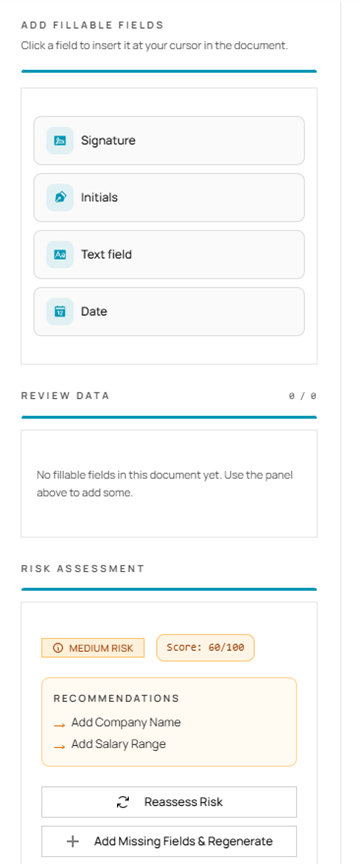
Your professional job description document will be ready in no time. You just click on open and review the draft. The draft comes with an AI risk assessment that suggests areas that need to be improved and missing information that needs to be added. After editing the draft, you can either reassess the risk or export your file in a Word or a PDF form.
Features of HR Docket’s job description generator
HR Docket has everything a smart job description needs. The platform is built for HR teams who care about quality, compliance, consistency, and speed. Some of its features include:
1. Guided AI editing: The platform has a built-in AI that turns your inputs into a polished job description.
2. Risk-aware review: HR Docket ensures that your job description meets professional standards by flagging unclear clauses, missing dates, inconsistent terms, and sensitive language before the document is shared.
3. Compliance coverage: The platform highlights the details that usually slow review: missing fields, unclear dates, policy gaps, and document-specific terms.
4. Export-ready formatting
5. HR Docket’s job description generator is built for everyone. Whether you are a manager, HR partner, or operations team, the platform helps you produce cleaner drafts within the shortest possible time.
Generate cleaner job descriptions today.
You don't need to overhaul your entire hiring process to start seeing better results. You just need to start with your next job description. Go to HR Docket's job description generator and try it for your next open role.
Visit HR Docket to explore the full suite of tools built to make every stage of your hiring process smarter, faster, and more human.