The Hidden Risk of "Template Drift": Is Your 3-Year-Old Employment Contract Still Legal?

Picture the last hire; someone on the team pulled up the standard contract, swapped in the name and salary, and sent it over for signature. Done in a few minutes and no drama.
Draft Employment Contract for Free
But when was the template truly written? Who reviewed it last? And does it still represent what employment law truly needs, such as flexible working hours, data processing, post-termination limits, and the dozen other areas where the regulations have quietly changed?
When queried about this issue, most people lack confidence in their ability to answer not because they are irresponsible but because the template has always existed, viewed as a solved problem long before the present crew came.
That assumption is what makes template drift so difficult to detect and so costly to correct?
No need to stress yourself, HRDocket is here to solve all these problems for you. This platform is a modern HR document platform built for teams that can't afford the risk of outdated paperwork. Instead of patching the same old file, you go from HR details to a professional employment agreement in minutes, not hours. Try HRDocket for free and thank me later.
How drift happens and why it's so easy to miss
Employment law does not pause between hiring cycles but statutory minimums vary. Courts provide rulings that redefined what provisions will truly hold up. Whole fields of work emerge faster than most businesses can update their paperwork.
The issue is not that people break their contracts but the template is seen as a solved problem. Everyone thinks everything is fine because it always has been. So, it sits there, accumulating silent danger with each new hire who signs it.
What makes drift difficult to detect is how it compounds invisibly. Every one-off edit that does not make it back to the master version adds another layer of risk that cannot be predicted.
A section quietly removed for one particular hire and never restored for the next. Over time, what started as a carefully drafted agreement becomes a patchwork of decisions made in isolation with no single person holding the thread.
This problem becomes known by teams when an employee is retiring, a regulatory review or a candidate sharp enough to object to specific language. By this point, the document has typically been signed by dozen people who all thinks it was current. The risk is not hypothetical, it is already in place, layered across every hire made with that template.
Think about what that means in real terms. Each of those employees operates under terms that may not align with what the law currently recognises. And any of them were to challenge a restriction clause, the weak foundation of that template becomes immediately visible and immediately expensive. This is not a rare example but an increasingly common one as employees become more aware of their rights and are willing to push back on agreements that no longer hold water.
The cost of that exposure is rarely just legal fees. There is the reputational dimension on how a contested contract looks to candidates, to regulators, and to your existing workforce. There is the operational disruption of managing a dispute while simultaneously running a hiring process.
And there is the quiet damage to team trust when people realize the document they signed on day one was not what it appeared to be.
Keeping your employment agreements current is not just a compliance task but a signal to your workers that the organization takes its commitments seriously, on both sides of the relationship.
Why "it's always worked" isn't the same as "it's fine"
The continuation of drift can be attributed to a specific mentality around employment contract templates. Because these documents have previously worked or at least haven't visibly failed, which means they carry an implied reliability that feels deserved. It's gone through hundreds of signings without issue and track record feels like proof of excellence.
However, the lack of a clear issue does not necessarily imply the absence of risk. Contracts fail in review when circumstances arise that nobody expected when the document was drafted.
The longer a template has been circulated without review, the greater the gap between what it states and what the present legal environment actually requires.
The teams that feel this the most strongly are those that felt their paperwork’s was in order until a disagreement, audit, or regulatory change revealed otherwise. At that point, the decision is not whether to modify the template, but rather how to manage the risk that has already been established across all contracts issued with it. That is a completely unique, and far more expensive, discourse to be having.
Common Compliance landmines in Aged Templates
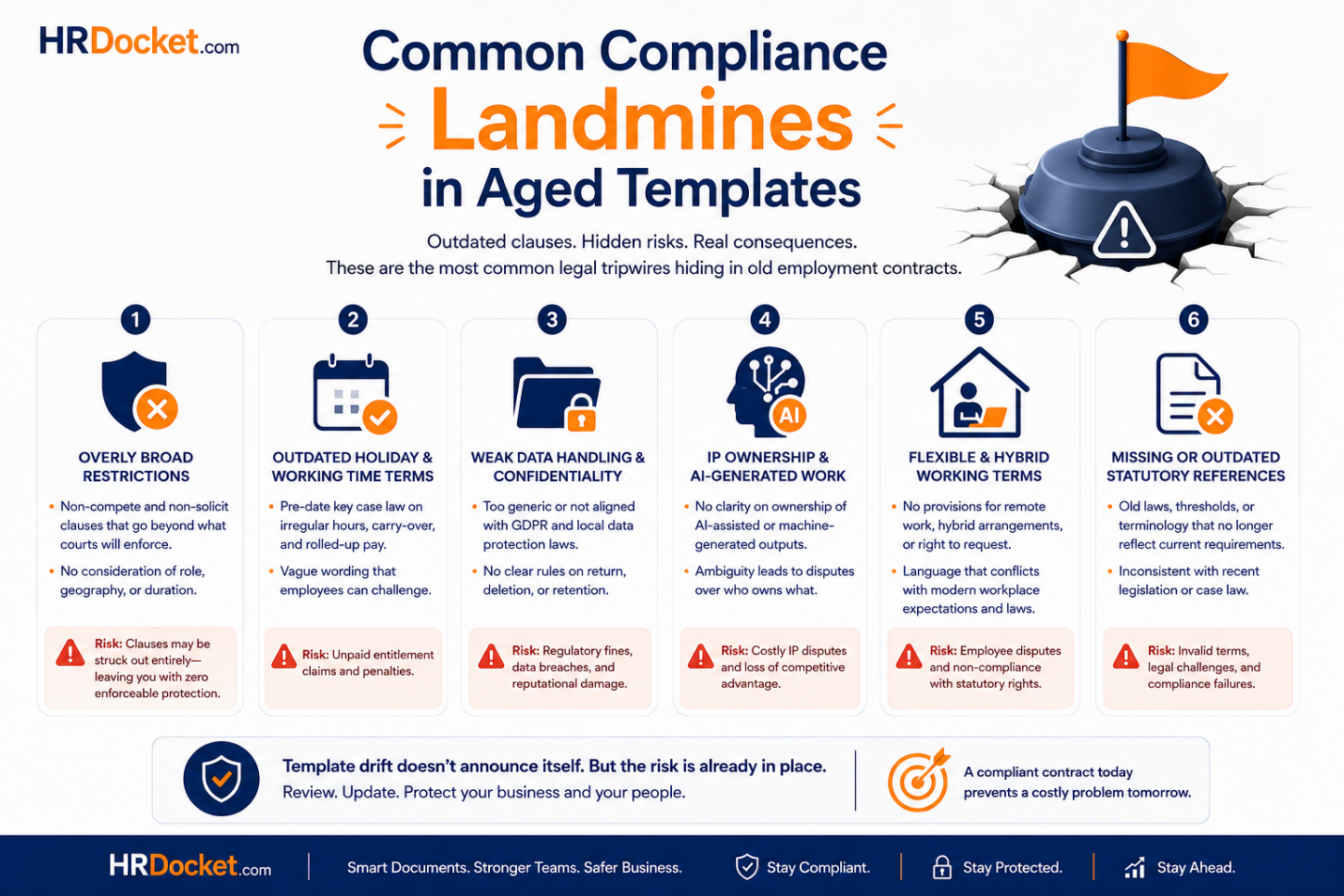
Not every section of your contract drifts at the same pace. These are the areas where outdated language tends to cause the most damage:
1. Post-termination Restrictions: Courts have become far less willing to enforce broad non-competes. An overly wide restrictions often gets struck out entirely not softened. The risk or danger is not just loosing specific case but having no enforceable protections at all on a role that needed.
2. Holiday & Working time Language: Entitlement rules around irregular hours, rolled-up pay, and carry-over rights have been clarified through case law. Generic clauses that predate these rulings leave a gap that employees can and do pursue.
3. Data Handling & Confidentiality: Your employment agreements need clause-level precision not a paragraph that gestures at confidentiality without distinguishing between categories of information or specifying what happens to data after termination.
4. IP Ownership & AI-generated Work: This one is newer but accelerating fast. If your team uses AI tools as part of their role, your intellectual property clauses may not address who owns what and that ambiguity has consequences beginning to surface in real disputes.
5. Flexible and hybrid working terms: A contract written in 2019 almost certainly says nothing meaningful about remote work arrangements. What was once optional to include is now something employees actively reference and, in many organizations, a statutory right they can formally invoke.
The thing these five areas have in common is that none of them required a legislative earthquake to become a problem. Most of the shift happened gradually — through case law, updated guidance, and changing workplace norms. A template that was perfectly adequate three years ago may now be missing language that employees, and courts, will expect to see. That is the quiet part of template drift: it does not announce itself.
And for HR teams operating without a dedicated legal resource, it is entirely possible to go through dozens of hiring cycles without anyone flagging the issue until the moment someone does. At that point the conversation shifts from routine administration to damage control, and the tool you choose to manage your contracts becomes far more consequential. This is precisely where HRDocket's compliance-first approach pays for itself many times over.
Fixing the problem: a practical compliance review

Template drift is completely fixable and you don't need a six-week legal engagement to address it. What you need is HR Docket, because it is a clear process and a better starting point.
1. Use Version Control: HR Docket handles this automatically, keeping the full version history linked to each employee record.
2. Get a risk review built into the workflow: HR Docket flags unclear clauses, missing fields, policy gaps, and inconsistent terms before anything leaves the workspace. It's the closest thing to a second pair of legal eyes on every document your team ships, without the hourly rate.
3. Match Template to the Role: HR Docket's contract generator builds role-specific terms, probation clauses, compensation, and confidentiality into every draft from the start, rather than adding them later.
4. Start from a current baseline, not a patched-up old one: Generating a fresh draft from HR Docket gives you a clean document that reflects what the law actually says today, without layers of accumulated assumption underneath it.
5. Stop treating the template as a solved problem. Assign a named owner not a team, a specific person who is accountable for knowing what version is current, what's changed since the last review, and when the next one is due. Without that, maintenance is everyone's responsibility and therefore nobody's.
Why Choose HR Docket To Solve This Issue
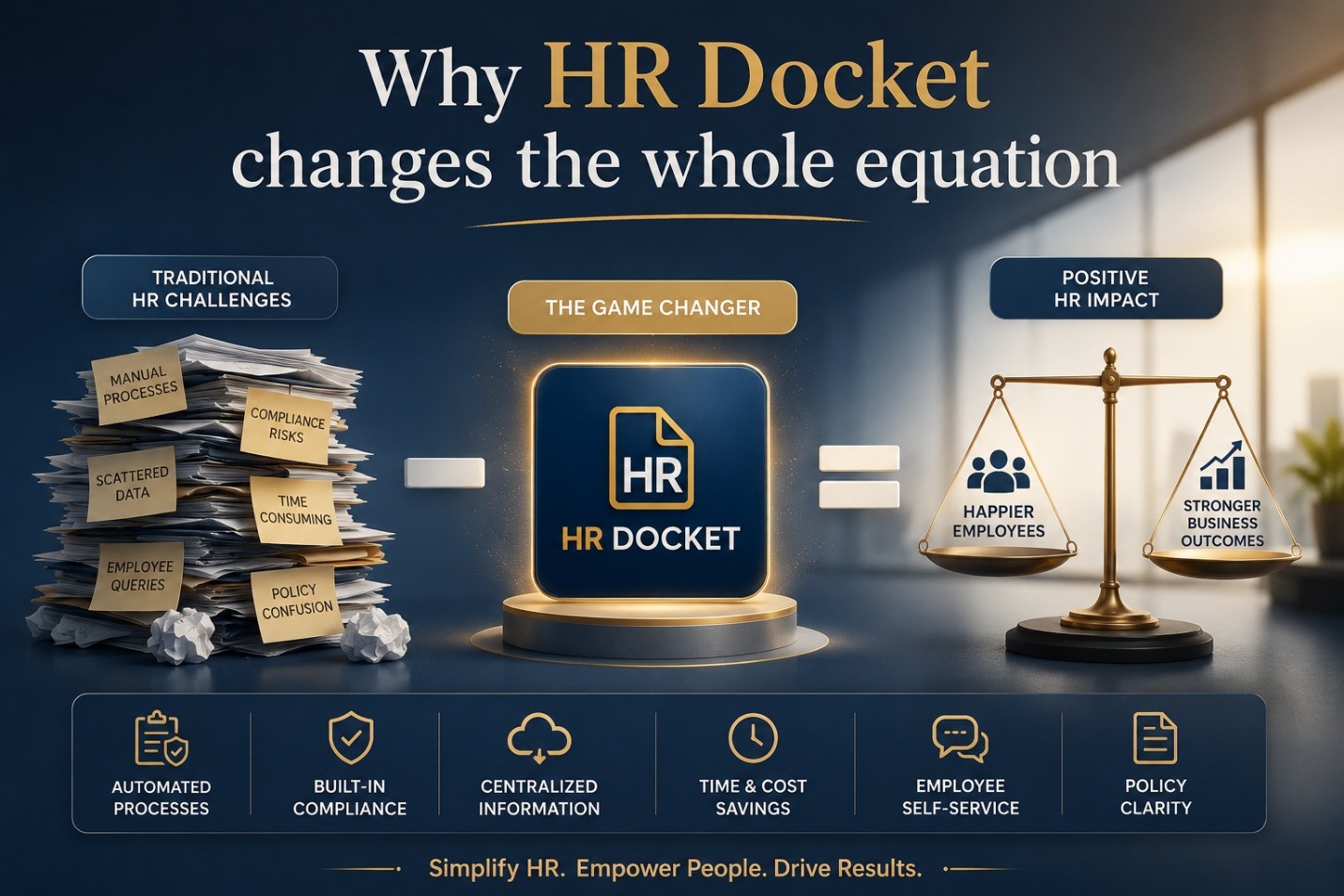
HR Docket was built purposely to assist people and organizations that needs to move fast without cutting corners on quality. HR Docket takes the details your HR team already knows like role, compensation, benefits, probation, etc. and structures a well-polished first draft in seconds without stressing yourself.
The outcome isn't just fast but risk-reviewed before it reaches anyone's inbox. Compliance checks surface the things that slow down review: missing dates, inconsistent terms, incomplete clauses, and sensitive language that needs a second look. The final document goes out signature-ready, with tracking built in and the full version history filed under the employee's record not buried in someone's downloads folder.
In practice, the workflow is as follows: Once a new hire has been verified, the HR partner launches the generator, enters the role data, and a complete first draft is returned in minutes. The partner reviews, validates what was agreed upon with the hiring manager, and exports the signature-ready document.
It is sent to the employee straight from the platform, with a tracked completion status. Once signed, it is saved instantly under the employee's profile. There is no manual saving. There is no version confusion. No chasing and it grows with each subsequent hire.
What Are HR Docket Subscription Plans?
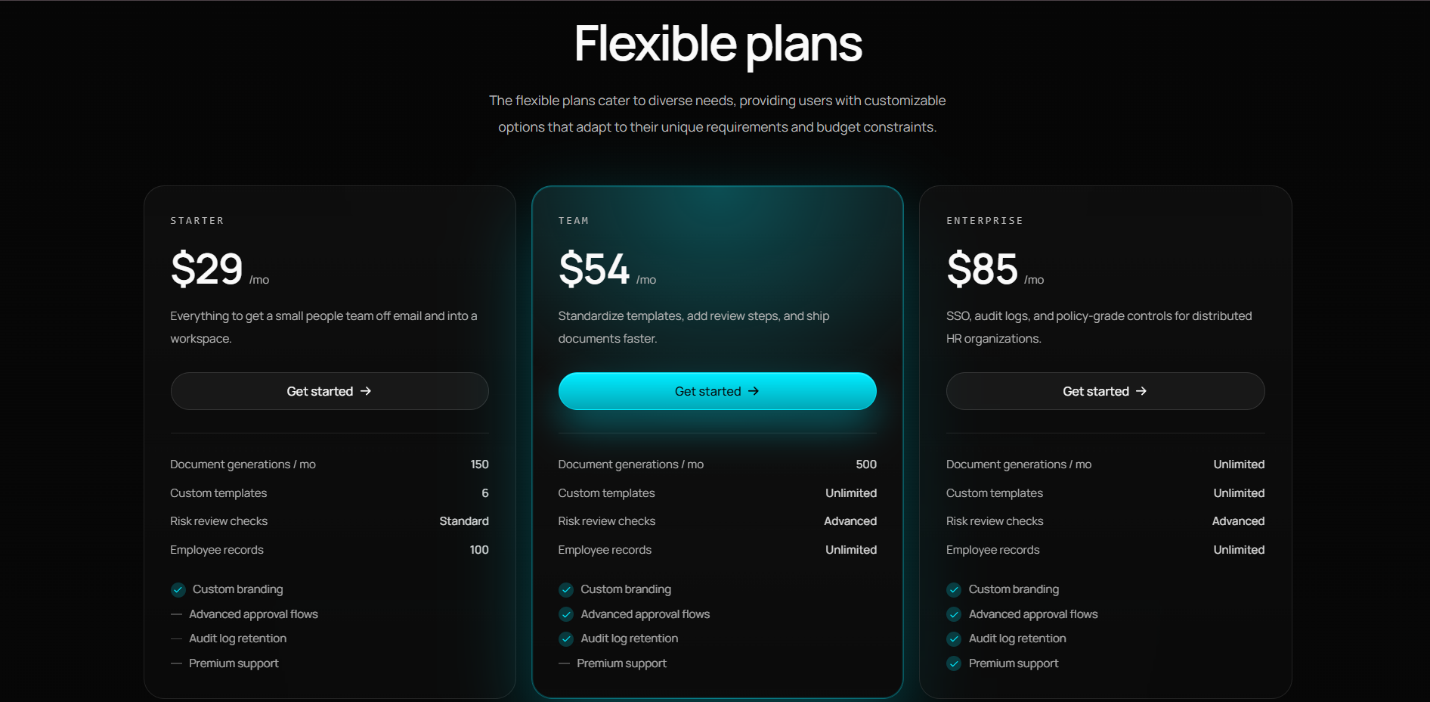
HR Docket comes with a cool subscription plan to suit any business, whether you are a small or big business. Access to the employment contract generator is included across all HR Docket plans, with no setup fees and no credit card required to get started.
The Starter plan at $29/month is designed for smaller people teams moving off email and spreadsheets, covering 150 document generations per month, six custom templates, standard compliance checks, and up to 100 employee records.
The Team plan at $54/month adds unlimited templates, advanced compliance review, unlimited employee records, custom branding, and approval workflows built for growing teams that need greater consistency and throughput as hiring accelerates.
For distributed HR organisations that need policy-grade controls at scale, the Enterprise plan at $85/month brings SSO, role-based access, full audit log retention, and premium support with custom integrations.
Every tier is designed around the same principle: reduce the distance between having the right information and getting a compliant document out the door. There's no lock-in, and you can start free to see exactly how it fits your current workflow before committing to anything.
Conclusion
Template drift is one of those risks that feels abstract until the moment it isn't. The contract that's been in circulation for three years the one everyone trusts because it's never caused visible problems is exactly the one most likely to contain language the current legal environment no longer supports. The track record of "no incidents" isn't evidence that the document is fine. It's evidence that the circumstances that would reveal its weaknesses haven't arisen yet.
The answer isn't a more thorough manual review process, or a longer legal checklist, or a commitment to do better next year. It's changing the starting point.
Using HR Docket means every new agreement starts from a current, compliant baseline, instead of editing an old file and hoping the right things got updated. It is built for the role, reviewed before it leaves the workspace, and filed properly when it comes back signed. For any HR team serious about protecting the business and its people, that is not a small thing — it is the difference between documentation that holds up and documentation that quietly falls apart the moment it is tested.
The stakes of getting employment agreements right have never been higher. The effort required to get them right has genuinely never been lower. The only real question is whether you catch the gap before a new hire does and with the right tool in place, that question a