Documenting Issues Fairly: How to Issue Warning Letters Without Inflaming the Situation
Delivering a formal warning is one of the most uncomfortable tasks a manager faces, often turning a productive conversation into a defensive one . This guide explores the "Compliance Shield" approach to disciplinary records—focusing on factual incidents, precise policy citations, and a professional tone to ensure your documentation is fair, clear, and legally defensible . Discover how risk-aware review can flag "ticking time bombs" in your templates before they leave your desk, helping you turn workplace conflict into operational clarity

Nobody walks into a disciplinary meeting after being summoned hoping it goes badly even if they are guilty.
Generate Warning Letter for Free
Delivering a formal warning is one of the most uncomfortable tasks a manager faces. It feels like a confrontation and a moment where trust is tested and the relationship between manager and subordinate hangs in the balance.
The most important thing every employee has to know is that a warning letter are just a formal letter communicating a message from a superior. The problem mostly arises when the employee finds a formal letter in their inbox with no context, no clarity, and language that reads like it was written by someone preparing for litigation rather than trying to solve a problem. Sadly, that is how most warning letters are.
The document that was supposed to open a productive conversation instead closes one. The employee gets defensive. The manager retreats. And HR is left managing the fallout from a process that should have been straightforward.
Most of the time, the breakdown is not about intent. It is about execution. Specifically, the gap between what needs to be communicated and how the documentation actually communicates it.
Why warning letters go wrong before they are even sent
A formal warning letter is one of the most consequential documents in HR. It creates a disciplinary record, puts the employee on notice, and sets the terms for what happens next. When done well, it's also one of the most useful tools in an important toolkit in any HR manager's docket. A warning letter should be a clear, honest statement of what went wrong, what the expectation is, and what the path forward looks like.
When done poorly, it is a grenade waiting to explode and cause massive devastation.
The most common failure patterns in most warning letters include mundane and missing dates. vague references to policy without citing the actual clause. The language used implies intent when the facts do not follow procedure. The next course of action is undefined and so open-ended that it is impossible to act on. The tone of the letter reads as prosecutorial rather than professional.
Each of these mistakes is fixable. However, they rarely identified it before the document went out, because the people drafting warning letters are usually doing it under pressure, without a reliable review process, from a template that hasn't been touched in years.
The real cost of inconsistent disciplinary documentation
Have you ever sat down to calculate the real cost of inconsistency in documenting disciplinary issues in an organization?
Inconsistency in how attendance issues, conduct problems, or policy violations get documented is not just an operational nuisance, but it's a liability that compounds quietly over time.
When one manager's warning letter is three paragraphs of careful written HR language and another's is a one-sentence note attached to an email thread, you don't have a disciplinary record. You have a patchwork. And a patchwork is very hard to defend if an employee later argues they were treated differently than colleagues in similar situations.
Consistent workplace policy documentation also matters internally. Employees who receive clearly written, factually grounded documentation in difficult circumstances are more likely to trust that the process is fair. That trust is worth something. It is the difference between an employee who engages with the improvement process and one who immediately calls a lawyer.
A company can lose millions over poor and inconsistent disciplinary documents when an aggrieved employee decides to go to court over an unfair process.
What fair documentation actually looks like
Fair doesn't mean soft. A well-written warning letter can be direct, firm, and completely unambiguous about consequences while still treating the recipient with professional respect and getting the desired result.
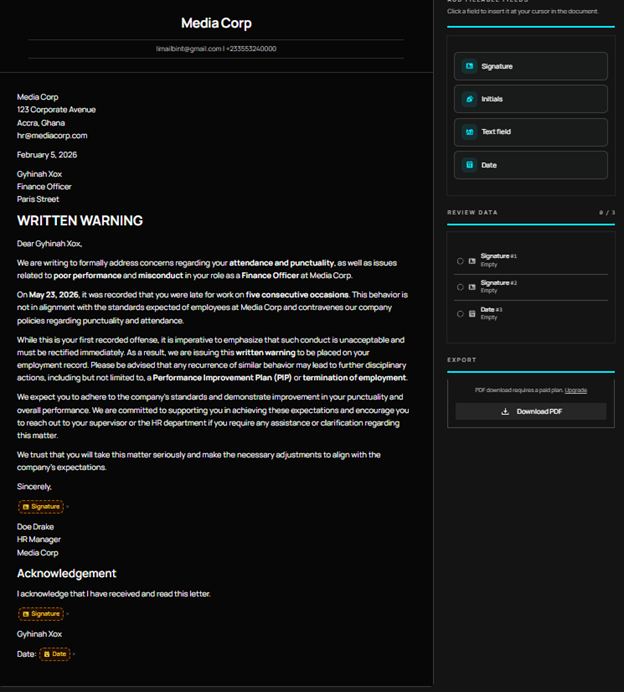
The structure that works follows a simple and well-taught plan. Here is what happened, here is the relevant policy, here is what needs to change, and here is what happens next. This can only be achieved when you follow this process:
The incident is stated factually: the dates, observed behaviors, and specific events are clearly stated. Example: On May 8, the employee (Mr. Lawson) arrived 35 minutes late without prior notification. But not "the employee (Mr. Lawson) has a persistent attitude problem with punctuality."
The policy reference is cited precisely. Which company policy was violated by the employee, and what does the code of conduct say about it? It is important for both clarity and consistency. If the same policy applies across your workforce, the documentation should say so the same way every time it is being violated.
The expectation going forward. The employee must be aware of what is expected of them going forward and must be specific, observable, and time-bound. State the specific requirements for compliance and the established timeline for completion. Vague guidance like "we expect improvement" gives the employee nothing to work toward and gives HR nothing to measure against.
The consequences must be stated plainly. What happens if the pattern continues? It does not need to be threatening in tone, but it does need to be clear. Employees deserve to understand the stakes.
The support being offered. Is there additional training, a check-in schedule, or a modified workflow? Documenting this protects the company and signals good faith.
Documenting attendance issues without making them personal
Punctuality is key to the growth of every organization, making attendance an essential tool for assessing employees.
Attendance is one of the most sensitive categories to document and is frequently mishandled by most organizations without the proper tool.
The challenge is that attendance problems almost always have context, including illness, caregiving responsibilities, transportation issues, and mental health struggles. None of that context automatically excuses a pattern of absence, but it does change how the documentation should be framed.
When you are writing up a recurring attendance concern, the goal is to document the observable pattern: dates, frequency, and impact on the team while keeping the language strictly factual and the tone firmly professional. A warning letter is not the place to speculate about cause or express frustration. It is the place to state the record clearly, reference the applicable workplace policy, and define what a return to good standing looks like.
When managers often use language that implies judgment. Phrases like "constantly calling in sick" or "repeatedly disrupting the work flow" introduce characterization that may not be supportable by facts alone and can create problems if the situation escalates. Replace those characterizations with the numbers: dates, occurrences, and documented impact on workflow.
Review steps carefully when drafting and Sending
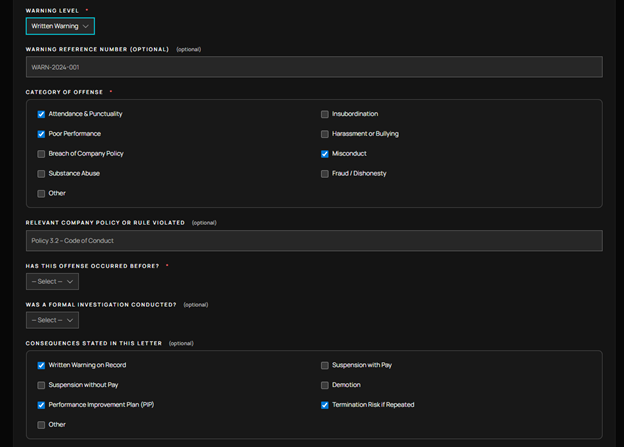
A thorough review must be done when drafting and sending a warning letter. Not a lengthy legal review for every routine letter, but at minimum, a structured check against a consistent set of criteria.
Does the letter include all required fields: employee name, role, date of incident, policy reference, Is the language consistent with how similar cases have been handled? Are there any phrases that could be read as implying discriminatory motive or passing judgment?
Most organizations don't have a formal review step built into their warning letter workflow because the process was never designed with one. The letter is drafted by a manager, forwarded to HR, adjusted in email, and often sent without anyone confirming that the final version meets modern and best practices.
Generate Performance Improvement Plan (PIP)
HR Docket's risk-aware review is built specifically to identify what is missed under pressure. It flags unclear clauses, missing fields, inconsistent terms, and sensitive language before the document leaves the workspace. That check takes seconds. The problems it reveals and identifies can take weeks for a manual system to detect.
Consistency at every level: the HR Docket way
If your organization is growing, you would eventually have warning letters being drafted by managers, HR officers, and supervisors handling disciplinary cases.
The fastest way to protect consistency is to standardize at the template level. Not a blank form, but a structured starting point with approved language for each issue type, including attendance, conduct, performance, and workplace policy violations that are consistent with your current organization's policies and can be refined when needed without circulating a new version of a Word document to everyone in the HR department.
That is what the generators in the HR docket are built for. These are approved wordings by document type and department, available to everyone drafting in your workspace, with customization possible within a structure that keeps outputs consistent. When the next manager needs to issue a formal warning, they are not starting from scratch but starting from something already aligned to your standards.
After the letter: keeping the record clean
The warning letter is the beginning of the disciplinary record, not the whole of it. What happens after it is issued matters just as much. The documentation of that next phase is where a lot of managers lose the thread.
If you have committed to a structured check-in cadence, those check-ins need to be documented and linked to the original record. If the employee meets the expectations outlined in the letter, that should be recorded. If they do not, the next phase needs to connect to the initial documentation.
HR Docket's employee-linked records keep generated drafts, saved versions, PDFs, and signatures organized under the right employee profile. So when someone asks in six months, or in a legal proceeding, what the timeline looked like, you have a clean, connected record rather than a trail of emails and file versions that require explanation.
Why the tone of the letter matters
There is a version of this conversation about documentation that treats tone as secondary but the legal substance is what matters and the feeling is irrelevant.
That is wrong, and experienced HR professionals know it.
The tone of a warning letter communicates organizational values. A letter that is cold, impersonal, or judgmental tells the employee the company's view and position on the matter.
A letter that is direct, factual, and professionally respectful and one that clearly documents the issue without editorializing about the person gives the employee room to respond constructively. It also signals to the broader organization, because these conversations are talked about, that HR here treats people fairly even when things go wrong.
That is not softness. That's the standard you would want applied to you.
Getting the draft right the first time
The reason warning letters often go out with problems is not that HR doesn't know what good documentation looks like; it is the workflow that makes it hard to consistently draft a fair letter. Managers send over informal notes and expect HR to build a complete letter. HR is working from a template that was last updated years ago. The review happens in email, between other tasks, under deadline pressure.
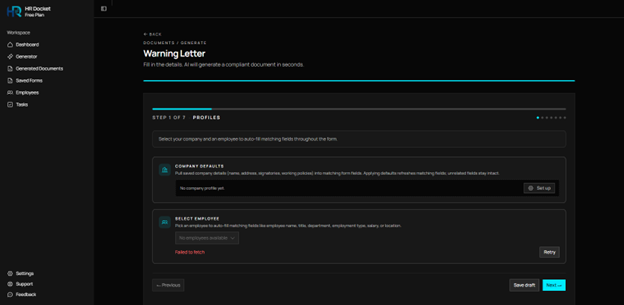
The HR Docket Warning Letter Generator is built to close that gap with guided inputs that structure the first draft, risk review that identifies what is missed, and export-ready output that goes straight to the employee's record. The average first draft takes four minutes. The review cycles are three times faster.
That speed doesn't come at the cost of quality. It comes from removing the parts of the process that were never adding value: starting from blank pages, chasing down templates, and wondering whether the language you just wrote is going to create a problem three months from now.
Using the right tools for the right work
You don't need to be an expert to create a warning letter. All that you need is the right HR tool.
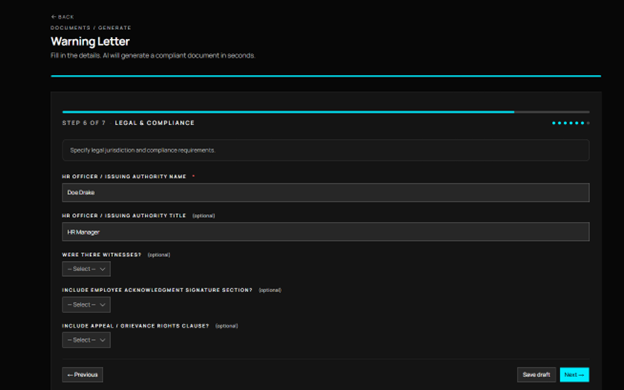
The HR Docket Warning Letter Generator does exactly that. It walks you through the facts, ensures you’re referencing the right workplace policy, and generates a draft that is professional, clear, and defensible. It takes the guesswork out of the language so you can walk into that meeting with confidence, knowing your documentation is fair, accurate, and defensible.
It is not about generating a document; it’s about generating clarity.
Conclusion: Turning Conflict into Clarity
Warning letters are difficult to write well because they include several things at once: document a real problem, reference applicable policy, define a way forward, and do all of it in a tone that keeps the working relationship intact.
The organizations that do this well are not necessarily the ones with the most experienced HR professionals. They are the ones with the best process, clear structure, consistent templates, a review step built in, and a record-keeping system that connects documentation to outcomes.
If your current warning letter workflow relies on memory, scattered templates, or manual review, then that system is worth fixing.
Start generating cleaner warning letters with HR Docket and spend your time on the human work, not the document mechanics.