Why Every New Contractor Needs an NDA Before Day One

Every organization has a “secret sauce.” It might be your unique process, your client list, your pricing strategy, or that one brilliant idea that sets you apart from competitors. The moment you bring a new contractor, freelancer, or consultant on board, you open the door to potential leaks. Why risk losing the fruit of your time, money, and creative energy when you can protect it with a single document?
Try Free NDA Generator
Building a business requires a high degree of trust. Many organizations lose their innovations and competitive advantage to competitors because they skip the critical step of contractor onboarding with proper protections.
The good news is that you do not need an expensive lawyer to protect your secret sauce. With HR Docket, you can generate a confidentiality agreement, commonly known as an NDA (Non-Disclosure Agreement), that will protect your innovations from outsiders.
What is an NDA (Non-Disclosure Agreement)?
A non-disclosure agreement (NDA) is a confidentiality agreement intended to protect sensitive information about one or more parties to a contract. It serves as a legal tool designed to safeguard an organization's sensitive information by restricting how it can be shared.
Some people might prefer to just rely on “trust” between the parties (especially close friends and family), but this can be a grave mistake if things don’t play out as expected. An NDA is a legally binding contract between the party that holds the sensitive information and the party that will receive it.
When it comes to contractor onboarding, a well-drafted NDA typically covers:
Proprietary business information: pricing models, operational processes, product formulas, supplier relationships, or any other internal knowledge that gives your business a competitive advantage.
Client and customer data: contact details, names, purchase history, or any personal data collected in the course of doing business.
Trade secrets: software, unique methods, recipes, designs, or strategies that are central to your value proposition.
Financial information: revenue figures, profit margins, cost structures, and financial projections.
Intellectual property: any creative or technical work, whether it's software code, marketing copy, design files, or research that the contractor may encounter or contribute to.
Internal communications: sensitive emails, meeting notes, strategy documents, and other internal conversations.
Types of Non-Disclosure Agreements
The non-disclosure agreements come in different forms. The common types of NDAs include:
Mutual Agreements: This is a situation where two businesses, considering the possibility of partnering, discuss strategies. In this case, each company may disclose information about its operations to better inform the other side of its capabilities. This sensitive information cannot be shared with any other party.
Non-Mutual Agreement: This is also referred to as a unilateral NDA, and it usually applies to new employees who have access to sensitive information about the company. It is non-mutual or unilateral because the employee is the only party signing the agreement. This type of NDA aims to prevent the employee from sharing confidential information.
Disclosure Agreement: This appears to be the opposite of a non-disclosure agreement. In this situation, an organization will require the employee to sign an agreement that allows them to share personal information and prevents them from being sued for doing so.
The difference between full-time employment and a contract offer
The world of business is evolving, and the fundamentals are changing very fast. Most businesses of every size are turning to contractors, freelancers, and consultants to fill critical gaps, launch new projects, and scale faster than ever before.
Most organizations add an inherent layer of legal obligation to the employment offer of full-time employees. When you hire an employee, they typically sign onboarding agreements as a standard procedure. There are also implied duties of loyalty and confidentiality that the law recognizes.
Contractors offer flexibility, specialized expertise, and cost efficiency that full-time hires often can't match. But contractors come with a different legal relationship than employees do. You need a signed confidentiality agreement that clearly establishes what information is private and outlines what the contractor can and cannot do with it.
Why You Need an NDA Before Day One
Most organizations often think, "I'll get the paperwork sorted once we see how things go." Or, "We haven't shared anything sensitive yet, so there's no rush." Unfortunately, that is where a lot of business owners get tripped up.
Information flows naturally in a working relationship. For this reason, it is important to take critical steps the moment a contractor steps into your world, whether that is joining a project call, accessing your systems, or sitting in on a client meeting. You can't always control what gets mentioned, shared, or observed in the normal course of doing business together.
Protecting sensitive work should be the first priority, even before the work starts. It must start at the offer stage, before the contract begins or the first email is exchanged. A properly executed NDA is part of the package deal. For instance, here is your scope of work, rate, and the confidentiality agreement we need you to sign before we move forward.
Trying to get someone to sign an NDA after they have already been exposed to your sensitive information is legally complicated and potentially awkward. The NDA may not even be enforceable if it looks like it was coerced or signed under pressure.
The Real Risks of Skipping the NDA
When an organization skips the NDA, a lot of things go wrong. Establishing a clear confidentiality agreement ahead of time will reduce the chances of problems occurring down the road. That good relationship between you and the other party may not always be long and fruitful.
If a contractor finishes a project with you, they might go to work with your direct competitor. They take everything they learned about your business model, your client relationships, your pricing strategy, and your internal processes. Because you do not have an NDA in place, it is more likely that your confidential information will be disclosed without your permission, and you could lose the chance to patent your invention. Without a signed NDA, you may have very limited ability to stop them or seek damages.
Without an NDA, freelancers may end up stealing your clients. Especially when they have access to every client's name, contact information, spending patterns, and relationship history. After the engagement ends, they reach out to your clients directly. Without a confidentiality agreement covering client data, it's very difficult to take legal action.
Some contractors might mistakenly mention sensitive details about your upcoming product launch to someone in their circles without even realizing the damage they are causing. With no NDA, you have no legal framework to address the breach.
Why organizations overlook NDAs and their implications
There is a lot of misinformation floating around about NDAs that causes business owners to either skip them entirely or draft ones that don't actually protect them. Common misconceptions about NDAs include the following:
1. NDAs Are Only for Big Companies
Most small and medium-sized businesses arguably have more to lose from a confidentiality breach, because they don't have the legal war chests or the brand resilience to recover the way a large corporation might. Every business has valuable sensitive information and does need an NDA.
2. A Verbal Agreement Is Good Enough
Verbal agreements are binding, but they are not good enough. They're incredibly difficult to prove and even harder to enforce. Courts want to see written contracts. If you are ever in a dispute, "we had a conversation about keeping things private" is not going to hold up the way a signed document does.
3. NDAs Are Offensive or Awkward to Request
NDAs are standard operating procedure. Established contractors, consultants, and freelancers are used to signing them. If a potential contractor flat-out refuses to sign a reasonable confidentiality agreement, that itself is a red flag worth paying attention to.
What Makes a Strong NDA for Contractor Onboarding?
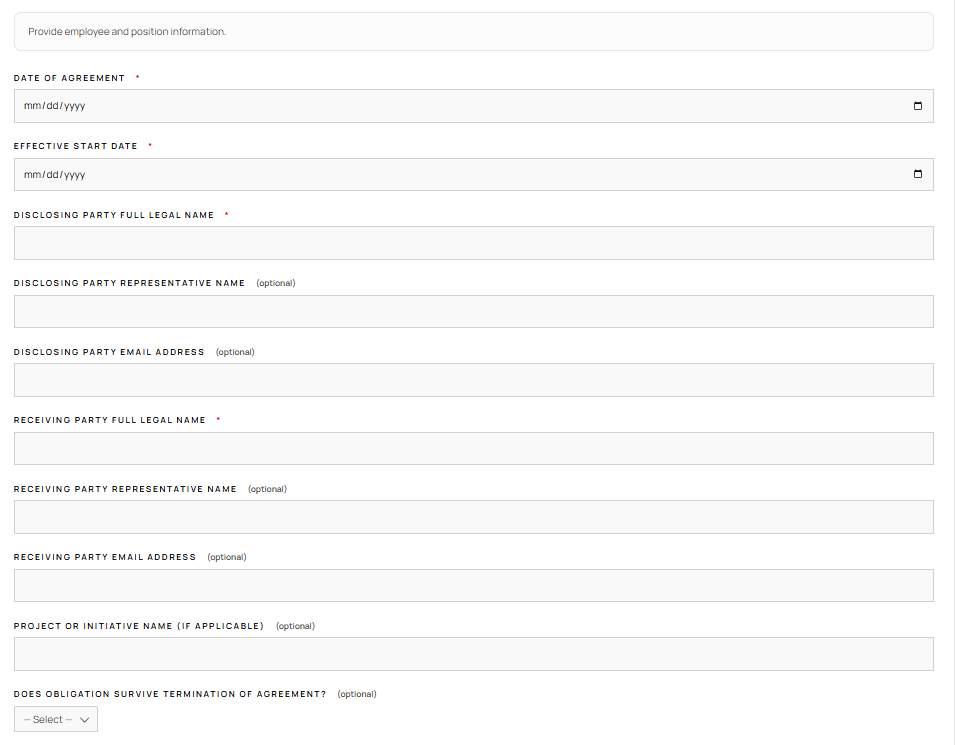
Not every NDA template you see online qualifies to be a professional confidentiality agreement form. Here is what to look for in a solid confidentiality agreement designed for contractor onboarding:
Clear Definition of Confidential Information: The NDA should spell out exactly what falls under its protection. Vague language like "all business information" can be challenging to enforce. Strong NDAs define categories of information explicitly, so there's no room for a contractor to claim they didn't realize something was confidential. This section should include business plans, financial data, client lists, technical specs and marketing strategies.
Duration of the Agreement: How long does the confidentiality obligation last? It needs to be clearly stated. Most NDAs often expire after 1-5 years post-engagement. However, NDAs are indefinite for certain categories like trade secrets.
Permitted Disclosures: There are situations where a contractor may be legally required to disclose information, for example, in response to a court order. A well-drafted NDA accounts for these scenarios and spells out the proper process.
Remedies for Breach: What happens if the contractor violates the agreement? The NDA should outline the consequences, including the right to seek injunctive relief (a court order stopping further disclosure) and monetary damages.
Governing Law: Which state's or jurisdiction's laws apply? This matters if a dispute ever ends up in court.
Making NDA Compliance Part of Your Onboarding Process
Protecting sensitive work shouldn't be an afterthought; it should be part of your onboarding process. The best businesses build confidentiality protection directly into their contractor onboarding workflow, so it happens automatically every single time, with zero risk of it being forgotten.
Step 1: Issue the NDA Along with the Contract Offer
When you send over the scope of work and rate agreement, include the NDA in the same package. Make signing it a condition of starting work. This signals professionalism and ensures nothing gets overlooked.
Step 2: Use a Digital Signing Platform
Don't rely on printing, scanning, and emailing PDFs. Use a digital document signing tool so both parties can sign electronically, timestamps are automatically recorded, and a copy is stored securely. This eliminates friction and creates a clean audit trail.
Step 3: Store Signed NDAs Systematically
Keep all your signed confidentiality agreements in one organized location or a dedicated document management tool. This way, you want to be able to pull up any contractor's signed NDA instantly if you ever need it.
Step 4: Update Your NDA Regularly
Business information and legal best practices evolve. Review your NDA at least once a year to ensure it still reflects what you actually need to protect and stays current with any relevant legal changes in your jurisdiction.
The easy way to create a clear NDA and protect your sensitive work
A legal dispute over a confidentiality breach can easily run into tens of thousands of dollars in legal fees, lost business, and damage to your reputation. If a contractor walks off with a client list and poaches your top accounts, the damage could be far more than that.
When you set a solid, professional-grade confidentiality agreement, your contractor onboarding process doesn't have to cost a fortune or eat up hours of your time. The right tools make it fast, simple, and affordable.
HR Docket provides you with exactly the kind of streamlined solution growing businesses need. The platform is designed for business owners who want professional-grade legal protection without the complexity or cost of drafting custom legal documents from scratch every time.
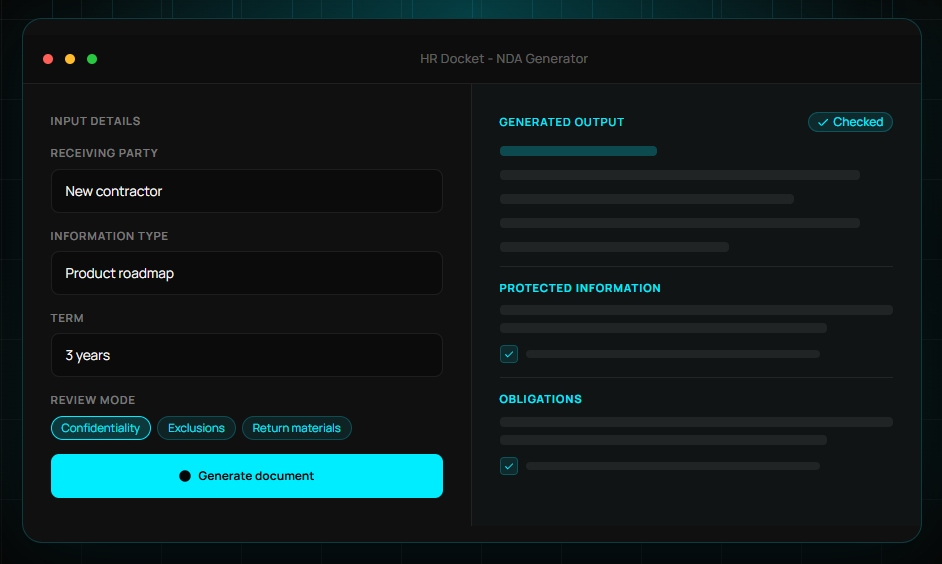
The HR Docket’s Non-Disclosure Agreement (NDA) generator lets you create a comprehensive, customizable confidentiality agreement tailored to your specific situation in minutes. You do not need to spend hours on the phone with an attorney for a routine document. The platform allows you to draft confidentiality agreements that define protected information, obligations, exclusions, term length, and return of materials.
Your Business Deserves to Be Protected
Don't wait until something goes wrong to wish you had put protections in place. The best time to establish confidentiality safeguards is before the relationship begins, and not after.
Whether you're onboarding your first contractor or your fiftieth, make NDA compliance a non-negotiable part of your process.
Getting your confidentiality agreement and protecting your sensitive work doesn't have to be complicated. HR Docket's Non-Disclosure Agreement (NDA) generator helps you protect your secret sauce in minutes.
You can also visit HR Docket today and set up HR documentation that your business needs. The platform provides various HR documentation and tools to help businesses build stronger relationships.