How to Turn "Performance Concerns" Into Measurable Goals And Save the Relationship
A vague improvement plan is often worse than no plan at all, creating the illusion of accountability without the substance . This guide explores how to move from adjectives to evidence, defining exactly what "meeting expectations" looks like week-by-week . Discover how to use structured prompts and risk-aware review to build PIPs that act as a genuine roadmap for success rather than just a pre-termination formality

This conversation happens in every company, at every size, across every industry.
Your manager calls you into his or her office and says they need to "discuss performance." Your manager opens the employee's file, and everything is disorganized without any proper timelines and performance metrics. Everybody, including the manager, is sure what "getting back on track" actually looks like.
Join HRdocket for Free
What follows is usually a complete overhaul and uncomfortable process that leaves the employee feeling blindsided and the manager feeling like HR handed them a legal liability disguised as a support structure.
It doesn't have to go that way.
When a performance improvement plan is built around clear expectations, honest timelines, and measurable outcomes, it stops being a paper trail but a genuine roadmap. One that can actually save the working relationship and sometimes the employee's career growth.
The problem with "performance concerns" as a category
At the beginning of every year companies and businesses go for retreats to discuss the year under review and draw up well-defined key performance indicators (KPIs) for both the company and their workers. However, measuring and keeping track of these KPIs is a major headache.
"Performance concerns" is key to every HR manager but one of the most difficult to work on. It covers everything from lateness to missed revenue targets to attitude problems nobody has documented yet. When the category is that broad, the response tends to be equally so.
A common failure in most organizations: a manager raises a concern, HR drafts something that sounds thorough but actually says very little, the employee signs without fully understanding what's being asked of them, and sixty days later everyone is surprised when nothing has changed.
It may sound like a manager signing their workers up for failure, but most managers genuinely want their people to succeed. The issue is structure. Specifically, the absence of it.
A vague improvement plan is worse than no plan. It creates the illusion of accountability without the substance. And when things don't improve, you're left trying to defend a process that was never designed to work in the first place.
What "measurable" actually means in this context?
Before you can measure a performance gap, you need to define it precisely enough with timelines that both you and the employee can understand ambiguity.
That means moving from adjectives to numbers. From impressions to evidence. From "not meeting expectations" to a clear articulation of what meeting expectations actually looks like, week by week.
A few practical translations:
Instead of "Needs to improve communication with the team" Try: "Responds to internal messages within one business day. Sends weekly project status updates to the team lead by EOD Friday."
Instead of: "Sales performance is below par" Try: "Closes a minimum of 8 qualified deals per month for the next 90 days, with deal sizes consistent with team average."
Instead of: "Shows lack of initiative" Try: "Proposes at least one process improvement or project idea per sprint. Raises blockers proactively rather than waiting for check-ins."
The goal isn't to set the bar unfairly high but to make the bar visible. Employees who know exactly what they're being measured against can actually try to achieve them. Employees given vague direction can only guess.
Building the improvement plan around the relationship, not just the record
Funny though, some managers sometimes pay less attention to the documentation phase and forget that the employee is still a person and is still worth a million.
A well-structured performance improvement plan acknowledges the gap without dehumanizing the person. It includes not just what needs to change, but also how the company will support that change and additional training, adjusted workload, clearer direction from management, and regular check-ins.
That support structure matters for two reasons.
First, it's fair. If someone is underperforming partly because they haven't received adequate guidance, a plan that holds them to a higher standard without addressing that gap isn't just unkind, but it's legally and operationally weak.
Second, it signals to the employee that this is a genuine attempt to help them improve, not a pre-termination formality. Employees who feel set up to succeed are more likely to engage seriously with the process.
The structured review: what good check-ins look like
Organizational communication often breaks down at the middle level of management. The initial conservation happens at the highest level by top management, where decisions are made and documents are signed. The managers who are supposed to supervise avoid the follow-up. When supervision fails, the employee assumes silence means things are fine. And then the review date arrives with everyone caught off guard.
Structured check-ins prevent this. They don't need to be long, but a 20-minute weekly touchpoint is enough to make sure the agreed plans and target are being followed before things start to worsen. What matters is that they're scheduled in advance, documented consistently, and tied directly to the success metrics in the plan.
A reliable check-in structure looks something like this:
Week 1–2: Orientation. Walk the employee through each metric. Make sure they understand what is expected of them and how to achieve it. Address any questions before the clock starts.
Week 3–6: Momentum. Review progress against each metric. Identify what's working and what isn't. Adjust support if needed, not the metrics themselves.
Final review: Outcome. Assess performance against the original goals. Document the result with the same specificity as the original plan.
Every check-in produces a brief written record. Not a lengthy debrief but just a timestamped summary of what was discussed, where the employee stands, and what the next steps are. That record becomes your audit trail if the situation escalates, and your evidence of good faith if it doesn't.
Drafting the plan: where most Managers spend too long
The irony of managing employee gaps is that most managers often spend and waste active productive time on the document itself.
They spend time cycling through templates, adjusting language, and trying to make something legally defensible rather than on the actual work assigned to them.
That's partly a workflow problem. When building a structured improvement plan requires starting from a blank page or a generic form with no context awareness, it becomes its own project. HR Docket is built specifically to collapse that task.
HR Docket's "Performance Improvement Plan" guided drafting uses structured prompts that stay on-brand and on-policy, so you're not writing from scratch every time a new employee is added. The platform checks and synchronizes missing fields and inconsistent clauses before the document leaves your workspace. A plan that's missing a defined end date or an unclear path can create problems if things don't resolve cleanly.
Once the plan is finalized, it moves directly to signature-ready output with tracked completion status. No email chains. No version confusion. No wondering whether the employee received the final version or a draft from two weeks ago.
Building a Framework for Success
Turning a performance concern into a growth opportunity requires a comprehensive and dedicated approach. Here is how to structure it:
1. Setup Measurable Goals
Vague objectives and plans are dead on arrival. Instead, set defined, specific, measurable timelines. Example:
Bad: "Be more proactive."
Good: "Submit the weekly status report by 8:30 AM every Monday."
When you define success metrics clearly, the employee knows exactly what they need to achieve.
2. Build in a Structured Review Cadence
One conversation is not a plan. A structured review enables you, the manager, to track the progress of the metrics set for the employee.
Schedule weekly check-ins to discuss setbacks and wins.
Document every conversation to create a clear timeline of support and feedback.
Adjust the plan if the initial metrics prove unrealistic, but never adjust the standard of accountability.
3. Use Tooling to Handle the Mechanics
This is where many managers fail. They spend hours struggling with document formatting, legal phrasing, and template structures, leaving them with no energy for the actual human work of coaching.
You need a tool that handles the document mechanics so your energy goes toward the conversation. This is exactly what the HR Docket PIP Generator is built to do.
The HR Docket Advantage
If you are building or rebuilding your performance management process, the HR Docket
Performance Improvement Plan Generator is your starting point. It offers:
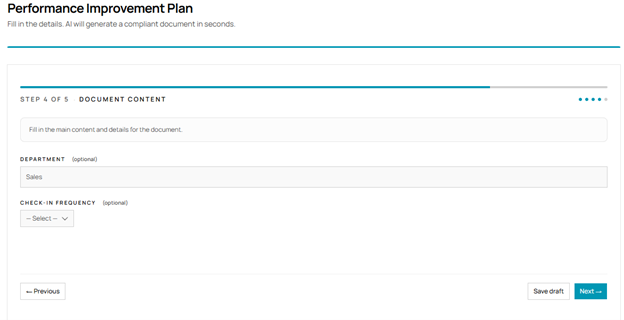
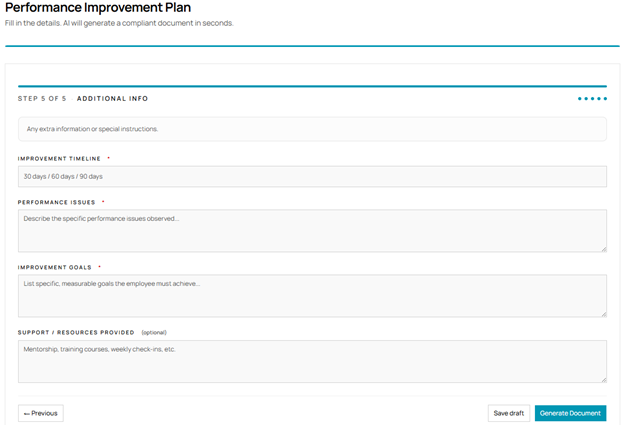
Structured Prompts: Guides you to ask the right questions to uncover root causes of employees failing to meet their objectives. You have an option to key in your check-in frequency, add improvement timelines, performance issues, and improvement goals.
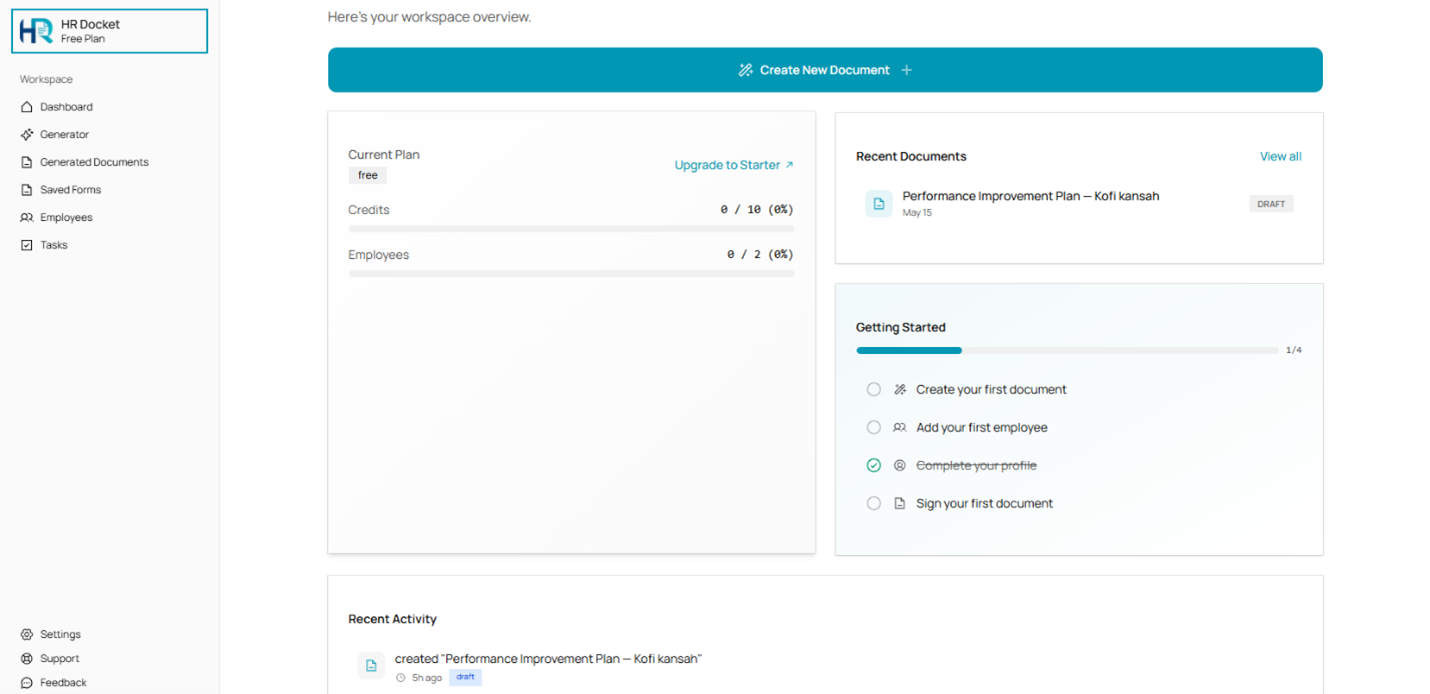
Friendly User Interface: The website is easy to navigate and does not require a tech expert to operate.
Risk-Aware Review: Ensures your language is clear and adheres to the laws of the jurisdiction you find yourself in.
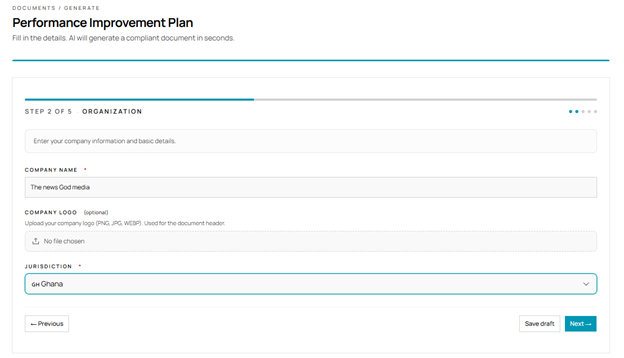
Signature-Ready Output: Generates professional documents in less than a minute. This helps you spend less time typing and more time engaging and tracking employee performance.
By using a performance improvement plan generator, you ensure consistency across your organization. You stop worrying about the document and start focusing on the employee.
When the plan works and when it doesn't
Success metrics serve two purposes that people sometimes interchange.
Firstly, they give the employee a target to aim for and a timeline to work within. When the employee meets them, the plan has worked as intended. The relationship continues, hopefully on stronger footing.
The second is they create a documented record of what was expected, what support was provided, and what outcome resulted. If the employee doesn't meet the goals, that record is used as the yardstick to measure the fate of the employee both internally and externally.
A plan without measurable goals fails at both. It doesn't give the employee enough to work toward, and it doesn't give HR enough to stand behind to measure those plans set for the employee.
This is why the specificity of your success metrics isn't just about the manager doing follow-ups and routine checkups on the workers, but it's the structural foundation the entire process depends on.
A note on tone: the document signals more than you think
Don't take your employees for granted. Employees read between the lines. A plan that's written in dense, legalistic language signals this: this is how we build a case. A plan that's written with clarity, specificity, and genuine acknowledgment of what support is being offered signals that we still want this to work.
Both can be professionally appropriate. But only one is more likely to get you the outcome you actually want, which is an employee who reengages and performs.
That doesn't mean softening the expectations; however, the goals should still be clear and the timeline clearly set. It means choosing language that treats the person as a professional being held to a professional standard, not as a problem to be managed out.
The tone of your improvement plan documentation is part of your employer brand. People talk. How you handle performance conversations, even difficult ones, can shape how current employees think about working there and how former employees describe it afterward.
All this can be done in one comprehensive platform that incorporates everything at the click of a button.
The bottom line
Performance gaps happen in every organization since humans are prone to mistakes and are affected by other internal and external factors beyond our control. However, how you respond to them with clarity, structure, and genuine support is what separates a successful and serious organization from an unorganized one.
A business that manages "performance concerns" through difficulty and emerges stronger from those that create legal exposure and lose talent they could have retained are the defining moments that make an organization great.
Start with measurable goals. Build in a structured review cadence. Make the support as clear as the expectations. And use tooling that handles the document mechanics so your energy goes toward the actual human work.
If you're building or rebuilding your performance management process, the HR Docket PIP Generator is a good place to start with structured prompts, risk-aware review, and signature-ready output in one workspace, so the document is the least of your problems.